Flashes and Floaters: When Your Eyewear Needs a Medical Visit
The Telltale Signs: When to Worry About Flashes and Floaters
Seeing occasional specks drift through your vision is common. So is catching a fleeting flash of light in the corner of your eye. Most of the time, these are harmless quirks of a healthy, aging eye. But sometimes, they are urgent warning signs of a retinal tear or detachment—a true medical emergency that can lead to permanent vision loss.
The challenge is knowing the difference. This guide will walk you through the critical signs that separate a benign annoyance from a sight-threatening condition. We will explain what causes these symptoms, how to perform a simple self-check, and when you must seek immediate medical attention instead of just assuming you need a new pair of glasses.
TL;DR: When to See an Eye Doctor Immediately
If you experience any of the following, especially if they are new and sudden, contact an ophthalmologist or go to the emergency room right away:
- A sudden "shower" of new floaters: This is often described as seeing hundreds of tiny black dots, a "swarm of gnats," or a cobweb that just appeared.
- New, persistent flashes of light: These look like lightning streaks or camera flashes in your peripheral (side) vision.
- A gray curtain or shadow: A dark, veil-like shadow that appears in your side vision and seems to be moving across your field of view.
- A sudden decrease in vision.
These symptoms together are the classic signs of a retinal tear or detachment. This is not a problem with your glasses; it's a structural issue inside your eye that requires urgent medical intervention.
Understanding Floaters: The "Cobwebs" in Your Vision
Floaters are tiny specks, threads, or cobweb-like shapes that drift through your field of vision. They are most noticeable when you look at a bright, plain background, like a blue sky or a white computer screen.
What Causes Floaters?
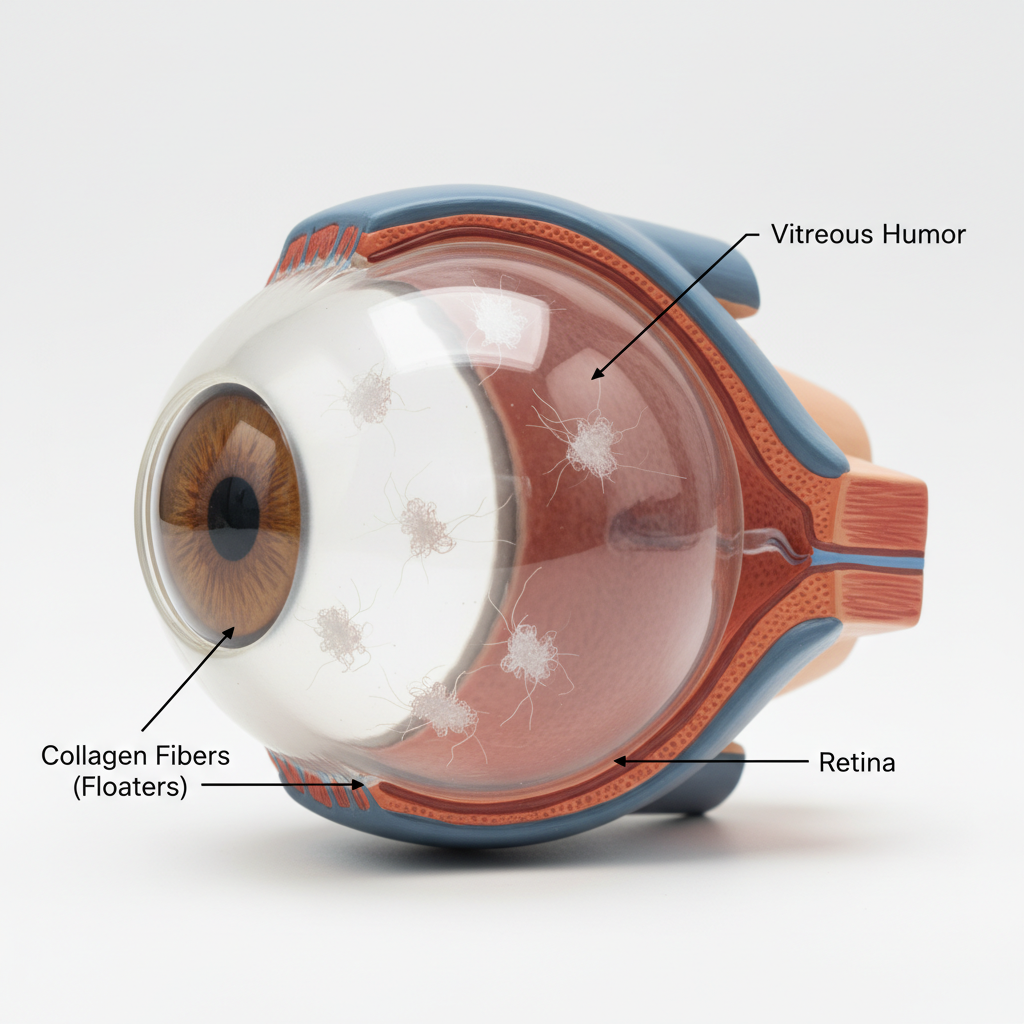
Your eyeball is filled with a clear, gel-like substance called the vitreous humor. As we age, this gel starts to liquefy and shrink. Microscopic fibers made of collagen within the vitreous can clump together. These clumps cast shadows on your retina, the light-sensitive tissue at the back of your eye. What you perceive as a "floater" is actually the shadow of these collagen fibers.
This process is a normal part of aging and is usually not a cause for alarm. Most people will experience floaters at some point in their lives.
When Are Floaters a Red Flag?
The key distinction between normal, long-standing floaters and dangerous ones is a sudden change.
- Normal Floaters: You may have had one or two floaters for years. They might move gently when you move your eyes, but their number and appearance are stable. They are an annoyance, but not a threat.
- Emergency Floaters: The most critical warning sign is a sudden shower of new floaters. If you suddenly see dozens or hundreds of new, tiny black spots, this can be a sign of bleeding inside the eye caused by a retinal tear. This is a fundamentally different experience from having a few stable, stringy floaters.
Decoding Flashes: The "Lightning Streaks" in Your Periphery
Flashes of light, medically known as photopsia, are the sensation of seeing light that isn't actually there. They are typically seen in your peripheral vision.
What Causes Flashes?
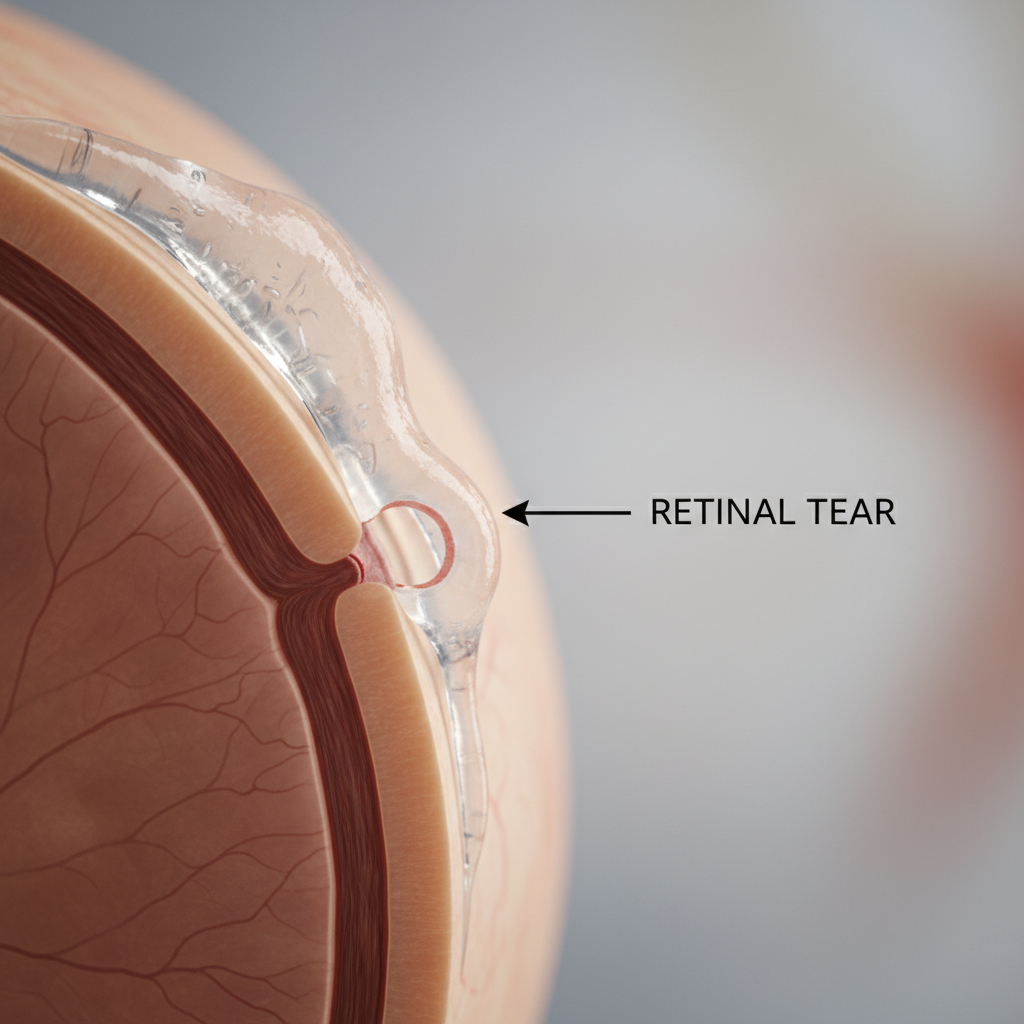
As the vitreous gel inside your eye shrinks with age, it can pull or tug on the retina. This mechanical stimulation causes the retinal cells to fire, sending a signal to your brain that it interprets as a flash of light. Imagine it like gently tapping on a microphone—the tap creates a sound, even though no one spoke. Similarly, the tug on the retina creates a light signal, even though no light entered the eye.
This event, called a Posterior Vitreous Detachment (PVD), happens to most people eventually and is usually harmless. The flashes often subside over a few weeks or months.
When Are Flashes an Emergency?
While flashes from a PVD can be normal, they can also signal that the vitreous is pulling hard enough to tear the retina. You should seek immediate medical attention if:
- The flashes are new and persistent.
- They are accompanied by a sudden increase in floaters.
- They are followed by a shadow or curtain in your vision.
It's also important to distinguish these ocular flashes from a visual aura associated with migraines. A migraine aura typically appears in both eyes, often has a shimmering or jagged pattern, and may grow over 15-30 minutes before fading. Ocular flashes are very brief, like a lightning streak, and are confined to one eye.
A Practical Self-Check Protocol
If you're experiencing new symptoms, here is a simple protocol to help you assess the situation.
Methodology Note: This self-check is an informational tool, not a diagnostic test. It is designed to help you communicate your symptoms clearly to a medical professional. It cannot replace a comprehensive, dilated eye exam by an ophthalmologist.
- The Monocular Check: Cover one eye, then the other. Do the flashes or floaters appear in only one eye? If the symptom persists in the same eye when you switch which eye is covered, it is almost certainly ocular (originating in the eye) and not neurological (like a migraine aura). This is a critical first step.
- The "Sudden Shower" Assessment: Think about the floaters. Are these the same one or two stringy floaters you've seen for years? Or did you just notice a brand-new "swarm of gnats" or "hundreds of black dots" that weren't there yesterday? The sudden onset of a large number of new floaters is the key indicator of a potential problem.
- The "Curtain" or "Veil" Check: Pay close attention to your peripheral vision. A retinal detachment is often described as a gray curtain, shadow, or veil that starts in your side vision and moves toward the center. A common mistake is to attribute this to a dirty eyeglass lens. If you see a persistent shadow in your vision, it is a medical emergency.
The Amsler Grid: What It Can (and Can't) Tell You
An Amsler grid is a tool used to monitor the health of the macula, the central part of your retina responsible for sharp, detailed vision. While it is excellent for detecting wavy lines (metamorphopsia) associated with conditions like macular degeneration, it is not sensitive for detecting peripheral retinal tears or detachments. A perfectly normal Amsler grid test does not rule out a retinal detachment.
Your Action Plan: What to Do Next
Your response should be dictated by the specific combination of symptoms you experience.
Call an Ophthalmologist or Go to an ER Immediately If:
- You experience the "holy trinity" of warning signs: a sudden shower of new floaters, new and persistent flashes, AND a curtain or shadow in your vision.
- You experience any one of these symptoms with a sudden, noticeable decrease in your vision.
- You have a history of high myopia (nearsightedness), previous eye surgery, or a serious eye injury, as these increase your risk.
Schedule a Routine (But Prompt) Eye Exam If:
- You notice a few new, stringy floaters without any flashes or vision loss.
- You experience occasional flashes that are not persistent and are not accompanied by new floaters or vision loss.
It is crucial to understand that these symptoms are not a sign that you simply need a new eyeglass prescription. They are signs of a change in the physical structure of your eye. Adjusting your lens power will not resolve them.
Frequently Asked Questions (FAQ)
Q1: Can stress cause floaters and flashes? While high levels of stress can cause a range of psychosomatic symptoms, there is no direct evidence that stress causes the physical changes in the vitreous that lead to flashes and floaters. However, stress can make you more aware of benign floaters that have always been there.
Q2: Do floaters ever go away? Most floaters do not truly "go away." Over time, your brain learns to ignore them, and they may settle out of your direct line of sight, making them much less noticeable. A sudden disappearance of floaters is not typical.
Q3: I've had floaters for years. Should I be worried? If your floaters are stable and have been present for a long time without any change in number or appearance, they are generally considered harmless. The concern is always a sudden increase or change.
Q4: Are flashes always a sign of a retinal tear? No. Most of the time, flashes are caused by a benign Posterior Vitreous Detachment (PVD). However, because there is no way for you to know if the pulling on the retina is harmless or has caused a tear, any new onset of flashes should be evaluated by an eye doctor.
Q5: What happens during an emergency eye exam for these symptoms? The doctor will put dilating drops in your eyes to make your pupils larger. This allows them to get a clear, wide-angle view of your retina. They will use specialized instruments with bright lights to carefully inspect the entire periphery of your retina to look for any tears, holes, or detachment.
Disclaimer: This article is for informational purposes only and does not constitute professional medical advice. The information provided should not be used for diagnosing or treating a health problem or disease. Always seek the advice of a qualified healthcare provider with any questions you may have regarding a medical condition.
References
- National Eye Institute (NEI). (n.d.). Flashes of Light. Retrieved from an authoritative health source.
- American Academy of Ophthalmology (AAO). (n.d.). What Are Floaters and Flashes?. Retrieved from a professional ophthalmology organization's patient education portal.
- StatPearls [NCBI]. (2023). Posterior Vitreous Detachment. Retrieved from the National Center for Biotechnology Information's medical reference library.
- StatPearls [NCBI]. (2023). Retinal Detachment. Retrieved from the National Center for Biotechnology Information's medical reference library.