Calculating Final Lens Thickness for Your Eyewear
TL;DR: Your Quick Guide to Thinner Lenses
Your Prescription is #1: Higher prescriptions (especially for nearsightedness) naturally create thicker lenses. This is non-negotiable.
Frame Size Matters Most: For the same prescription, a larger frame will always result in a thicker lens edge than a smaller frame. This is the most important choice you can make.
High-Index is Your Friend: High-index lens materials (1.60, 1.67, 1.74) are denser and bend light more efficiently, allowing them to be significantly thinner and lighter.
PD Must Be Precise: An accurate Pupillary Distance (PD) ensures the optical center of the lens is correctly placed, preventing unnecessary thickness from decentration.
Ever ordered a new pair of glasses online, excited for their arrival, only to be disappointed by lenses that felt thick, heavy, and distorted your profile? You're not alone. I've seen this happen countless times, and the frustration is completely avoidable. The final thickness of your lenses isn't a mystery or a matter of luck; it's a predictable outcome based on a few key variables.
This guide will walk you through exactly what determines lens thickness. We'll go beyond the basics and share the practical rules that opticians use to ensure a great-looking and comfortable final product. By understanding these factors—your prescription, your frame choice, and the lens material—you can set realistic expectations and make informed decisions before you click "buy."
The 'Big Three' Factors That Dictate Lens Thickness
Three primary elements work together to determine the final profile of your lenses. While you can't change your prescription, you have significant control over the other two. Understanding how they interact is the key to managing your outcome.
1. Your Prescription (Sphere, Cylinder, and Axis)
First, let's start with the factor you can't change: your prescription power. As explained by eye care experts at the Cleveland Clinic, your prescription details the power needed to correct your vision.
Myopia (Nearsightedness): If you have a minus (-) Sphere (SPH) power, you are nearsighted. These lenses are concave—thinnest at the center and thickest at the outer edge. The higher the number (e.g., -6.00 vs. -2.00), the thicker the edge will be.
Hyperopia (Farsightedness): If you have a plus (+) Sphere (SPH) power, you are farsighted. These lenses are convex—thickest at the center and thinnest at the edge. Higher plus powers lead to more noticeable center thickness, which can create a "bug-eye" magnification effect.
Astigmatism: The Cylinder (CYL) and Axis values correct for astigmatism, an imperfection in the curvature of your eye. This adds complexity and can increase thickness in a specific direction across the lens.
2. Your Frame Choice: The Most Important Decision You'll Make
This is the variable where you have the most control and where many buyers make a critical mistake. The size and shape of your frame directly impact the final thickness of your lenses, especially for myopic prescriptions.
Here’s a simple rule: The larger the lens, the thicker the edge.
Why? An uncut lens blank is a large circular puck. For a minus lens, the thinnest point is the very center. To make your glasses, the lab cuts your frame's shape out of this blank. If you choose a large, oversized frame, the shape must be cut from the outer, thicker parts of the blank. If you choose a smaller, more centered frame, the shape can be cut from the inner, thinner part of the blank.
Here are some practical heuristics I use when advising clients with moderate to high prescriptions:
For powers from -3.00 to -5.00 D: Aim for a frame with an "eye size" (the width of one lens) under 52 mm.
For powers stronger than -5.00 D: Your best results will come from frames with an eye size under 50 mm, or even 48 mm if possible.
Choosing a smaller, rounder frame that centers your eye well is the single most effective strategy for minimizing visible lens thickness. For more on finding the right fit for a strong Rx, see our guide on wearing thin, stylish frames with a high prescription.
3. Your Pupillary Distance (PD)
Your Pupillary Distance (PD) is the measurement in millimeters between the centers of your pupils. This measurement dictates where the optical center of your lenses should be placed. An accurate PD is crucial not just for clear vision, but also for aesthetics.
If your PD is narrow and you choose a very wide frame, the lab has to "decenter" the optical center of the lens to align with your pupils. This often means they have to use a larger lens blank to begin with, forcing them to cut the lens from a thicker portion. An error of even 2 millimeters can increase thickness and introduce unwanted prismatic effects that cause eye strain. For this reason, getting an accurate PD is non-negotiable. You can learn how to measure your PD at home or understand more about why even a small PD error can matter.
Choosing the Right Lens Material: A High-Index Primer
After frame choice, selecting the right lens material is your next line of defense against thick lenses. This is where "high-index" lenses come in.
What is Refractive Index?
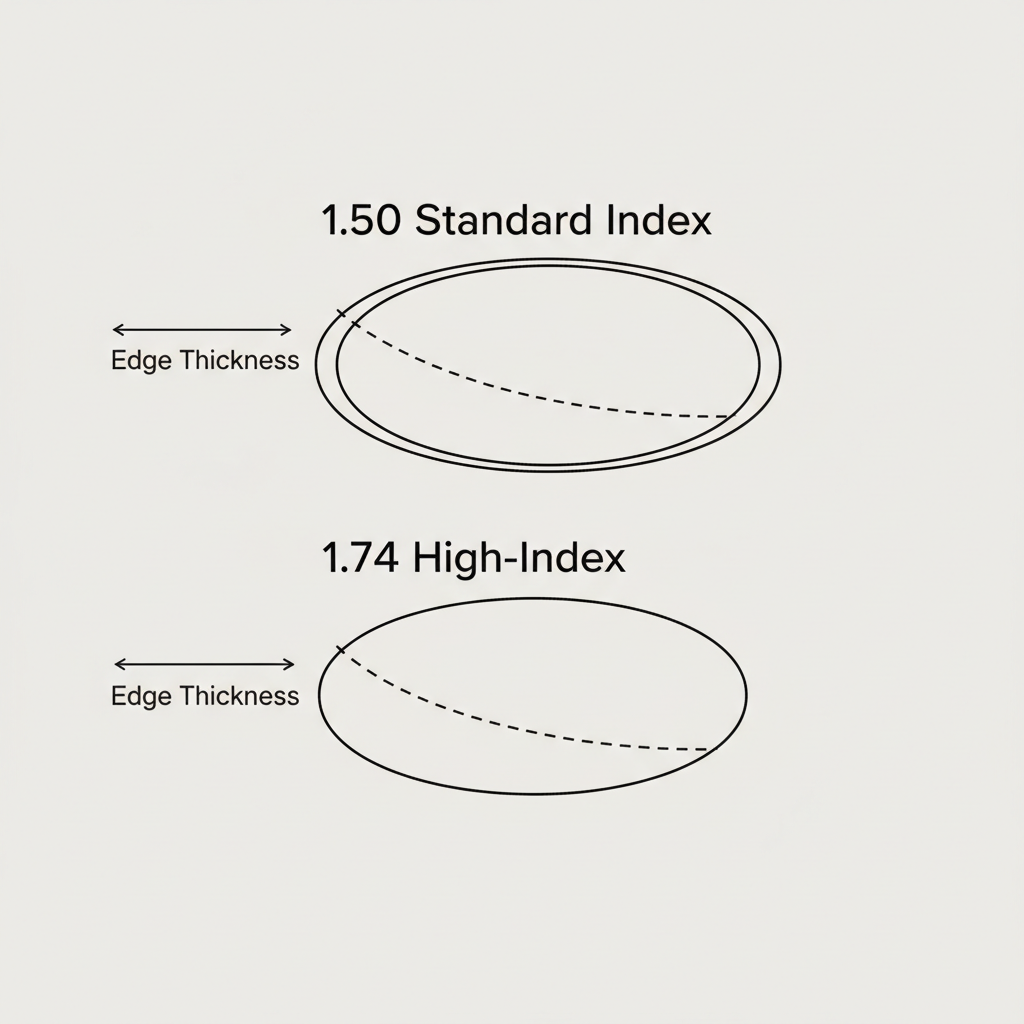
The refractive index of a lens material is a number that describes how efficiently it bends light. As noted by optical experts at Ferris State University, materials with a higher refractive index can bend the same amount of light using less curvature, which translates to a flatter, thinner, and lighter lens.
Standard plastic lenses have an index of 1.50. High-index lenses range from 1.53 up to 1.74.

A Practical Guide to Choosing Your Index
Upgrading your lens index costs more, so it's important to choose the right one for your needs. You don't need the highest index for a weak prescription. Here is a reliable framework for making this decision:
| Prescription Power (Diopters) | Recommended Refractive Index | Key Benefit |
|---|---|---|
| Up to ±3.00 D | 1.50 (Standard Plastic) | Cost-effective and perfectly suitable for mild prescriptions. |
| ±3.00 D to ±5.00 D | 1.60 / 1.61 (High-Index) | The first step up. Offers a noticeable reduction in thickness and weight. |
| ±5.00 D to ±8.00 D | 1.67 (High-Index) | The workhorse for high prescriptions. Provides a significant reduction in bulk. |
| Above ±8.00 D | 1.74 (High-Index) | The thinnest and lightest plastic lens available, offering the best cosmetic result for very strong prescriptions. |
Debunking a Common Myth: "Coatings Make Lenses Thicker"
A common misconception I hear is that adding coatings, like an anti-reflective (AR) coating, will add to the lens thickness. In reality, these coatings are applied in layers that are mere nanometers thick—they have virtually zero impact on the final size or weight of the lens. In fact, an AR coating is essential for high-index lenses. Because they are more efficient at bending light, they also reflect more light, causing distracting glare. An AR coating allows more light to pass through the lens for clearer vision and makes the lenses appear more transparent and less noticeable.
Advanced Technology for Superior Aesthetics
Beyond material, modern lens manufacturing offers design features that further enhance the cosmetic appearance of your glasses.
Aspheric and Atoric Lens Designs
Traditional lenses have a spherical front surface, meaning it’s curved like a ball. For high powers, this can create visual distortions, especially when looking away from the center of the lens. It also contributes to the "bug-eye" (with plus lenses) or "small-eye" (with minus lenses) effect.
Aspheric lenses use a more complex, non-spherical front surface that gradually flattens from the center to the edge. This design:
Reduces the magnification or minification effect.
Provides a wider field of clear vision.
Further trims down the edge thickness and center bulk.
Atoric lenses are an even more advanced version that applies this complex curvature across the entire surface to account for astigmatism, providing the best possible aesthetics and visual clarity.
Safety and UV Protection: A Non-Negotiable Standard
No matter the thickness, all prescription eyewear sold in the United States must meet specific safety standards. According to FDA guidance (21 CFR 801.410), all lenses must be impact-resistant, verified through a "drop-ball" test. This ensures your lenses can withstand the rigors of daily wear.
Furthermore, UV protection is critical for long-term eye health. A study published in PubMed found that plastic lens materials are inherently better at blocking UV radiation than glass. Many modern materials, like polycarbonate and high-index plastics, offer 100% UV protection built-in.
Pro Checklist: How to Get the Thinnest Lenses Possible
Feeling empowered? Here is a simple checklist to run through when you place your next order.
Start with a Valid Prescription and PD. Don't guess. Remember, under the FTC's Eyeglass Rule, your eye doctor must give you a copy of your prescription, whether you ask for it or not. You have a right to take it anywhere. If you need help understanding it, check out our simple guide to reading your prescription.
Choose a Small, Centered Frame. Pay attention to the eye size measurement. Avoid oversized styles if you have a high minus prescription.
Invest in the Right High-Index Material. Use the table above as your guide. Don't over-buy, but don't skimp if your prescription warrants an upgrade.
Ask for an Aspheric Design. For powers above +/- 3.00 D, an aspheric or atoric design makes a world of difference in both appearance and peripheral vision.
Provide a Vertex Distance for High Powers. If your prescription is very strong (above +/- 8.00 D), the distance from the back of the lens to your eye (vertex distance) can affect the power you experience. Mentioning this to your online vendor can help them fine-tune the final product.
Wrapping Up: Taking Control of Your Eyewear
While you can't change your prescription, you are far from powerless in determining how your final glasses look and feel. By strategically choosing a smaller frame, investing in the appropriate high-index material and lens design, and ensuring your PD is precise, you can achieve a result that is thin, lightweight, and comfortable. You don’t have to accept thick, heavy lenses as a given, even with a strong prescription. Armed with this knowledge, you can confidently navigate the options and order your next pair of glasses with predictable, satisfying results.
Frequently Asked Questions (FAQ)
Q: Will my lenses be thicker if I have astigmatism?A: Astigmatism (the CYL and Axis on your prescription) can add thickness, as it requires correcting power in a specific meridian of the lens. However, using an atoric lens design can help mitigate this and provide a much better cosmetic outcome compared to a standard spherical lens.
Q: Do high-wrap or curved sports frames make lenses thicker?A: Yes, significantly. High-wrap frames require complex calculations and much larger lens blanks to create the curve while maintaining the correct optics. This almost always results in thicker lenses, especially at the outer edges. For this reason, they are often not recommended for very high prescriptions.
Q: Is it safe to buy high-prescription glasses online?A: It can be, provided you are diligent. A study did find a higher rate of error in online orders compared to those from traditional opticians. However, by ensuring you provide a recent, accurate prescription and a verified PD, you can greatly increase your chances of success. For more information, you can review our checklist for buying glasses safely online.
Disclaimer: This article is for informational purposes only and does not constitute professional medical advice. The information provided is not a substitute for a comprehensive eye exam or a consultation with a qualified optometrist or ophthalmologist. Always consult with a professional for any health-related concerns, especially if you have pre-existing conditions.