Binocular Vision Dysfunction (BVD): The Hidden Cause of Headaches
The Hidden Strain: Could Your Eyes Be the Real Source of Your Headaches?
You’ve had the scans, seen the specialists, and tried the medications, but the chronic headaches persist. They often feel like a dull pressure behind your eyes, worsening as the day goes on, especially after hours spent reading or staring at a screen. You might also feel inexplicably dizzy, anxious in crowded spaces, or find it difficult to concentrate on a line of text. If this sounds familiar, the root of your problem may not be neurological but visual—a condition known as Binocular Vision Dysfunction (BVD).
While standard eye exams might show you have 20/20 vision, they often miss the subtle misalignments between your eyes that can trigger a cascade of debilitating symptoms. BVD occurs when your eyes are not perfectly in sync, forcing the intricate network of eye muscles to work constantly to merge two separate images into one clear, single picture. This relentless strain can manifest as headaches, dizziness, and even anxiety, leaving both patients and doctors searching for answers in the wrong places.

What is Binocular Vision Dysfunction?
Think of your visual system like the alignment on a car. If the wheels are out of sync, the car can still drive straight, but it requires constant, tiring corrections from the driver. The car’s engine and suspension (your muscles and brain) endure extra wear and tear. Similarly, BVD is a condition where your eyes, though individually healthy, are not perfectly aligned. This forces your brain to engage in a continuous, subconscious struggle to fuse the two slightly different images from each eye into a single, coherent view.
This is fundamentally different from visual acuity, which is what a standard 20/20 eye chart test measures. You can have perfect acuity in each eye and still suffer from significant binocular vision issues. According to insights from behavioral optometry, this is a primary reason why many BVD sufferers are told their eyes are "perfectly healthy."
The most common types of misalignment include:
Vertical Heterophoria (VHP): A subtle vertical misalignment where one eye aims slightly higher than the other.
Convergence Insufficiency (CI): Difficulty turning the eyes inward to focus on a near object, a condition for which office-based vision therapy has been shown to be over three times more likely to succeed than placebo treatments, according to research published in PMC.
This constant effort to compensate for misalignment overworks the eye muscles and floods the brain with conflicting sensory information, leading to a wide range of symptoms that go far beyond simple eye fatigue.
More Than Meets the Eye: The Surprising Symptoms of BVD
The effects of BVD are not confined to the eyes. The brain’s struggle to reconcile mismatched visual signals can impact your balance, concentration, and even your mental well-being. A key indicator used by practitioners is when a patient reports headaches alongside symptoms from at least two of the following categories.
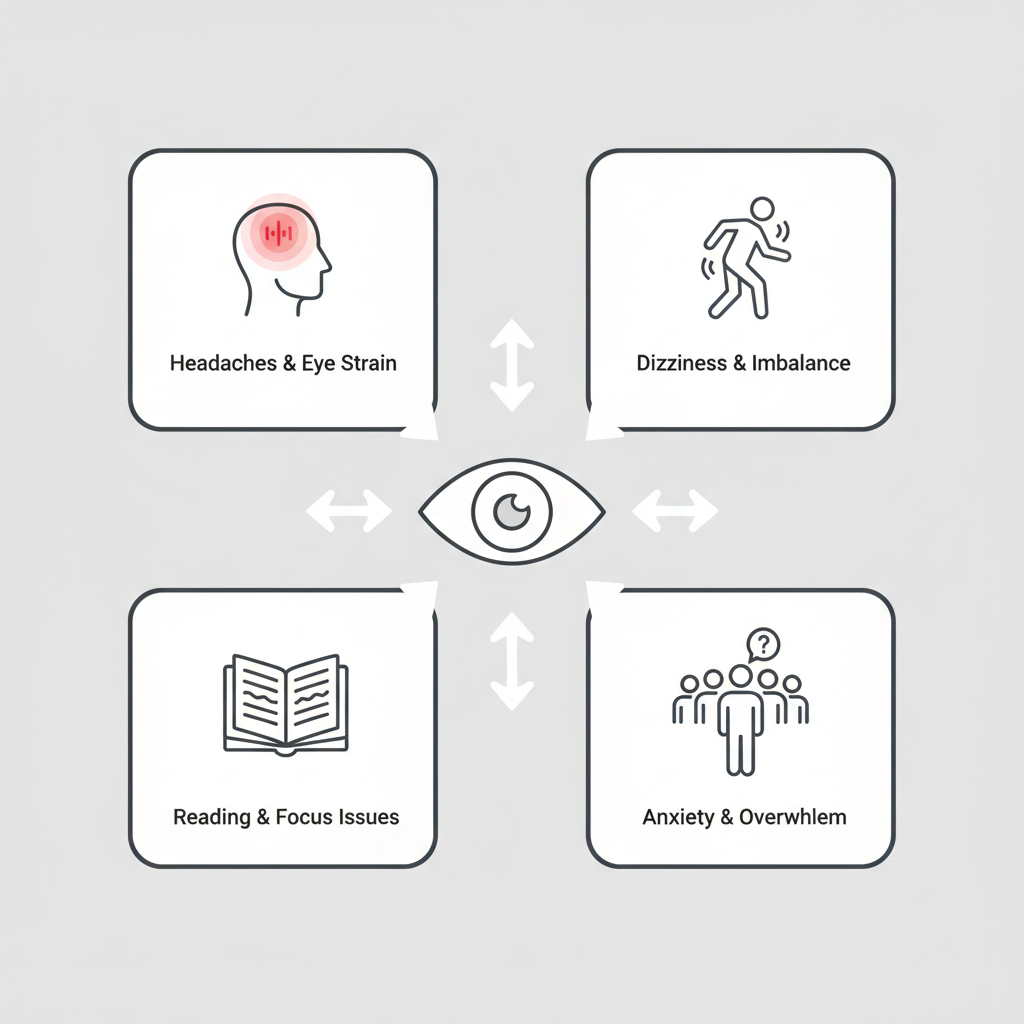
BVD Symptom Checklist:
Head and Eye Symptoms:
Persistent headaches, often described as a "pressure" behind the eyes, that worsen throughout the day.
Eye strain or a feeling of fatigue, especially with near work.
Sensitivity to light (photophobia).
Dry, gritty, or tired eyes.
Dizziness and Balance Issues:
Feeling dizzy, lightheaded, or "off-balance" in various situations.
Motion sickness or nausea, especially when scrolling on a screen or as a passenger in a car.
Unsteadiness or drifting when walking.
One study on balance disorders found that patients with Vertical Heterophoria experienced a significant reduction in unsteadiness with specialized prism lenses.
Reading and Concentration Difficulties:
Losing your place while reading or having to re-read lines.
Words appearing to "swim," blur, or double on the page.
Difficulty with attention and focus, which can be mistaken for attention deficit disorders.
Psychological and Related Symptoms:
Feeling anxious or overwhelmed in large, visually stimulating environments like grocery stores or crowds.
Pain in the neck, shoulders, or upper back from tilting the head to compensate for misalignment.
Remarkably, a 2023 study presented at the Psych Congress found that 57.6% of patients being treated for anxiety and depression screened positive for BVD, suggesting a profound link between visual dysfunction and mental health symptoms.
Diagnosis: Why a Standard Eye Exam Isn't Enough
The reason BVD is so often missed is that the tests required to detect it are not part of a routine eye exam. A comprehensive binocular vision assessment goes beyond the standard "which is clearer, one or two?" approach.
| Feature | Standard Eye Exam | Binocular Vision Assessment |
|---|---|---|
| Primary Goal | Measures visual acuity (20/20) and screens for eye disease. | Measures how the eyes work together as a team. |
| Key Tests | Refraction, eye pressure, visual field screening. | Phoria testing, prism cover tests, convergence measurements, detailed symptom questionnaires (like the BVDQ). |
| Focus | How well each eye sees independently. | The degree of eye alignment, focusing stamina, and tracking ability. |
| Outcome | Prescription for nearsightedness, farsightedness, or astigmatism. | May result in a standard prescription plus specialized prism lenses to correct misalignment. |
During a specialized evaluation, the optometrist will conduct tests to measure the precise nature and magnitude of the misalignment. This involves using tools like prisms to determine how much light needs to be bent to allow your eyes to work together effortlessly.
The Solution: How Prism Lenses Restore Visual Harmony
For many BVD sufferers, the solution lies in prescription glasses with prism lenses. A prism is a specialized lens that bends light before it enters your eye. It redirects the image to where your eye is naturally aiming, effectively "tricking" your brain into thinking the eyes are perfectly aligned.
This redirection eliminates the constant strain on your eye muscles. As a foundational text from StatPearls explains, prisms work by deviating the path of light, which allows the visual system to achieve fusion without the exhausting muscular effort. The result is often a dramatic reduction, or even elimination, of headaches, dizziness, and other BVD symptoms.
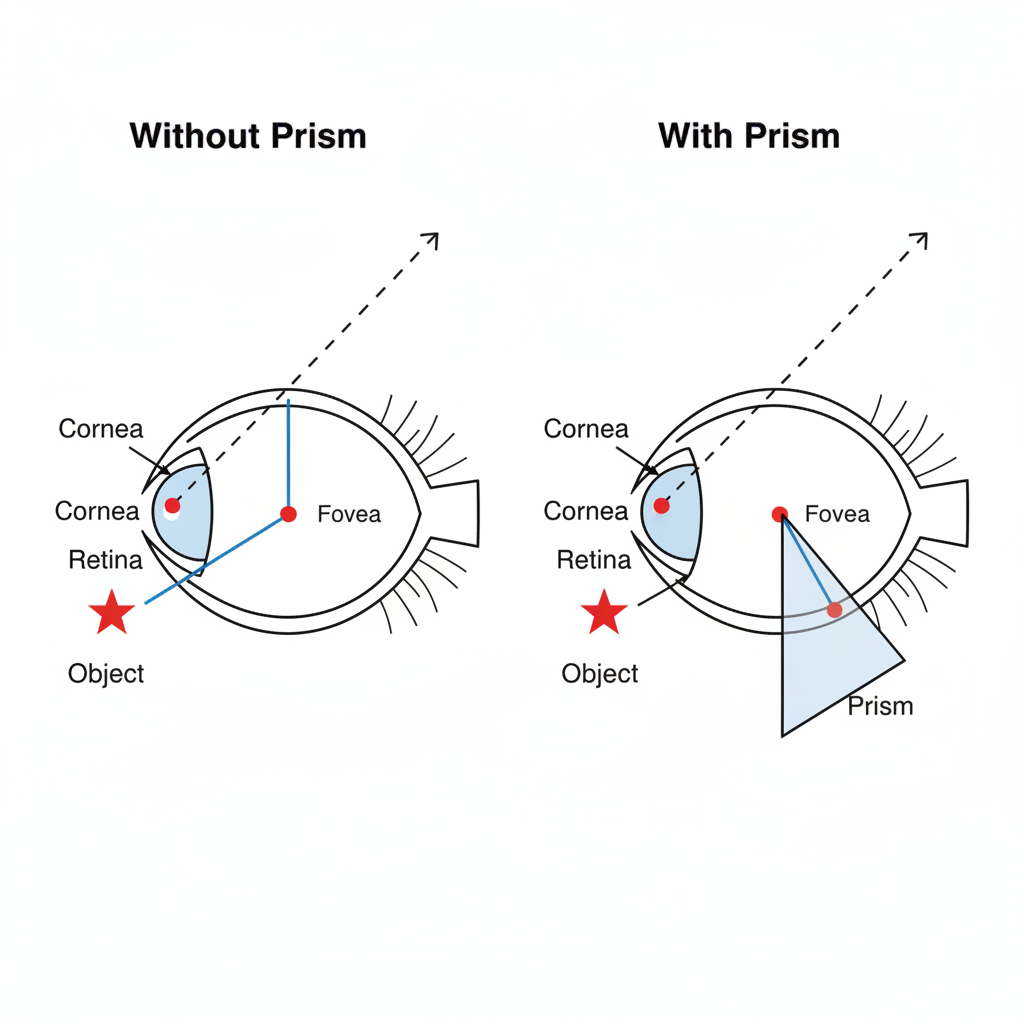
It is important to note that there is an adaptation period of one to two weeks for new prism lenses. During this time, it is crucial to wear them consistently. Some patients may initially feel that their symptoms are different or that objects appear slightly distorted. This is a normal part of the brain adjusting to the new, corrected visual input. If objects seem to "swim" or curve, it may indicate the prism power needs fine-tuning.
Reclaiming Your Life from Chronic Symptoms
If you have been struggling with unexplained headaches, dizziness, and eye strain, it is possible that your eyes hold the key. Binocular Vision Dysfunction is a real and treatable condition that is frequently overlooked by standard medical and optical evaluations. By understanding the connection between eye alignment and your symptoms, you can take the first step toward finding a solution.
Seeking an eye care professional who specializes in binocular vision assessments can provide a definitive diagnosis and open the door to treatment with prism lenses, potentially offering relief from symptoms that have plagued you for years.
Disclaimer: This article is for informational purposes only and does not constitute professional medical advice. If you are experiencing chronic headaches, dizziness, or other severe symptoms, please consult with a qualified healthcare provider for a comprehensive evaluation and diagnosis. The information presented here is not a substitute for a professional eye examination.
References
Feinberg, E. B., & Tuteja, S. (2023). Prisms. In StatPearls. StatPearls Publishing. Available at: https://www.ncbi.nlm.nih.gov/books/NBK580488/
CITT-ART Investigator Group. (2020). Vision Therapy for Convergence Insufficiency in Adults: A CITT-ART Investigator Group Study. Optometry and Vision Science, 97(9), 709–717. Available at: https://pmc.ncbi.nlm.nih.gov/articles/PMC8092638/
Rosner, M. S., et al. (2023). A High Percentage of Patients Seeking Treatment for Anxiety and/or Depression Screen Positive for Binocular Vision Dysfunction (BVD). Poster presented at Psych Congress 2023. NVM Institute. Available at: https://nvminstitute.org/wp-content/uploads/2023/08/Psych-Congress-BVD-Poster.pdf
Mallia, K., et al. (2022). Unsteadiness and Associated Factors in Patients with Vertical Heterophoria. Journal of Clinical Medicine, 11(20), 6138. Available at: https://pmc.ncbi.nlm.nih.gov/articles/PMC9540399/