









Tinted Prescription Lenses: What They Are and How to Style
Tinted prescription lenses have been showing up in everyday eyewear, not only in sunglasses. The difference comes down to one number: light transmission. A sunglass lens typically transmits 8 to 40 percent of light (blocking the rest). A fashion-tinted prescription lens lets through 75 to 92 percent, which means you can wear it indoors without losing clarity. Here is what these lenses are, how to choose a color, what to watch out for technically, and how to style them in 2026.

What Tinted Prescription Lenses Actually Are
Tinted prescription lenses start as a standard prescription lens and go through a dye process where the lens is submerged in a heated color solution. The dye absorbs into the lens material itself rather than sitting on the surface, so the color is stable and consistent. The result is a lens that corrects your vision and carries a visible color tone at the same time.
How They Differ From Sunglasses
The clearest way to understand tinted prescription lenses is to compare them directly with sunglass lenses across three factors.
Factor | Sunglass Lenses | Tinted Prescription Lenses |
Light transmission | 8 to 40% (blocks most light) | 75 to 92% (lets most light through) |
Primary purpose | UV protection, glare reduction | Style and color tone |
Where you wear them | Outdoors only | Indoors and outdoors |
Because tinted prescription lenses let the majority of light through, your eyes remain fully visible to other people and your vision is not meaningfully affected in normal indoor lighting.
How They Differ From Transition Lenses
Transition lenses (also called photochromic lenses) are clear indoors and darken automatically when exposed to UV light outdoors. They come back to clear when you move back indoors, typically within a few minutes.
Tinted prescription lenses are a fixed color. They do not change based on the environment. If you want a consistent color visible at all times, including indoors, that is the defining advantage of a tinted lens over a transition lens.
The Color Options and What Each One Does to Your Look
Colors fall into three groups based on how much visual impact they carry.
Neutral Tones
Gray. Gray is the closest thing to a neutral in tinted lenses. It adds a cool, low-key edge to any frame without shifting the color temperature of your overall look. Your eyes still read clearly through the lens. Gray works with any outfit color and suits every skin tone. It is the lowest-risk starting point for anyone new to tinted lenses.
Brown. Brown adds warmth. On a tortoiseshell frame, a brown tint creates a unified, tonal look from frame to lens. Brown pairs especially well with warm or olive skin and earth-tone outfits. It reads subtle in most settings, making it a strong everyday option.
Fashion Tones
Green. Light green lenses read as vintage and artistic. Deeper green sits closer to editorial. Green is flattering on fair to medium skin and works well with neutral or monochrome outfits where the lens becomes the focal point of the look.
Pink. Light pink is consistently popular in eyewear and across social platforms. It reads soft and intentional rather than costume-like when kept at a low to medium concentration. Pink pairs naturally with light or white outfits and tends to read softer in casual settings. Deeper pink is bolder and more statement-forward.
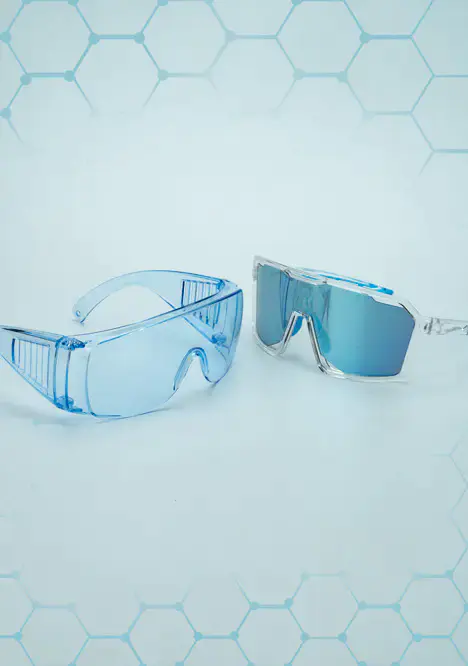
Blue. Light blue adds a cool, minimal quality to a frame. It pairs naturally with silver metal frames and cool-toned outfits. Blue works best on skin with cool or neutral undertones.
High-Impact Tones
Orange and amber. These are the warmest and most visually assertive options. An amber or orange tint on a clean frame makes the glasses the clear focal point of the outfit. Pair with an all-neutral look to keep the glasses as the only statement. Orange and amber tend to complement warm-toned outfits and settings particularly well.
Choosing Your Concentration
The same color comes in different densities, commonly described as 10%, 20%, 30%, or 50% tint. Here is what each level looks like in practice:
Concentration | Effect | Best For |
10% | Almost invisible indoors | First-time wearers who want minimal color |
20 to 25% | Clearly visible, comfortable indoors | Everyday wear, office settings |
30% | Noticeable color, glasses become a visual element | Social settings, fashion-forward looks |
50%+ | Strong color, approaches light sunglass effect | Outdoor-adjacent use; not recommended for driving |
A practical note: 10% concentration is subtle enough that many people find the effect barely registers in normal indoor lighting. If you are ordering tinted lenses for style reasons, 20 to 25% is the concentration where the color actually shows.

What to Know Before You Order Tinted Prescription Lenses
Prescription Strength and Color Uniformity
Lens thickness affects how evenly the dye distributes. In a thicker lens (which higher prescriptions require), the dye tends to concentrate more at the edges than at the center, creating an uneven color gradient. If your prescription is above +4.00 or -4.00, choosing a high-index lens (1.67 or 1.74 index) reduces lens thickness significantly, which improves color uniformity.
Lensmart offers 1.56, 1.61, 1.67, and 1.74 index lens options that work with prescription eyeglasses, which is worth factoring in if you have a stronger prescription and want consistent color.
Anti-Reflective Coating Compatibility
Anti-reflective (AR) coating and tinted lenses can be combined, but the coating slightly reduces the apparent saturation of the tint: the color will appear a shade lighter than without AR coating. If color vibrancy is a priority, you can skip AR coating. If everyday visual comfort matters more, AR coating is still worth adding since it meaningfully reduces glare and internal reflections.
Effect on Color Perception
Tinted lenses do affect how you perceive colors slightly:
● Gray: The most color-neutral option; minimal shift in how you see surrounding colors
● Brown and amber: Warm colors appear warmer; useful for contrast enhancement
● Blue and green: Can slightly reduce red-orange perception
For most casual and professional use, this has no practical impact. For work that requires accurate color judgment (graphic design, photography, color grading), a tinted lens is worth removing during that specific task.
Care and Durability
The dye in quality tinted lenses is stable under normal use and generally does not fade from regular cleaning or wear. Two things that can cause color shift over time: prolonged direct exposure to intense UV (such as leaving glasses in a sun-exposed car interior) and contact with acetone or alcohol-based products. For daily cleaning, water and a microfiber cloth are sufficient.
Frame Type Considerations
Tinted lenses add visual weight to a frame. A slim metal frame or a simple acetate frame with a light tint tends to look more refined than a thick frame paired with a deep tint, where the combined visual weight can feel visually heavy. Clear acetate frames with a fashion tint are among the most versatile combinations: the frame stays neutral while the lens carries the color.

How to Style Tinted Glasses in 2026
The Concentration Rule for Indoor Wear
The reason some tinted glasses read as "indoors with sunglasses on" is concentration, not color. A 50%+ tint blocks enough light that the effect is visually similar to sunglasses. Keeping concentration at 30% or below is the practical threshold for indoor-appropriate tinted eyewear.
Three Outfit Scenarios
Daily commute and office. Gray or light brown at 20% concentration with a slim metal or simple acetate frame. The tint is present but unobtrusive. Most people will notice the color only on a second look, but the overall polish of the glasses goes up noticeably versus a clear lens.
Creative or social settings. Green or pink at 30% with a clear or thin metal frame. Keep the rest of the outfit in a single neutral color so the glasses become the one clear style element rather than competing with clothing for attention.
Spring and summer styling. Pink or light blue at 20 to 30% with lightweight, natural-fabric clothing (linen, cotton, thin knit). The lens color and the lightness of the fabric share the same visual register. For fall and winter, brown and amber tints connect better with the season's color palette.
A Counter-Intuitive Starting Point
Most people choosing their first tinted lens default to 10% thinking it will be safer. In most indoor lighting, 10% is barely detectable. The styling benefit of a tinted lens comes from the color being visible. Starting at 20% gives you an actual result without being loud about it.
Ready to Try a Tinted Lens
Tinted prescription lenses sit between clear lenses and sunglasses: they correct your vision, add a color tone that is visible indoors, and give your glasses a different kind of presence without blocking your view or looking like you forgot to take off your sunglasses. The first decision is concentration, because that determines whether the effect shows up at all. BrowseLensmart to see what tint and lens index combinations are available for your prescription.

FAQ
Q1: Will tinted prescription lenses affect how well I can see?
No. The dye process changes the color of the lens but does not affect the prescription, the optical center, or the clarity of vision. The only practical note is that very high concentrations (50% and above) reduce the total amount of light reaching your eye, which can make low-light environments slightly dimmer. At 20 to 30% concentration, there is no meaningful impact on vision quality.
Q2: Can tinted lenses be added to any frame style?
Nearly all frame types support tinted lenses, including full-rim, semi-rimless, and rimless frames. Rimless frames have one specific consideration: because the lens edge is exposed rather than enclosed in a frame, any unevenness in the dye distribution (more common with higher prescriptions) is more visible. For rimless frames with a strong prescription, a light tint concentration and high-index lens material help minimize this.
Q3: Do tinted lenses cost more than regular prescription lenses?
Yes. Tinted lenses typically add to the cost of a standard prescription lens because of the additional dyeing step in production. The exact amount varies by provider. Online eyewear retailers generally charge less for this addition than traditional optical shops, where tinting fees are often higher.
Q4: Can I get gradient tinted lenses for prescription glasses?
Yes. Gradient tinted lenses apply color from the top of the lens down, fading to near-clear at the bottom. The practical advantage for prescription wearers is that the lower portion of the lens (used for reading and close work) remains close to clear while the upper portion carries the color. Gradient tints also tend to look softer and more natural than a flat, uniform tint across the entire lens.


