



Progressives vs. Bifocals: A Practical Wear Experience Comparison
Most people searching for multifocal glasses already know the basic pitch. Progressives have no visible line. Bifocals do. But that summary skips the part that actually matters: what wearing each one feels like in your daily life, and why the wrong choice leaves you squinting at a computer screen or tripping on stairs. Here is what you actually need to know before you decide.
Progressive Lenses: What They Are and How They Feel to Wear
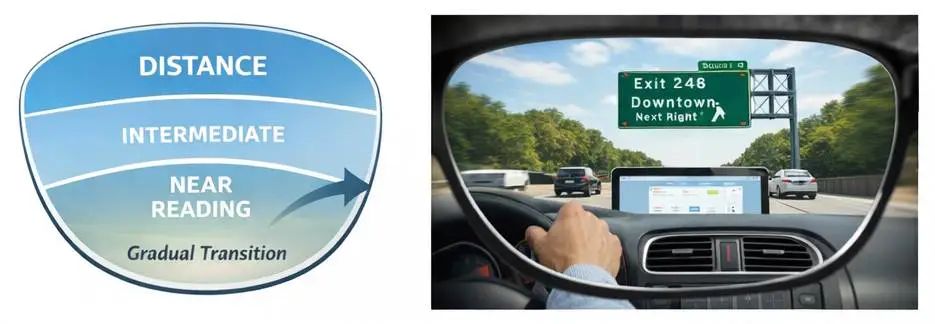
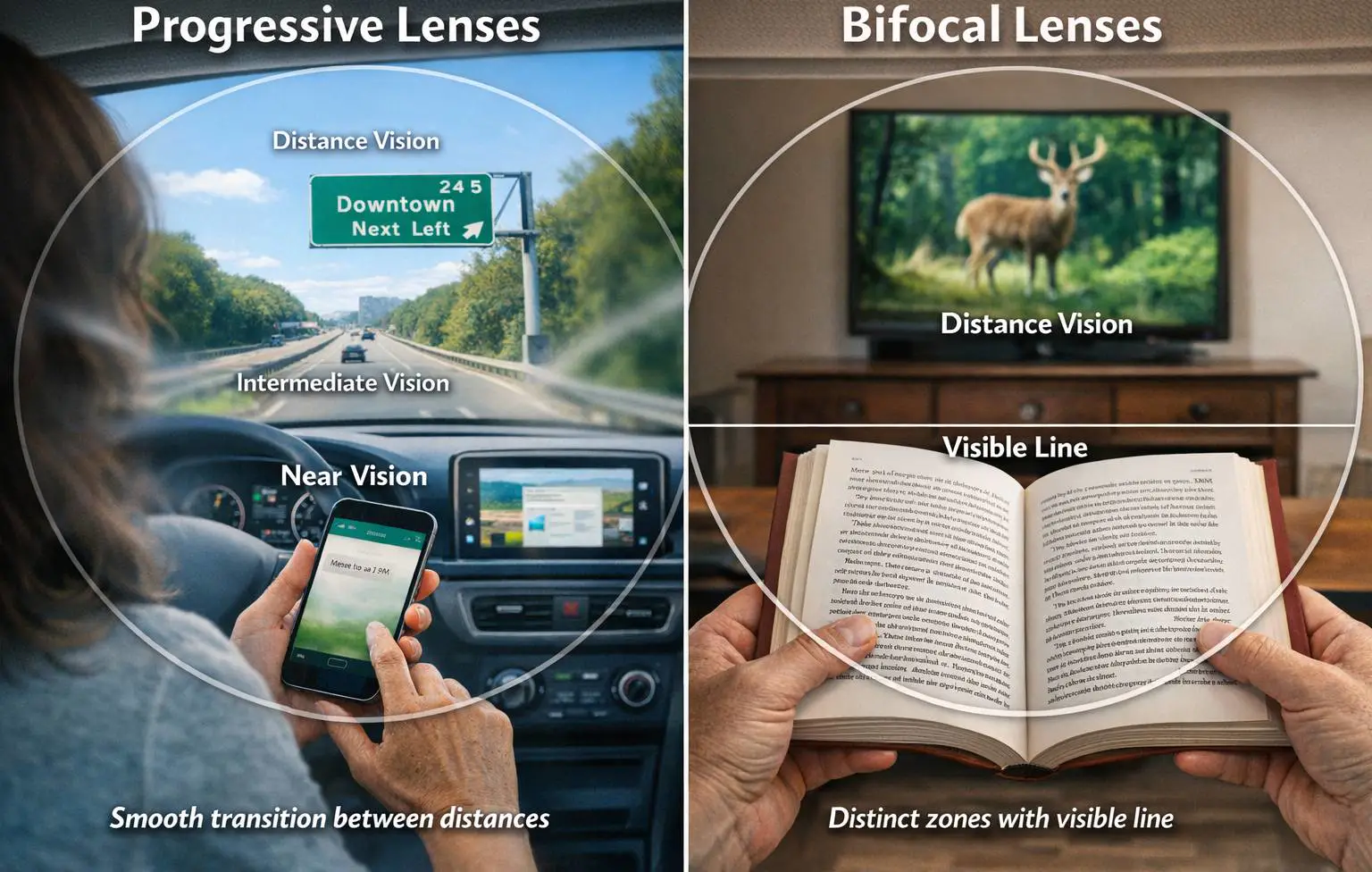
Progressive lenses, sometimes called no-line bifocals, correct distance, intermediate, and near vision within a single lens. There is no visible dividing line. Instead, the lens power shifts gradually from top to bottom, with the strongest reading power sitting at the lower portion.
The first time you put on a pair, the experience feels slightly off. Your peripheral vision looks blurry or wavy at the edges. This is normal and expected. The clear zone runs down the center of the lens like a narrow corridor, and you need to train yourself to point your nose at whatever you want to see clearly, rather than just moving your eyes sideways.
What the daily experience looks like:
● Looking up to read a road sign: clear
● Glancing at your laptop screen at mid-range: clear
● Looking down to read a text message: clear
● Glancing sideways at something without turning your head: soft and slightly distorted
That last point is the adjustment most people underestimate. The distortion on the outer edges never fully disappears. Your brain learns to ignore it, usually within one to three weeks. After that, most wearers stop noticing it entirely.
Bifocal Lenses: What They Are and Who Still Uses Them
Bifocal lenses split the lens into two sections with a visible horizontal line. The upper portion handles distance vision. The smaller lower segment handles near vision, typically reading distance.
The wearing experience is more immediate and predictable. You look through the top for driving or watching TV. You drop your gaze into the lower segment for reading. There is no learning curve for finding the right zone. Most people adapt within three to seven days.
What the daily experience looks like:
● Reading a book for an hour: comfortable, wide reading area
● Switching from a conversation across the room to a menu: noticeable jump as your eye crosses the line
● Working on a computer: the screen often falls in the gap between the two zones, which creates strain
That middle distance gap is where bifocal lenses consistently disappoint. A standard laptop or desktop monitor sits at roughly 20 to 26 inches away, which falls right between the distance and near zones. Many bifocal wearers end up tilting their head back awkwardly to catch the text through the reading segment, and that posture adds up over a workday.
What the Adjustment Period Really Feels Like for Each Lens Type
This is the section most buying guides skip. It is also where most people either give up too early or push through discomfort that actually signals a fitting problem. Progressive lenses typically take one to three weeks to adapt to, while bifocals usually require only three to seven days. Here is what each stage actually feels like.
Progressive Lenses: Week One and Week Two
Days 1 to 3: Mild dizziness, swimming sensation when turning your head, slight headache by afternoon. This is your visual system recalibrating. Wear the glasses full-time. Switching back to your old pair resets the process.
Days 4 to 7: The swim effect starts to settle. You begin naturally pointing your nose at objects without thinking about it. Reading at a table feels more natural. Stairs still require extra attention.
Days 8 to 14: Most people report that the distortion has become background noise. Computer use feels easier. Walking feels normal again.
When to go back to your optician: If dizziness or blurry central vision continues past two weeks, the fitting measurements are likely off. Even a 2mm error in pupillary distance can make the clear corridor unusable. This is a fit problem, not a lens problem.
Bifocal Lenses: Days 1 to 7
The adjustment is mostly about learning where to look. The image jump at the dividing line feels jarring at first, particularly when walking down stairs or stepping off a curb. Most people stop noticing it by day five.
Side-by-Side Comparison: Progressive Lenses vs Bifocals
Feature | Progressive Lenses | Bifocal Lenses |
Vision zones | 3 (distance, intermediate, near) | 2 (distance, near) |
Visible line | No | Yes |
Computer use | Excellent | Poor |
Reading area width | Narrower | Wider |
Adaptation time | 1 to 3 weeks | 3 to 7 days |
Image jump | None | Present |
Peripheral distortion | Present on outer edges | None |
Cost | Higher | Lower |
Best for | Dynamic, multi-distance daily use | Sustained reading, fixed-distance tasks |
This multifocal glasses comparison is a practical starting point, but your prescription strength and frame choice also affect how each lens performs. A tall frame with enough vertical space is particularly important for progressive lenses, since a short frame compresses the corridor and reduces the usable reading area.

Which Lens Fits Your Daily Routine
Rather than listing abstract pros and cons, consider which of these situations matches your actual week.
Choose progressive lenses if you:
1. Spend more than four hours a day on a computer or tablet. The intermediate zone covers screen distance, and extended screen time with bifocals frequently leads to neck strain from head tilting.
2. Move between tasks constantly throughout the day. Progressive lenses handle the transitions without requiring you to consciously shift your gaze to a specific zone.
3. Drive frequently and also need reading vision for maps or your phone. Progressive lenses cover both without the image jump that can be disorienting at speed.
Choose bifocal lenses if you:
1. Spend most of your day reading physical books, newspapers, or doing detailed handwork. The wider near-vision segment is genuinely useful for sustained close work at a fixed distance.
2. Have tried progressives before and could not adapt. Many failed adaptations trace back to incorrect fitting measurements rather than the lens design itself, so it is worth revisiting with an optician. That said, bifocals remain a reliable option if adaptation genuinely is not possible.
How to Choose the Right Multifocal Glasses For Your Lifestyle
Picking the right lens type is only half the decision. How the glasses are made and fitted determines whether they actually work for you day to day.
Frame height matters for progressives. A frame with less than 28mm of vertical lens height cuts off part of the reading zone. If you prefer smaller or more fashion-forward frames, check the lens height before ordering. This is especially relevant for adults in their 40s and 50s, where the reading prescription tends to increase over time and requires more vertical lens space to work properly.
Your prescription strength affects the corridor width. Higher add powers (the difference between your distance and reading prescriptions) create narrower clear corridors and more peripheral distortion. If you are new to progressives and have a high add power, expect a longer adaptation period.
Occupational lenses are worth knowing about. If computer use is your main concern, office progressives dedicate more of the lens surface to intermediate and near vision. They are not suitable for driving but are noticeably better for desk work than standard progressives.
An anti-reflective coating reduces glare from screens and overhead lights. It can make extended reading more comfortable with both lens types, and is worth adding to any progressive or bifocal purchase, particularly for eyewear over 40, when contrast sensitivity starts to naturally decline.
Find Your Fit Before You Buy
The real difference between progressive lenses and bifocal lenses comes down to how you use your eyes during a typical day. For most people over 40 who work with screens and move between tasks throughout the day, progressive lenses are the practical choice. They correct all distances without a visible line. For those who primarily read, do close-up work, or want a faster adjustment period, bifocals remain a solid option.
At Lensmart, both lens types are available across a wide range of frames, with options suited to different prescriptions and face shapes. If you are ready to find the pair that fits your routine, browse prescription eyeglasses at lensmartonline.com.

FAQs
Q1: Can I Wear Progressive Lenses if I Have Astigmatism (An Uneven Cornea That Blurs Vision)?
Yes. Progressive lenses can be made to include an astigmatism correction. Your optician will incorporate it into the full prescription.
Q2: Can You Use Progressive Lenses for Driving at Night?
Yes. Many wearers find progressives comfortable for night driving once adapted. Adding an anti-reflective coating reduces glare from headlights and street lights, which makes a noticeable difference.
Q3: Why Do My Bifocals Give Me a Headache When I Use the Computer?
The computer screen typically falls in the gap between bifocal zones. You may be unconsciously tilting your head or straining your eyes to find a clear focal point, which causes the headache. An occupational or office progressive lens is designed specifically for this use case.
Q4: Why Can’t I Read With My Progressive Lenses?
Progressive lenses require you to point your nose, not just move your eyes, toward what you want to read. If reading feels blurry, try dropping your chin slightly and looking through the lower center of the lens rather than the outer edges.
Q5: Is It Harder to Adapt to Progressives the Older You Get?
Somewhat. Higher add powers that come with age create narrower clear corridors, which can extend the adaptation period. First-time wearers in their 50s may need slightly longer than those starting in their early 40s.