



SPH -0.25 to -6.00: What Your Myopia Number Means in Real Life
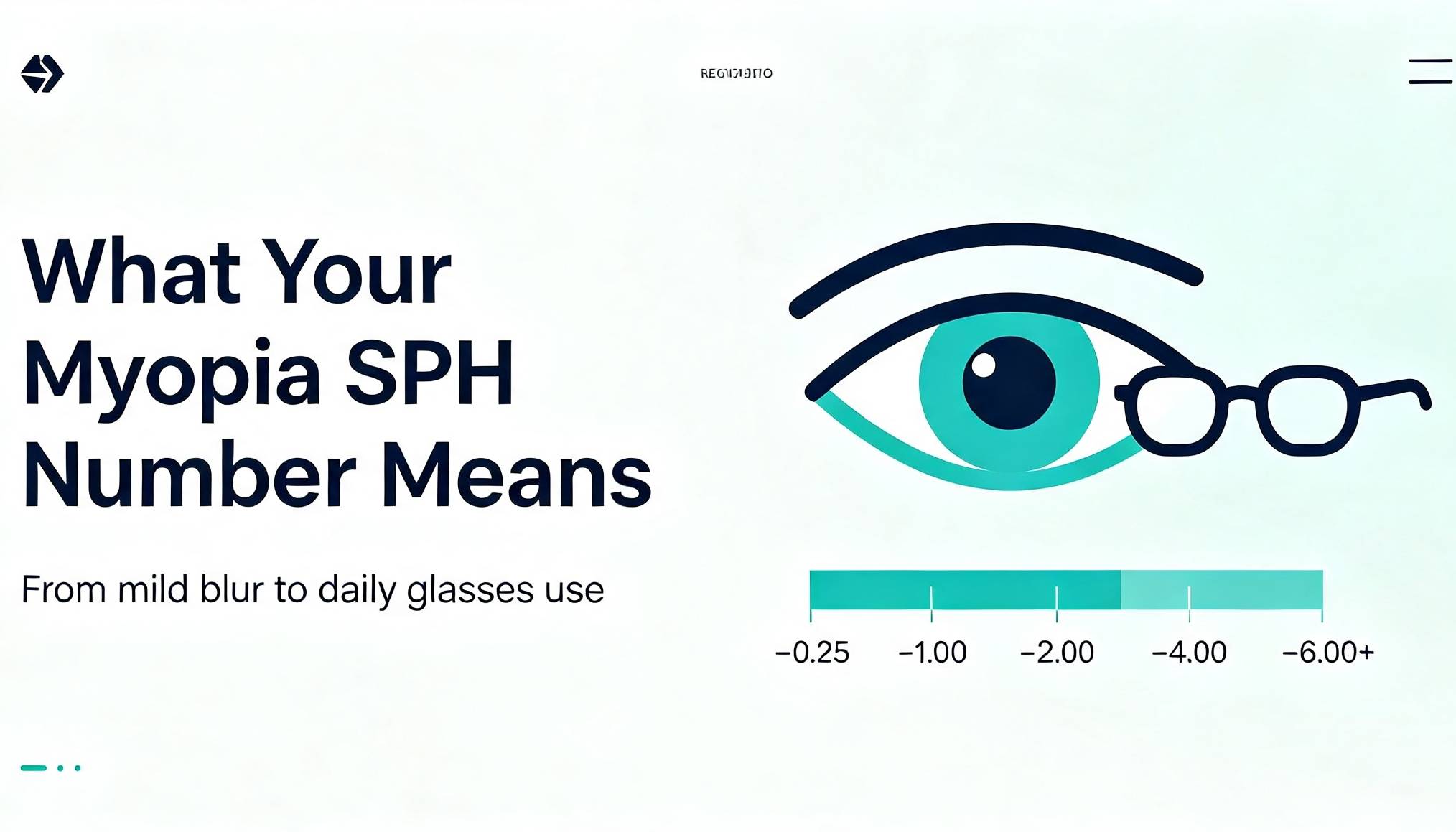
You check your glasses prescription and see -2.00 next to SPH, with no clue what that number actually changes about your day. Myopia SPH numbers explained on a chart rarely match what you actually notice in daily life. Each SPH value tells your optician exactly how much correction your eyes need. Your own number below can show you what changes for driving, reading, and picking new frames.
A Fast Look at the Ranges Below
● At -0.25 to -1.00, most people only reach for glasses while driving or watching a movie.
● At -1.25 to -2.00, faces a few feet away start to lose detail without glasses.
● At -2.25 to -3.00, full time glasses use becomes the norm for most people.
● At -3.25 to -4.00, lens edges can show up on larger frames.
● At -4.25 to -6.00, thin high index lenses and smaller frames become the practical choice.
What a Minus Sign on Your Prescription Shows
If you are asking what does my myopia prescription mean, the short answer starts with the minus sign. It shows nearsightedness, so light focuses in front of the retina instead of directly on it. Myopia diopters explained in simple terms come down to steps of 0.25 on the SPH line, with each step adding a bit more correction.
The number on your chart describes how much correction your eyes need. It does not rate how weak your eyes are on its own. A common mix up is reading -3.00 as "300 degrees." That figure comes from a different scale used in some countries, where diopters are multiplied by 100 for convenience, but the SPH number on a standard prescription works differently.
Myopia Scale: From Mild to High
Myopia prescription numbers fall into three broad groups, and each one shapes daily life a bit differently.
Category | SPH Range |
Mild myopia | -0.25 to -3.00 |
Moderate myopia | -3.25 to -6.00 |
High myopia | Above -6.00 |
Lens thickness, daily glasses use, and certain eye health checks all shift as the number climbs from one group to the next. High myopia above -6.00 usually calls for closer eye health monitoring and more frequent checkups.
-0.25 to -1.00: You May Not Need Glasses Every Day
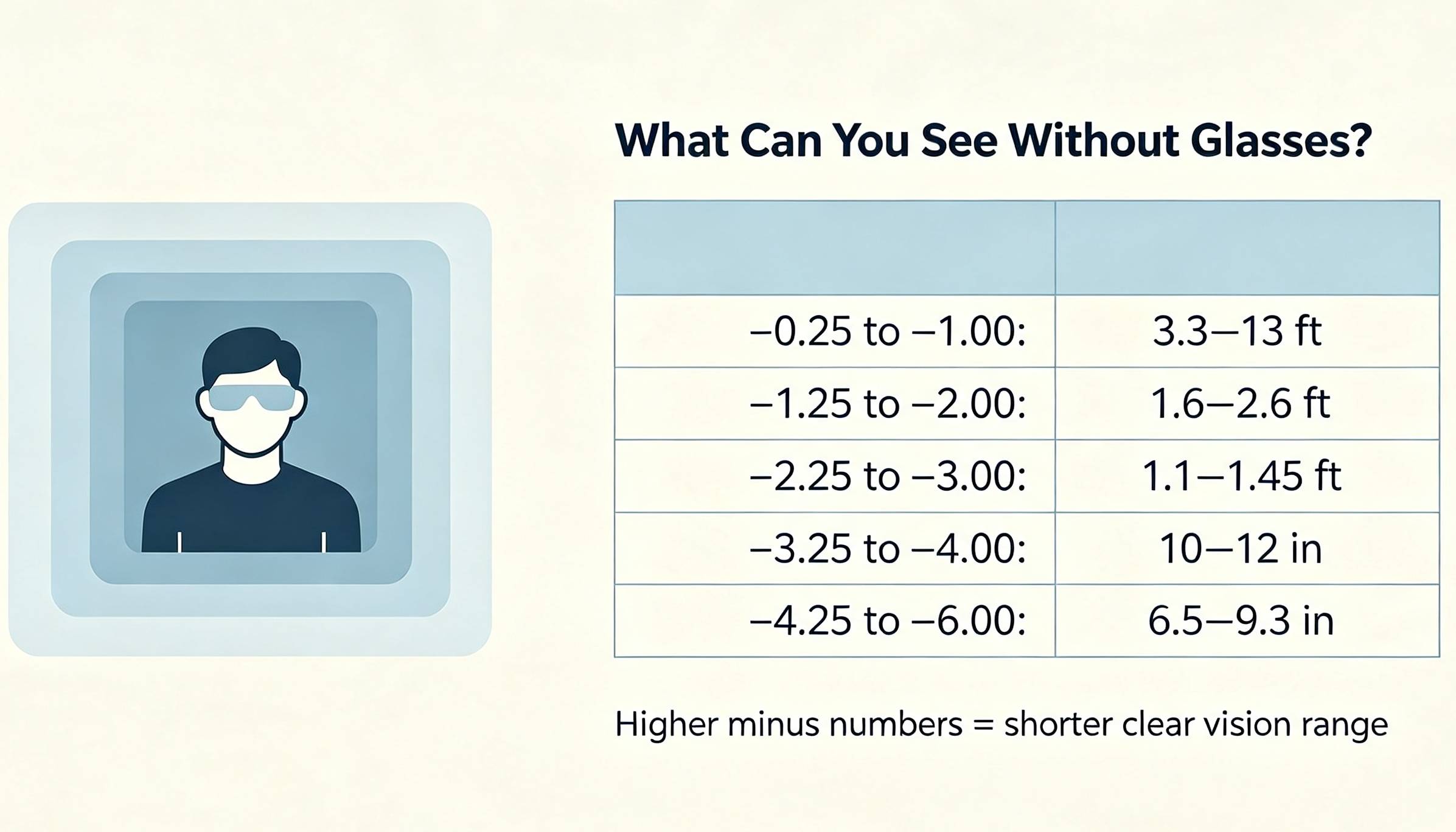
At -0.25 to -0.50, clear vision without glasses usually reaches about 6.6 to 13 feet (2 to 4 m). Most people handle daily tasks without wearing correction at this level.
At -0.75 to -1.00, clear vision drops to about 3.3 to 4.4 feet (1 to 1.33 m). Faces a few steps away can start to lose sharpness at this point.
● Driving is the main task that calls for glasses in this range.
● Most states require correction once your vision falls below a set standard on the driving test.
● Night driving can bring mild glare around headlights and streetlights.
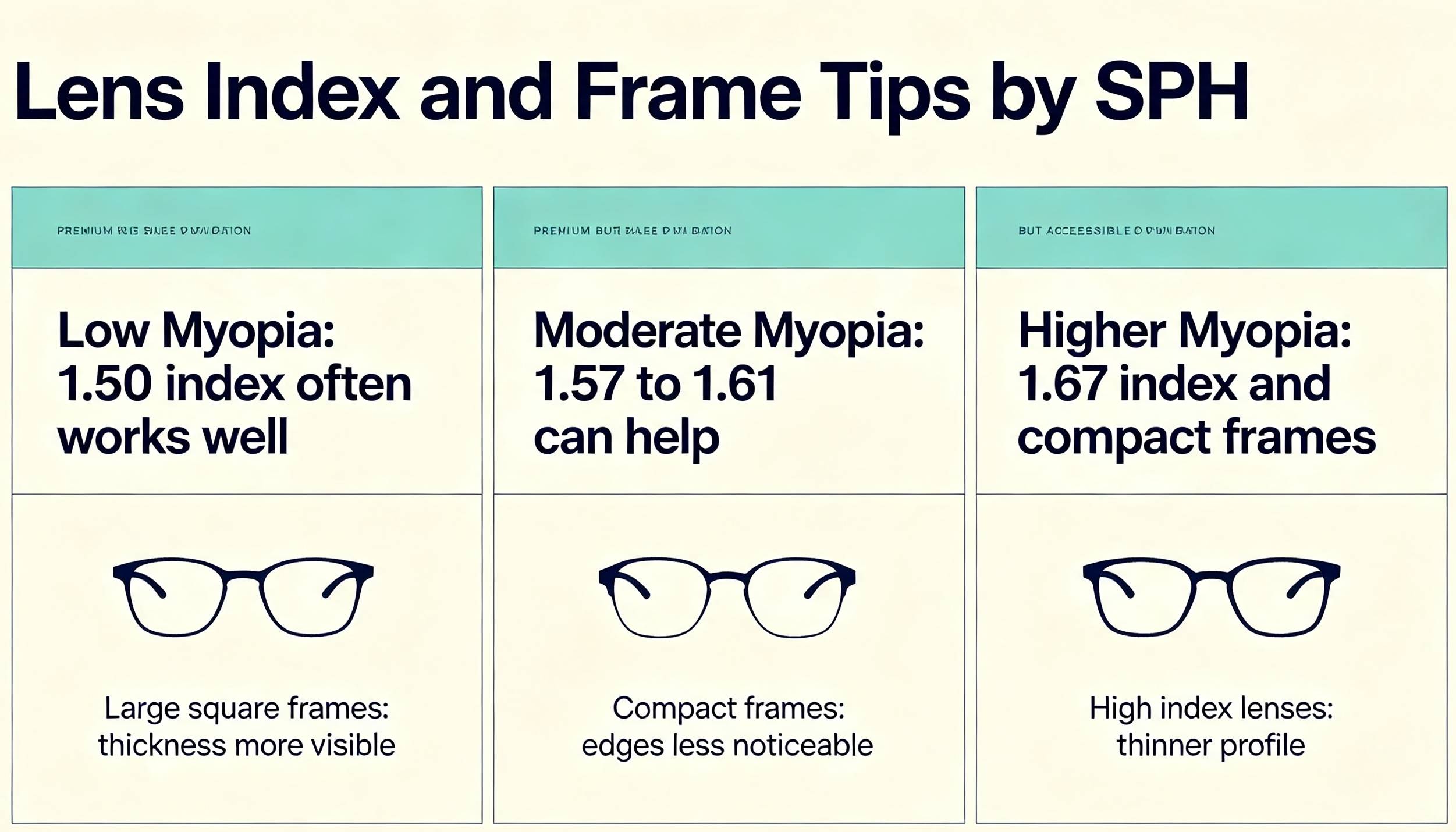
● A standard 1.50 index lens works fine here, with no need for a thinner option.
-1.25 to -2.00: Clear Up Close, Blurry a Few Feet Away
Clear vision without glasses covers about 1.6 to 2.6 feet (0.5 to 0.8 m). A whiteboard from the back of a small classroom or a face across a table gets harder to read.
● Close up tasks like reading a book or checking a phone stay sharp without correction.
● Outdoor spaces and busy public areas feel harder to navigate without glasses.
● Night driving can bring noticeable glare and halos around lights.
● Most people start wearing glasses full time once they reach this range.
● A 1.50 index lens still works, though 1.57 gives a slightly thinner result.
-2.25 to -3.00: The Range Where Glasses Become a Daily Habit
Clear vision without glasses drops to about 1.1 to 1.45 feet (33 to 44 cm) at -3.00, roughly the point where many people start to wonder how bad their vision really is.
● A phone screen at typical reading distance, close to 12 inches (30 cm), stays clear without glasses.
● Seeing your own face clearly in a bathroom mirror gets difficult without correction.
● Sports, cycling, and walking around a store all get harder without glasses.
● Many people at this level start asking their eye doctor about contacts or laser surgery.
● Lens thickness starts to matter more, and 1.57 to 1.61 index lenses are worth asking about.
-3.25 to -4.00: When Lens Edges Start Showing on Your Frame
Without glasses, clear vision falls to about 10 to 12 inches (25 to 31 cm).
● Daily tasks like showering or swimming rely fully on unaided vision at this level.
● Lens edges can start to show along the sides of standard frames.
● A slight shrinking look around the eyes can appear with stronger minus lenses.
● Larger or square frames tend to make lens thickness more visible.
● A 1.61 index lens is a solid pick here, and 1.67 is worth asking about as you approach -4.00.
-4.25 to -6.00: You Need Both Clear Vision and a Thinner Lens
Clear vision without glasses shrinks to about 6.5 to 9.3 inches (17 to 24 cm) here. Getting through a full day without correction becomes very hard.
Frame choice gets more limited too. Large frames paired with a strong prescription tend to show thick, visible edges. Eye health checks also matter more here, and regular eye exams are worth keeping up with once your prescription reaches this range.
Compact round frames and high index lenses help keep lens thickness less noticeable. A 1.67 index lens is a good fit through most of this range. Laser surgery also becomes a realistic option for many people at this level. Prescriptions stronger than -8.00 sit outside the range covered here, and that is typically where a 1.74 index becomes the standard recommendation.
What Your SPH Number Does Not Tell You
SPH covers only one part of a full prescription. Astigmatism, listed as CYL, and reading power, listed as ADD, can shape daily vision as much as SPH does.
● Two people can share a -3.00 SPH and still see very differently if one also has -1.50 of astigmatism.
● A stronger minus number does not directly show how healthy your eyes are, since corneal health and the back of the eye matter too.
● Your SPH number alone does not predict how fast your prescription will change over time.
● A teenager at -2.00 can shift faster than an adult sitting at -4.00.
A Quick Reference: What Can You See at Each SPH Level?
SPH | Clear Vision Range (No Glasses) | Daily Impact | Suggested Lens Index |
-0.25 to -0.50 | About 6.6 to 13 ft (2 to 4 m) | Low, mainly distance tasks | 1.50 |
-0.75 to -1.00 | About 3.3 to 4.4 ft (1 to 1.33 m) | Low to moderate, some outdoor tasks | 1.50 |
-1.25 to -2.00 | About 1.6 to 2.6 ft (0.5 to 0.8 m) | Moderate, public spaces get harder | 1.50 to 1.57 |
-2.25 to -3.00 | About 1.1 to 1.45 ft (33 to 44 cm) | High, glasses worn all day | 1.57 to 1.61 |
-3.25 to -4.00 | About 10 to 12 in (25 to 31 cm) | Very high, lens edges show | 1.61 to 1.67 |
-4.25 to -6.00 | About 6.5 to 9.3 in (17 to 24 cm) | Very high, frame choice limited | 1.67 |
Higher lens index numbers cut down on edge thickness, which matters more once your prescription passes -4.00. Lensmart also has a related guide to thin glasses for high prescriptions.
Find Your Fit at Lensmart Online
Your SPH number lines up with a real level of blur, from a slightly soft street sign at -0.50 to a room that stays out of focus at -5.00. Frame style and lens thickness both shift as that number grows. Lensmart Online offers a range of frame styles and lens index choices, so you can look for a pair that fits your prescription, your face, and your budget.
FAQs
Q1: Is -3.00 considered bad eyesight?
Not exactly. -3.00 sits at the upper edge of mild myopia and the lower edge of moderate myopia. Clear vision without glasses reaches about 1.1 to 1.45 feet (33 to 44 cm) at this level. Most people at this stage wear glasses full time and see well with correction.
Q2: What can a person with -2.00 vision see without glasses?
A person with -2.00 SPH usually sees clearly up to about 1.6 feet (0.5 m). Close up tasks like reading and phone use stay sharp without correction. Distance tasks like driving or reading street signs need glasses.
Q3: At what SPH do I need high index lenses?
High index lenses become worth considering from about -4.00 upward, where a 1.67 index gives a noticeably thinner result than a standard lens. Past -8.00, a 1.74 index offers the thinnest option available.
Q4: Does a higher myopia number mean my vision will keep getting worse?
Not always. A higher SPH shows how much correction your eyes need right now, not a fixed path forward. Age, genetics, and daily screen habits all play a part in how fast a prescription shifts over time.
Q5: What is the difference between -1.00 and -2.00 vision in daily life?
At -1.00, clear vision reaches about 3.3 to 4.4 feet (1 to 1.33 m), and glasses are mainly needed for driving. At -2.00, clear vision drops to about 1.6 to 2.6 feet (0.5 to 0.8 m), and most people wear glasses all day.