


Why 3D Movies Make You Dizzy: The Science of Depth Perception
Why 3D Movies Make You Dizzy: The Science of Depth Perception
That feeling of unease—a creeping headache, a sense of dizziness, or even full-blown nausea—during a 3D movie is a surprisingly common experience. You might think you're just sensitive, but what you're feeling is a fascinating conflict between your eyes and your brain. This discomfort is your body's reaction to a neurological puzzle, one that reveals the incredible, and sometimes fragile, teamwork required to see the world in three dimensions.
This isn't just about a bad movie experience. The strain you feel in the theater is often a magnified version of subtle vision challenges that can affect your daily life, from reading a book to working on a computer. Understanding this phenomenon is the first step toward not only enjoying movies more but also recognizing the signs of an underlying, and often treatable, functional vision issue.
TL;DR: Why 3D Makes You Uncomfortable
- The Core Problem: 3D movies force your eyes into an unnatural state. Your focusing system (accommodation) knows the physical screen is far away, while your aiming system (convergence) is tricked into pointing at 3D objects that appear much closer. This conflict is the primary source of eye strain and headaches.
- The Motion Sickness Link: When the film shows dramatic motion—like flying or falling—your eyes are telling your brain "we're moving!" while your inner ear (the vestibular system) reports that you are sitting perfectly still. This sensory mismatch is a classic recipe for motion sickness and nausea.
- Hidden Vision Issues are Magnified: For many, 3D dizziness is the first sign of an underlying Binocular Vision Dysfunction (BVD). These are common conditions where the eyes struggle to work together as a perfect team. A 3D movie, with its intense visual demands, pushes this weak teamwork to its breaking point.
- Is It Fixable? Yes. For most people, the discomfort is temporary and can be managed with simple strategies. For those with underlying BVD, the awareness gained from a bad 3D experience can lead to solutions like vision therapy or specialized glasses that improve comfort in all aspects of life.
How Your Brain Builds a 3D World
To understand why the 3D illusion breaks, we first need to appreciate how the real thing works. Your ability to perceive depth isn't in your eyes; it's a complex process constructed inside your brain. It relies on two perfectly coordinated systems.
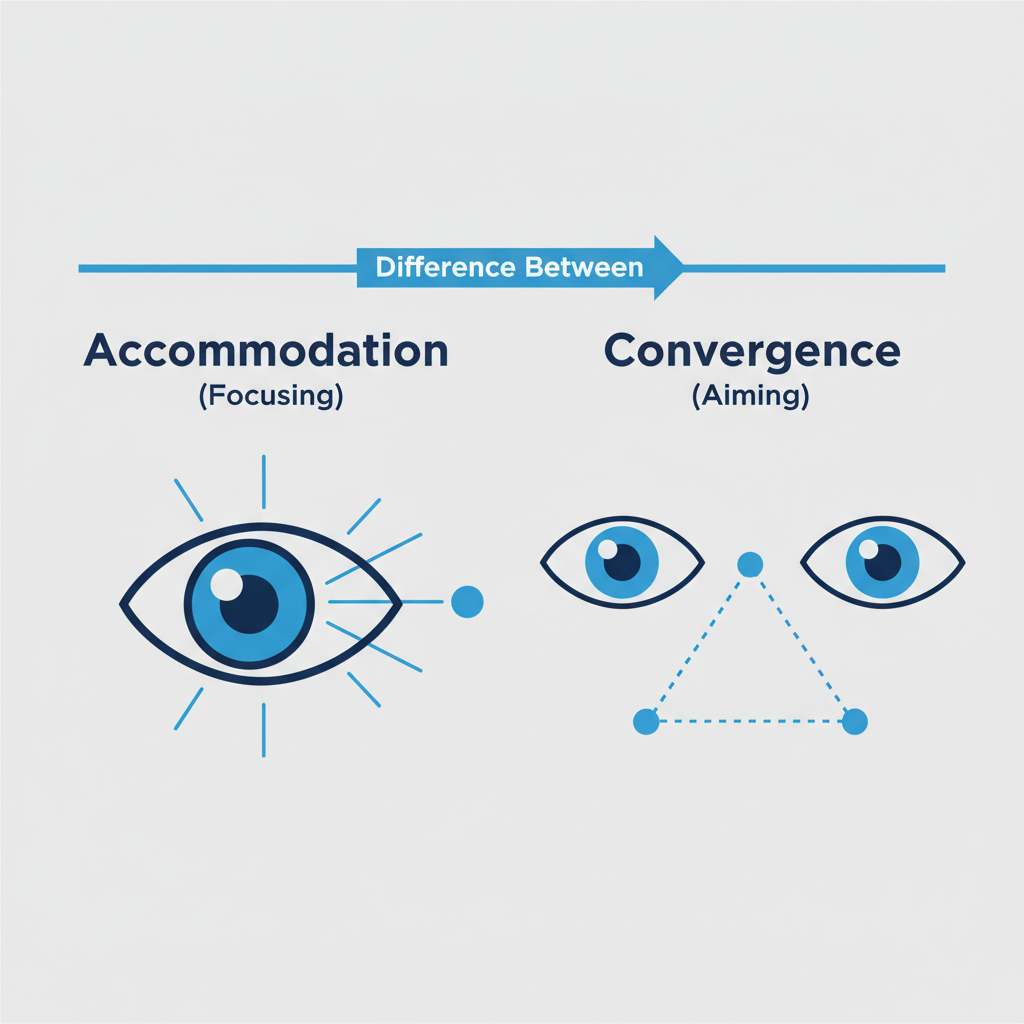
1. Accommodation (The Focus System)
Inside each eye is a flexible lens. When you look at something, tiny muscles change the shape of this lens to bring the object into sharp focus. This is called accommodation. Your brain knows that to see a nearby object clearly, it needs to engage these muscles.
2. Convergence (The Aiming System)
Because your eyes are set a few inches apart, they each see a slightly different image. To create a single, unified picture, both eyes must pivot inward to aim at the same point. This inward turning is called convergence. The closer the object, the more your eyes have to converge. Your brain calculates depth based on the angle of this convergence.
In the natural world, these two systems are perfectly linked. For your entire life, your brain has learned that when it converges your eyes by a certain amount, it must accommodate your lenses by a corresponding amount. This link is a fundamental, hard-wired reflex.
The 3D Movie Illusion: A Deliberate Deception
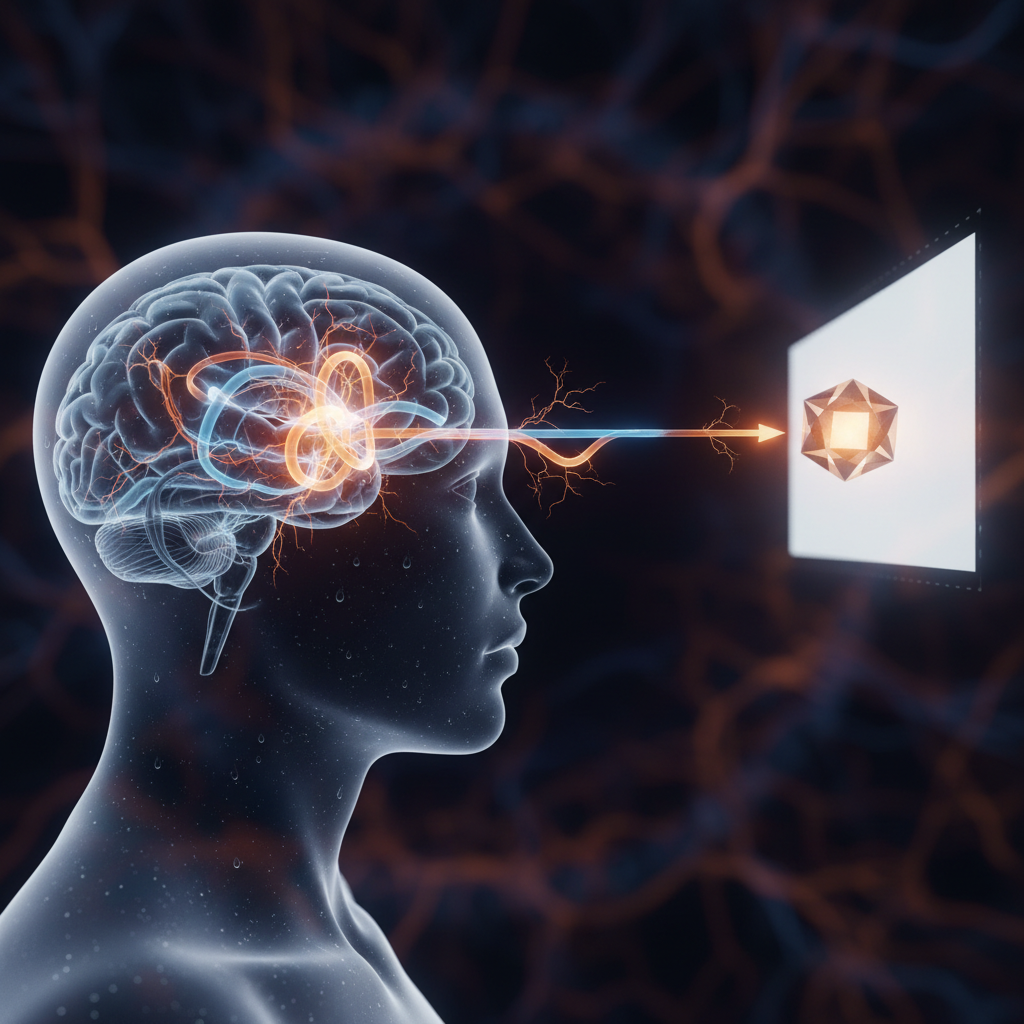
A 3D movie works by deliberately breaking that link. The technology, typically using polarized glasses, sends a slightly different image to each of your eyes, mimicking natural binocular vision. This tricks your convergence system. If an alien spaceship is meant to look like it's hovering in the middle of the theater, the images sent to your eyes are manipulated to force them to converge at that point in space.
Herein lies the conflict.
Your convergence system is aiming at a spaceship ten feet away. But your accommodation system knows perfectly well that the light is coming from a flat, physical screen fifty feet away.
- Accommodation says: "Focus at 50 feet!"
- Convergence says: "Aim at 10 feet!"
This battle between accommodation and convergence is the root cause of 3D-induced eye strain, fatigue, and headaches. Your brain is trying to resolve an impossible paradox, and the muscles in and around your eyes are paying the price for this constant, unnatural effort. As noted in a review of 3D display discomfort, this sensory disagreement is a primary source of viewer fatigue and nausea, affecting a significant portion of the audience.
Who Is Most Likely to Feel Dizzy? The Hidden Culprits
If everyone experiences this conflict, why do some people leave the theater feeling fine while others feel sick? The answer is that a 3D movie acts as a stress test for your binocular vision system. Those who experience the most discomfort often have a subtle, underlying weakness that goes unnoticed in daily life.
Convergence Insufficiency (CI)
This is the most common form of Binocular Vision Dysfunction. It means the eyes have trouble turning inward together to focus on a near object. Someone with CI might read for 20 minutes before the words start to "swim" or they get a headache. The sustained convergence demanded by a 3D film can exhaust their visual system in minutes. Research has shown that structured, office-based vision therapy can be three times more effective than placebo treatments for improving symptoms of CI.
Vertical Heterophoria (VH)
This is a subtle vertical misalignment of the eyes. Your brain works constantly to fuse the two slightly offset images, and this effort can lead to a host of symptoms, including dizziness, anxiety, and neck pain. A study presented at the Psych Congress found that over half of patients seeking treatment for anxiety and depression screened positive for BVD, with VH being a common culprit. The disorienting visual field of a 3D movie can easily overwhelm the brain's ability to compensate for this misalignment.
Poor Vergence Flexibility
Seeing in 3D isn't just about aiming at one spot; it's about smoothly and quickly shifting your focus and convergence from near to far and back again. A 3D movie with rapid depth changes requires your eyes to be agile. People with poor vergence facility struggle with these quick shifts, leading to a feeling of being visually "stuck" or disoriented.
How to Enjoy 3D Movies Without the Discomfort
If you're sensitive to 3D effects, you're not doomed to a 2D-only existence. You can mitigate the strain with a few practical strategies.
- Sit in the Sweet Spot: Choose a seat in the middle of the row, and a bit further back from the screen. This reduces the extremity of the convergence angles your eyes have to manage and minimizes overwhelming peripheral motion.
- Follow the 20-20-20 Rule: Every 20 minutes, pause and look at something 20 feet away for at least 20 seconds. If possible, take your 3D glasses off during this break. This allows your accommodation-convergence link to briefly reset to normal.
- Let Your Head Do the Work: When adapting to new glasses, especially progressives, the advice is to "point your nose at what you want to see." The same applies here. Instead of just darting your eyes around the screen, turn your head to follow the action. This helps keep the most important visual information in the clearest part of your field of view.
- Know When to Stop: If you start to feel significant strain or nausea, don't try to power through it. Take the glasses off for an extended period. Pushing your visual system past its limit will only result in a longer-lasting headache after the movie.
When Dizziness Is More Than Just a Movie Problem
If you consistently find 3D movies, VR headsets, or even just reading for long periods to be uncomfortable, it may be a sign that an underlying Binocular Vision Dysfunction is affecting your daily life. The symptoms aren't always obvious and are often misdiagnosed.
Common signs of BVD include:
- Headaches or eye strain, especially with computer work or reading.
- Dizziness, lightheadedness, or a feeling of being off-balance.
- Anxiety in visually "busy" environments like grocery stores or crowds.
- Skipping or re-reading lines of text.
- Pain in the neck and shoulders from tilting your head to align your eyes.
If this sounds familiar, it may be worth seeking a functional vision evaluation from an optometrist who specializes in binocular vision. Unlike a standard eye exam that just checks your clarity (20/20), a functional exam assesses how your eyes work together as a team. Treatments like prism lenses, which help align what the two eyes see, or vision therapy, which is like physical therapy for the brain-eye connection, can provide significant relief.
Frequently Asked Questions
Q: Can 3D movies cause permanent eye damage? A: No. According to the American Academy of Ophthalmology, watching 3D movies will not damage your eyes. The discomfort is caused by functional strain on the eye muscles and brain, not by any physical harm to the structures of the eye itself.
Q: Why don't I get dizzy playing 3D video games on a console or PC? A: While the principle is similar, the viewing conditions are different. The screen is typically smaller and at a more consistent distance. Furthermore, you are in control of the "camera" movement, which reduces the visual-vestibular mismatch that causes motion sickness. However, virtual reality (VR) headsets can, and often do, produce the same symptoms as 3D movies for the same reasons.
Q: I just got new progressive lenses and feel dizzy. Is this the same problem? A: It's a very similar mechanism. New progressive lenses can cause a "swim effect" due to peripheral distortions, creating a conflict between what your eyes see and what your inner ear senses. This visual-vestibular mismatch can feel just like 3D-induced dizziness. For more information, you can read our guide on Switching from Single Vision to Progressives: Why the Peripheral Blur Is Normal.
Q: Are children more vulnerable to 3D dizziness? A: Children's visual systems are highly adaptable, so many are not bothered. However, a strong, consistent aversion to 3D movies in a child can be a sign of an underlying binocular vision problem like convergence insufficiency. Because these issues can impact reading and learning, it's worth mentioning to an eye doctor.
Disclaimer: This article is for informational purposes only and does not constitute professional medical advice. If you are experiencing persistent dizziness, headaches, or vision problems, please consult with a qualified optometrist or medical professional for a comprehensive evaluation.
References
- 3D Display Discomfort and Nausea. (2021). Wikipedia. Available at: https://en.wikipedia.org/wiki/Health_effects_of_3D
- Convergence Insufficiency Treatment Trial Study Group. (2008). Randomized clinical trial of treatments for symptomatic convergence insufficiency in children. Archives of Ophthalmology, 126(10), 1336–1349. Available at: https://pmc.ncbi.nlm.nih.gov/articles/PMC2789454/
- Feinberg, D., et al. (2023). The Overlap of Binocular Visual Dysfunction and TBI with Anxiety and Depression. Psych Congress. Available at: https://nvminstitute.org/wp-content/uploads/2023/08/Psych-Congress-BVD-Poster.pdf
- American Academy of Ophthalmology. (2010). Are 3D Movies a Health Risk? AAO.org. Available at: https://www.aao.org/eye-health/news/are-3d-movies-health-risk