


Stress-Induced Vision Loss: How Anxiety Affects Your Eyesight
TL;DR: How Stress Impacts Your Vision
High levels of stress and anxiety can directly cause temporary but disruptive vision problems. This isn't a permanent change to your eye's structure, but a functional issue where your brain and eye muscles react to psychological pressure. Common symptoms include fluctuating blurry vision, eye strain, light sensitivity, and even brief double vision. The solution often involves a combination of minor prescription adjustments, targeted eye exercises, and, most importantly, stress management techniques.

How Your Mind Physically Alters Your Sight
Have you ever felt your heart race or your palms sweat before a big presentation? That's your sympathetic nervous system kicking into its "fight-or-flight" mode. This same ancient survival mechanism, triggered by modern stressors like deadlines and personal anxiety, can have profound effects on your eyes.
When your body perceives a threat, it releases hormones like adrenaline and cortisol. This cascade prepares you to either confront or flee danger, and your eyes are a critical part of that response. While helpful for spotting a predator in the wild, this response is less suited for navigating a crowded inbox.
Here’s how it breaks down:
- Pupil Dilation: Your pupils widen to let in more light, enhancing your awareness of your surroundings. In an office or brightly lit environment, this can lead to uncomfortable light sensitivity (photophobia) and glare.
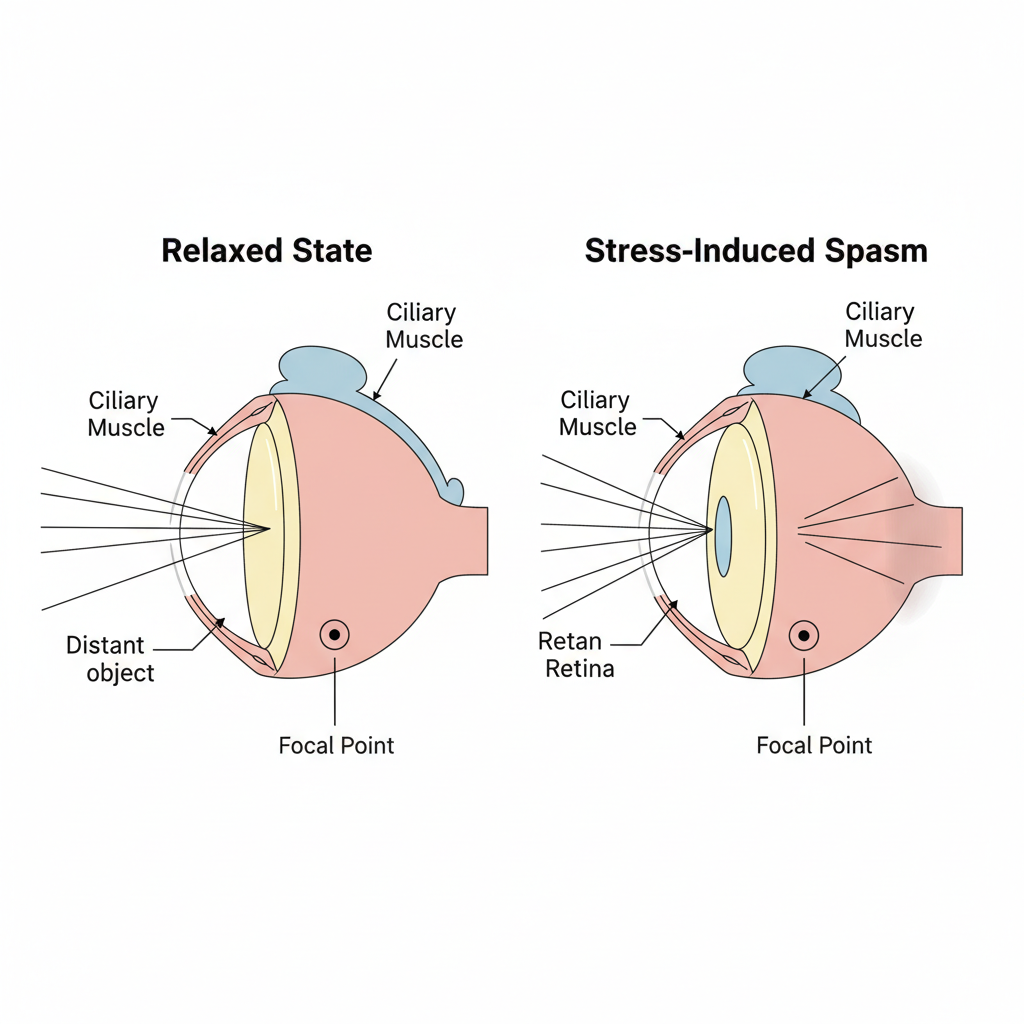
- Ciliary Muscle Spasm: This is the most common cause of stress-induced blurriness. The ciliary muscle inside your eye is responsible for changing the shape of your lens to focus on objects at different distances. When you're stressed, this muscle can tense up and get "stuck," a condition known as an accommodative spasm or "pseudomyopia." Your eyes become locked in a near-focus state, making distant objects appear blurry. It’s the physiological equivalent of a muscle cramp in your eye's focusing system.
- Exacerbated Binocular Stress: Most people have a very small, manageable misalignment of their eyes, known as a phoria. Your brain easily compensates for this. However, under stress, your brain's capacity to manage this compensation decreases. This can unmask the underlying phoria, forcing your eye muscles to work overtime to maintain single vision, leading to eye strain, headaches, and sometimes even intermittent double vision.
Is It Stress, or Something More Serious?
Because the symptoms of stress-induced vision problems can overlap with more serious eye conditions, it is absolutely essential to start with a comprehensive eye exam. An optometrist or ophthalmologist can rule out underlying diseases like glaucoma, cataracts, diabetic retinopathy, or neurological issues.
Once serious conditions are ruled out, identifying a stress-related cause often comes down to pattern recognition. A key indicator practitioners look for is variable acuity. If your vision clarity fluctuates significantly during the exam itself, it’s a strong clue. Your vision might test poorly at first, but then improve after you take a few deep breaths and relax.
Expert Insight: Why Standard Tests Can Be Misleading In cases of high stress, automated refraction machines (which provide a baseline for your prescription) can be unreliable. An accommodative spasm can trick the machine into producing a false nearsighted (myopic) reading. An experienced clinician will notice these inconsistencies and perform further testing to find the true, relaxed state of your eyes.
Ask yourself these questions:
- Do your vision problems get worse during periods of high stress, like final exams or a difficult project at work?
- Do your eyes feel better and your vision seem clearer on weekends or during a vacation?
- Do the symptoms come and go, rather than being constant?
If you answered yes, it’s highly likely that stress is a contributing factor.
A Practical Toolkit for Calmer, Clearer Vision
Managing stress-related vision issues requires a two-pronged approach: reducing the strain on your visual system and managing the underlying stress itself. Here are effective strategies that combine optical support with behavioral changes.
Optical Support to Reduce Demand
Even if you have 20/20 vision, certain lenses can provide significant relief by reducing the workload on your focusing muscles.
- Low-Plus "Support" Lenses: For individuals experiencing accommodative spasm, an eye doctor might prescribe a very slight "plus" power (e.g., +0.25 or +0.50) specifically for near work. These lenses do some of the focusing work for you, allowing your ciliary muscle to relax. They are often referred to as "anti-fatigue" or "computer" lenses.
- Binocular Support with Prisms: If stress is exacerbating an underlying eye alignment issue (phoria), a very small amount of prism can be ground into your lenses. As noted in a review of advanced presbyopia correction methods in the Review of Optometry, prisms help redirect light to align with your eyes' natural resting position, dramatically reducing the strain your brain endures to fuse two images into one. This must be prescribed cautiously by a doctor, as incorrect prism can worsen symptoms.
Behavioral Strategies for Immediate Relief
These habits help counteract the physiological effects of stress on your eyes.
- Master the 20-20-20 Rule: This is non-negotiable for anyone who works at a computer. As we've detailed in our guide to the 20-20-20 rule for prescription wearers, setting a timer to look at something 20 feet away for 20 seconds every 20 minutes is the most effective way to force your ciliary muscle to relax.
- Practice Conscious Blinking: When you stare at a screen, your blink rate can drop by more than half, from a normal 15 times a minute to just 5-7, according to the American Academy of Ophthalmology. This causes dry, irritated eyes. Set a reminder to blink fully and deliberately every few minutes. A full blink means your top and bottom eyelids actually touch.
-
Use Diaphragmatic Breathing: This technique directly activates your parasympathetic nervous system, the "rest and digest" counterpart to your "fight-or-flight" response. It can help break the cycle of stress that leads to muscle tension.
- Sit or lie down comfortably.
- Place one hand on your chest and the other on your belly.
- Inhale slowly through your nose for four counts, feeling your belly rise while your chest stays relatively still.
- Hold your breath for two counts.
- Exhale slowly through your mouth for six counts, feeling your belly fall.
- Repeat for 2-5 minutes.
Frequently Asked Questions (FAQ)
Can stress and anxiety cause permanent vision loss?
For the vast majority of people, stress-induced vision problems are temporary and functional. They do not cause permanent damage to the eye's structure. However, chronic stress is a risk factor for other health issues that can affect your eyes. More importantly, you should never assume your symptoms are "just stress." A professional diagnosis is essential to rule out conditions that can lead to permanent vision loss.
How long does it take for stress-related vision problems to go away?
This depends entirely on managing the root cause: the stress. Some people find relief within days of implementing relaxation techniques and using support lenses. For others, if the stress is chronic, the symptoms may persist until the larger life stressors are addressed.
Are over-the-counter (OTC) reading glasses a good fix?
They are generally not the ideal solution. OTC readers offer the same power in both eyes and do not correct for astigmatism. According to the Cleveland Clinic, this can lead to more eye strain. For stress-induced blur, the required power is often very specific and low, and a customized prescription from a doctor is far more effective.
Your Path to Calmer, Clearer Vision
The connection between your mind and your eyesight is undeniable. Recognizing that the blurriness and strain you feel may be your body's response to pressure is the first step toward finding relief. By working with an eye care professional to rule out disease and explore supportive lenses, and by integrating mindful habits into your daily routine, you can effectively manage these symptoms.
Listen to what your eyes are telling you. They are often a window not just to the world, but to your own well-being.
Disclaimer: This article is for informational purposes only and does not constitute professional medical advice. Always consult with a qualified healthcare provider or optometrist for any health concerns or before making any decisions related to your vision or treatment.
References
- Review of Optometry. (n.d.). A Closer Look at Presbyopia Correction. Retrieved from https://www.reviewofoptometry.com/article/a-closer-look-at-presbyopia-correction
- American Academy of Ophthalmology. (n.d.). Computers, Digital Devices and Eye Strain. Retrieved from https://www.aao.org/eye-health/tips-prevention/computer-usage
- Cleveland Clinic. (2022, December 19). Are ‘Cheaters’ as Good as Prescription Reading Glasses? Retrieved from https://health.clevelandclinic.org/are-drugstore-cheaters-as-good-as-prescription-reading-glasses