


PRK Recovery Timeline: Why Vision Fluctuates During Healing.
Your Day-by-Day Guide to PRK Healing
Photorefractive Keratectomy (PRK) is a highly effective laser vision correction procedure, but its recovery journey is distinctly different from other surgeries like LASIK. While LASIK involves creating a corneal flap, PRK works by gently removing the cornea's outer layer (the epithelium) to reshape the tissue underneath. This "no-flap" approach has long-term stability benefits but requires a longer, more dynamic healing period as the epithelium regrows.
This guide provides a detailed, reassuring timeline for your PRK recovery. We will explain exactly why your vision will fluctuate, what to expect at each stage, and how to ensure the best possible outcome. Understanding the "why" behind the healing process is the most powerful tool to reduce anxiety and trust the journey.
TL;DR: Key PRK Recovery Milestones
- Days 1-4: Discomfort, light sensitivity, and very blurry vision. A protective bandage contact lens is in place while the surface epithelium regrows.
- Weeks 1-2: Bandage lens is removed. Vision is functional but blurry and inconsistent. You can likely resume most daily activities.
- Weeks 2-6: The "Vision Rollercoaster." Expect significant daily fluctuations from blurry to clear as the deeper corneal layers (stroma) remodel. This is the most psychologically challenging but completely normal phase.
- Months 2-3: Vision becomes more stable and consistently clearer. Fine-tuning of focus occurs. Most patients can drive comfortably and read smaller text.
- Months 3-12: Final stabilization. The cornea completes its healing, and your final, stable prescription is achieved. Any residual haze resolves.
The First Week: Rebuilding the Surface
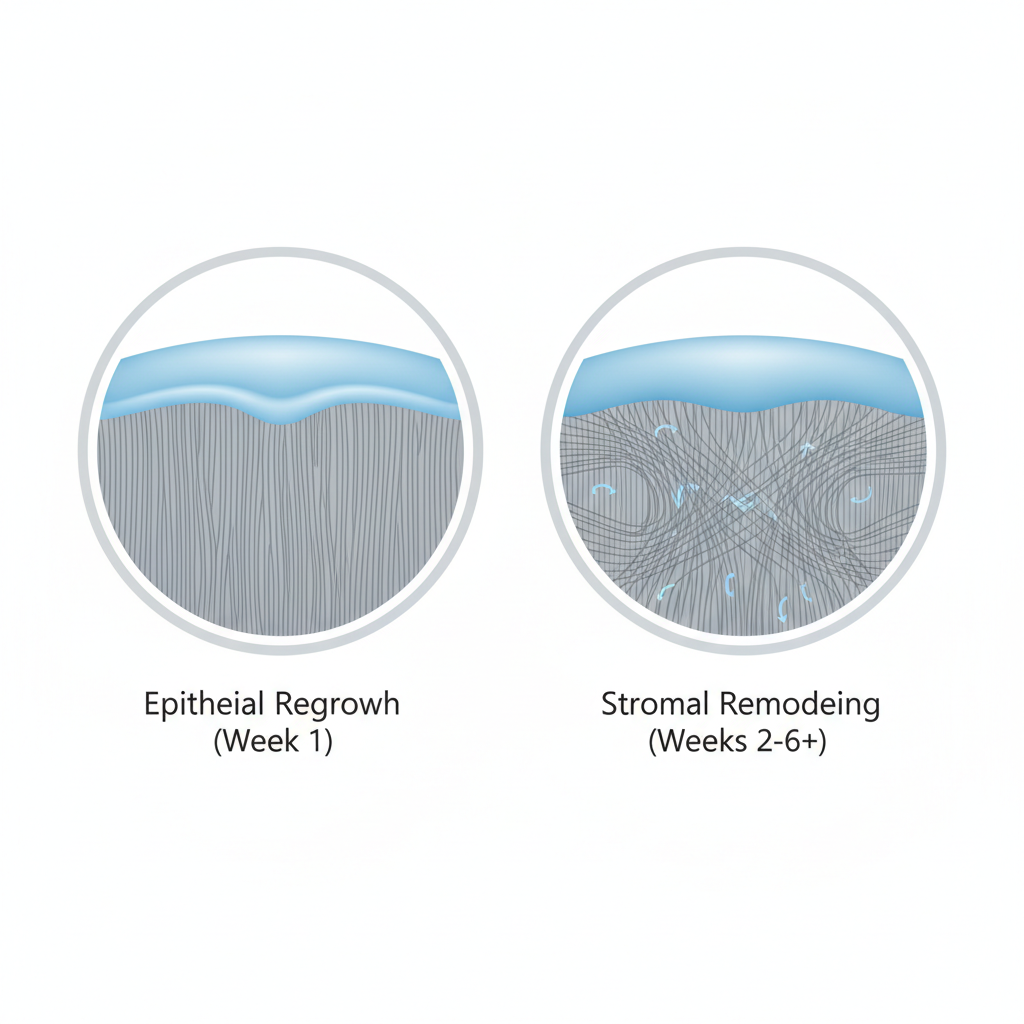
The initial days after PRK are focused on one critical task: regenerating the epithelial layer. Think of it as a sophisticated, living bandage that needs to heal smoothly over the newly shaped cornea.
Immediately after your procedure, your surgeon will place a clear, non-prescription bandage contact lens on your eye. This lens is not for vision; its purpose is to protect the sensitive tissue underneath from your eyelid’s blinking and to create a clean environment for the new epithelial cells to grow across the corneal surface.
During these first 3-5 days, expect:
- Discomfort: It is normal to experience sensations ranging from grittiness and burning to moderate pain. Your doctor will provide medicated eye drops and may recommend pain relievers to manage this.
- Significant Light Sensitivity (Photophobia): The world will seem overwhelmingly bright. Wearing high-quality sunglasses, even indoors, is essential.
- Watery Eyes & Blurry Vision: Your vision will be very blurry, similar to looking through a foggy window. This is due to the uneven healing surface and the bandage lens itself.
Your primary job during this week is to rest your eyes and diligently use your prescribed antibiotic and steroid eye drops. These drops prevent infection and control the initial inflammatory response, setting the stage for successful healing. Around day 4 or 5, you will visit your doctor to have the bandage contact lens removed, marking the end of the first phase.
Weeks 2 to 6: The Vision Rollercoaster Explained
This is the phase that most challenges a patient's confidence, and understanding the biology behind it is key. Once the surface epithelium has covered the cornea (after about a week), the deeper healing begins. This involves the reorganization of collagen fibers within the corneal stroma—the very tissue the laser reshaped. This process is called stromal remodeling.
Imagine the stromal layer as a dense, microscopic forest. The laser has selectively cleared paths through it, and now the surrounding structure is slowly settling into its new, permanent shape. This settling is not a linear process. It involves cellular migration, changes in tissue hydration, and the synthesis of new collagen. The result? Your vision can change dramatically from one day to the next, or even from morning to evening.
It’s common for a patient to wake up with 20/25 vision one day and be 20/60 the next. This fluctuation is not a sign of failure; it is the hallmark of normal PRK healing. A practical heuristic many surgeons use is to expect about one week of significant fluctuation for every diopter of correction. So, a patient with a -5.00 D prescription should anticipate a longer period of variability than someone with a -2.00 D prescription.
The Critical Role of Steroid Drops & Haze
During this phase, your use of steroid eye drops is non-negotiable. The body’s natural healing response can sometimes be too aggressive, leading to the formation of corneal haze, a fine, cloudy scarring that can blur vision. Steroid drops work by modulating this inflammatory response, ensuring the cornea heals transparently.
Skipping steroid doses, especially during the second month, is one of the most common causes of significant or prolonged haze. Adhering strictly to your doctor’s prescribed tapering schedule is crucial for achieving a crystal-clear outcome.
Months 2 to 6: Finding Stability
As you move into the second and third months, the dramatic swings in vision begin to subside. The stromal remodeling process matures, and your vision becomes more stable and predictable. You will notice more "good vision days" than "bad vision days."
- Higher Corrections: Patients with higher levels of myopia (e.g., -6.00 D or more) should be aware that their journey to clear, stable vision may take longer. It’s not uncommon for final clarity to emerge closer to the 3-month mark.
- Functional Vision: By the end of this period, most patients have excellent functional vision. Driving, especially at night, becomes more comfortable as glare and halos diminish. Reading fine print and performing detailed tasks will feel more consistent.
Throughout this stage, you must continue to protect your eyes. UV light can trigger inflammation and increase the risk of corneal haze. Wearing sunglasses that block 100% of UVA and UVB rays any time you are outdoors is not optional—it is a critical part of your post-operative care. According to the American Optometric Association, proper UV-blocking lenses are essential for safeguarding eye health, a fact that is doubly true for a healing cornea.

6 to 12 Months: The Final Polish
The final six months of your first year post-PRK are about achieving your ultimate visual potential. The corneal tissue completes its healing and becomes fully stable. Any minor residual haze typically resolves completely during this time.
By the end of one year, your prescription is considered permanent. While your eyes will continue to undergo normal age-related changes (like presbyopia), the correction from the PRK procedure is stable. This long-term stability is one of the primary advantages of surface ablation procedures like PRK.
Frequently Asked Questions (FAQ)
Q: Why was my vision sharper yesterday than it is today?
A: This is the classic PRK "rollercoaster" and is caused by stromal remodeling. As the deeper corneal layers heal, microscopic shifts in cells and fluid cause daily fluctuations in vision. This is a normal and expected part of the process, especially in the first 2-6 weeks.
Q: Is it normal for one eye to heal faster than the other?
A: Yes, it is very common for one eye to be slightly ahead of the other in the healing curve. Each eye is a unique biological system. As long as you are following your drop schedule for both eyes, this asymmetry is typically not a cause for concern and usually evens out over time.
Q: When can I safely drive?
A: This varies significantly. While some patients meet the legal driving standard within a week or two, it is unsafe to drive as long as your vision is fluctuating significantly. For many, comfortable and safe driving, particularly at night, is more realistic around the 4 to 6-week mark. Always consult with your doctor at your follow-up appointments.
Q: Why are my steroid drops so important?
A: Steroid drops control inflammation to prevent corneal haze. Haze is a cloudiness that can develop as a result of an overactive healing response and can limit your final visual acuity. Following your prescribed tapering schedule precisely is the single most important thing you can do to prevent this complication.
Q: How soon can I use my computer and smartphone?
A: You can use digital devices as soon as you feel comfortable, but expect difficulty and strain in the first few weeks. Your ability to focus on near tasks will fluctuate. Use lubricating drops frequently, take many breaks using the 20-20-20 rule, and be patient with yourself.
Disclaimer: This article is for informational purposes only and does not constitute professional medical advice. The PRK recovery process can vary based on individual factors and the specifics of your surgery. Always follow the guidance and instructions provided by your ophthalmologist and surgical team. If you experience severe pain, a sudden decrease in vision, or signs of infection, contact your doctor immediately.
References
- American Optometric Association. (n.d.). UV Protection. AOA.org. Retrieved from https://www.aoa.org/healthy-eyes/caring-for-your-eyes/uv-protection
- U.S. Food and Drug Administration. (2022). What are the risks and how can I find the right doctor for me? FDA.gov. Retrieved from https://www.fda.gov/medical-devices/lasik/what-are-risks-and-how-can-i-find-right-doctor-me
- National Eye Institute. (2023). Facts About the Cornea and Corneal Disease. NEI.NIH.gov. Retrieved from https://www.nei.nih.gov/learn-about-eye-health/eye-conditions-and-diseases/cornea-disease-and-injury