



Choosing Between Polarized and Anti-Reflective Lens Coatings
TL;DR: Polarized vs. Anti-Reflective Coatings
Polarized Lenses: These are specialized sunglasses designed to cut intense, horizontal glare from surfaces like water and pavement. They are ideal for daytime outdoor activities but can cause issues with viewing digital screens.
Anti-Reflective (AR) Coating: This is a transparent coating applied to regular lenses to reduce reflections from all angles. It is essential for improving clarity during night driving, computer use, and is considered a necessity for post-operative patients.
For Surgical Recovery: An anti-reflective coating is non-negotiable. It minimizes visual disturbances like halos and starbursts that are common after cataract or LASIK surgery. Polarized lenses are typically not recommended during the initial healing phase.
The Verdict: Your choice depends on your lifestyle. AR coating is a versatile, everyday solution for most people, while polarized lenses are a high-performance tool for specific outdoor situations.
When you get a new pair of glasses, the prescription is just the starting point. The lens coatings you choose are what truly adapt your eyewear to your life, enhancing comfort, clarity, and safety. Two of the most important and frequently confused options are polarized lenses and anti-reflective (AR) coatings.
While both manage light, they solve different problems. Understanding this difference is crucial for everyone, but it becomes a critical health decision for individuals recovering from eye surgery like LASIK or cataract removal. This guide will break down the science, benefits, and drawbacks of each, helping you make the best choice for your visual needs.
The Clarity Enhancer: Understanding Anti-Reflective (AR) Coatings
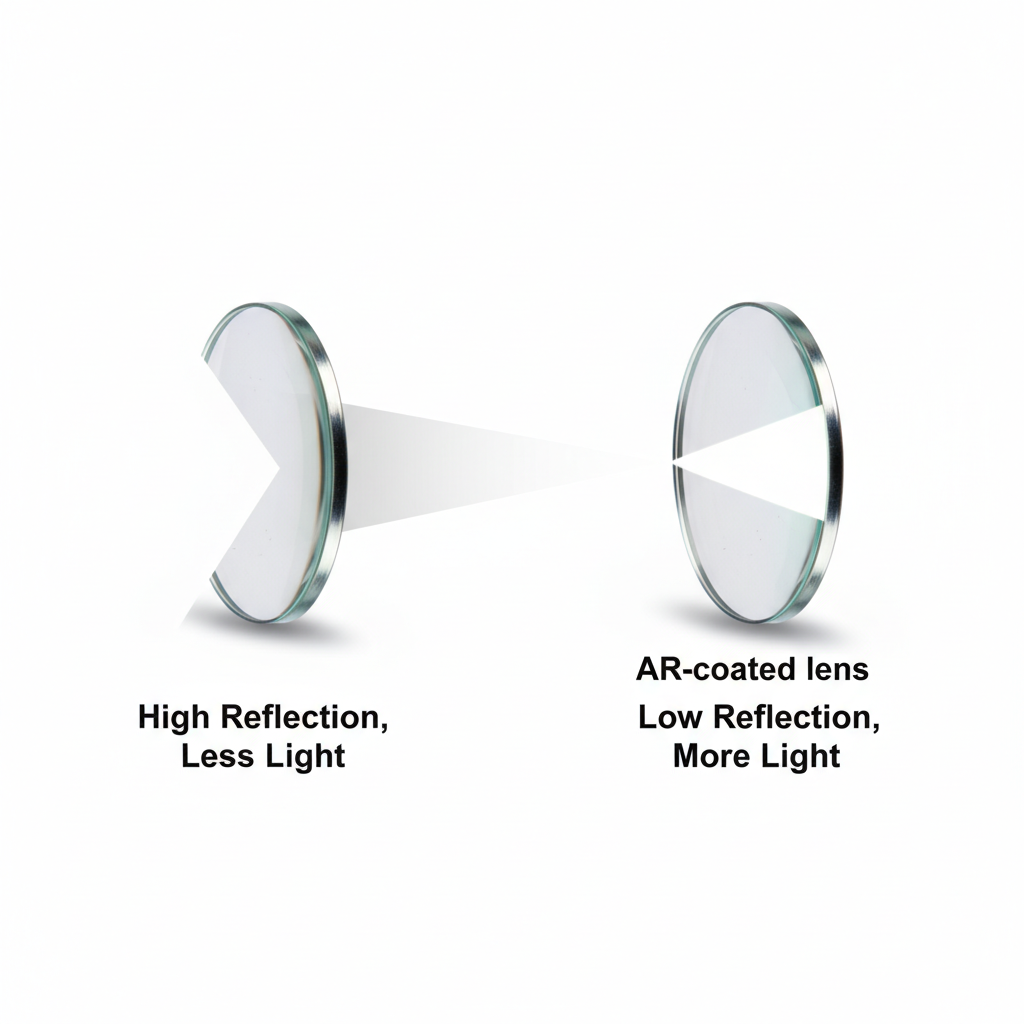
An anti-reflective coating is a microscopically thin, multi-layer treatment applied to the surface of eyeglass lenses. Its primary job is to reduce the amount of light that reflects off the front and back of your lenses. By minimizing these reflections, high-quality AR coatings allow up to 99.5% of available light to pass through the lens and reach your eye, resulting in clearer, sharper vision.
Think of it as the difference between a standard window and the invisible-looking glass at a museum. The AR coating removes distracting reflections that can interfere with your vision, especially in challenging lighting conditions.
Why AR Coatings Are Essential for Post-Operative Recovery
For anyone who has recently undergone cataract or LASIK surgery, an AR coating is not just a feature—it's a clinical necessity. Here’s why:
Reduces Symptom Discomfort: After refractive surgery, patients are often more sensitive to light and visual disturbances. Studies of post-LASIK outcomes, such as the one by Bailey & Zadnik, have noted that a significant percentage of patients report new symptoms like halos (17.5%) and glare (19.7%) in the months following the procedure. An AR coating directly combats these issues by minimizing the internal lens reflections that cause such visual artifacts, leading to a more comfortable and less stressful healing process.
Improves Visual Quality: The goal of surgery is to achieve the clearest vision possible. Lingering reflections from the surface of your new glasses can compromise that outcome, creating "visual noise" that detracts from your newfound clarity. An AR coating ensures the view through your lenses is as crisp and transparent as possible.
Expert Insight: Immediately after surgery, the eye's visual system is in a sensitive adaptation period. An AR coating is considered a non-negotiable standard of care because it provides the cleanest possible visual slate, free from the distracting reflections that can exacerbate common post-op symptoms like glare and halos.
Key Use Cases for AR Coatings
Night Driving: AR coatings are a game-changer for nighttime visibility. They significantly reduce the starbursts and halos from oncoming headlights and streetlights, allowing you to see the road more clearly and react faster.
Computer Use and Office Work: In an office environment, you're surrounded by reflective sources—your monitor, overhead fluorescent lights, and windows. AR coatings cut down on the resulting eye strain and visual fatigue, making long hours in front of a screen more comfortable.
Aesthetic Appearance: By eliminating reflections on your lenses, AR coatings make them look nearly invisible. This allows people to see your eyes more clearly and improves your appearance in photos and on video calls.
It's important to note that the durability of these coatings can vary. Premium AR coatings are bonded to the lens and include extra hydrophobic and oleophobic layers that repel water and oil, making them easier to clean and far more scratch-resistant than basic versions.
The Glare Eliminator: Understanding Polarized Lenses
Polarized lenses are different from AR coatings. They are not a coating but rather a specialized filter built into the lens itself. This filter contains a chemical laminate with molecules aligned vertically, acting like a set of microscopic venetian blinds.
This structure blocks the intense, horizontally-oriented light that reflects off flat surfaces. This phenomenon is known as glare. While a standard tinted lens just makes everything darker, a polarized lens selectively eliminates the blinding glare itself, dramatically increasing visual comfort and clarity in bright, sunny conditions.

Why Polarized Lenses Are Contraindicated for Initial Post-Op Use
While excellent for sunny days, polarized lenses are generally not recommended immediately following eye surgery. By dramatically altering the light entering the eye and eliminating certain visual information (horizontal waves), they can interfere with the brain's delicate neuro-adaptation process. During this critical healing phase, the visual system needs stable, predictable input. The altered contrast and depth perception from polarized lenses can feel disorienting.
Safety Note: This is why eye care professionals typically advise patients to use high-quality, UV-blocking, non-polarized sunglasses (ideally with an AR coating) in the weeks following a procedure. The priority is protection and stabilization, not aggressive glare reduction.
The Downsides and "Gotchas" of Polarization
While highly effective for glare, polarization has functional drawbacks, particularly in our modern digital world.
Screen Blackouts: As noted by experts at Harvard Health, polarized filters can block the light emitted from many LCD and LED screens. This can make your smartphone, tablet, or even the gas pump display appear dark or completely black. For anyone who needs to use digital devices outdoors, this can be a significant problem.
Driving & Aviation Hazards: This screen-blocking effect extends to the cockpit and the car. The Federal Aviation Administration (FAA) explicitly advises pilots against wearing polarized lenses because they can obscure modern digital flight instruments. Similarly, they can interfere with head-up displays (HUDs) and some infotainment screens in cars.
Polarization is Not UV Protection: It is a common and dangerous misconception that polarization is the same as UV protection. As research has shown, they are entirely separate features. Cheap, unregulated sunglasses can be polarized to reduce glare but may offer little to no UV protection. This is worse than wearing no sunglasses at all, as the darker tint causes your pupils to dilate, allowing more harmful UV radiation to enter the eye, as highlighted by experts at the MD Anderson Cancer Center.
Head-to-Head: Polarized vs. AR in Real-World Scenarios
To make the choice clearer, let's compare how each lens performs in specific situations.
| Scenario | Polarized Lenses | Anti-Reflective (AR) Coating | Winner & Recommendation |
|---|---|---|---|
| Post-Operative Recovery | Contraindicated. Can interfere with healing and adaptation. | Essential. Reduces halos and glare for a comfortable recovery. | Anti-Reflective |
| Night Driving | Dangerous. Reduces overall light, making it harder to see. | Essential. Reduces glare from headlights, improving safety. | Anti-Reflective |
| Driving (with HUD/Digital Dash) | Problematic. Can cause screens to appear black or distorted. | Excellent. Reduces dashboard reflections without obscuring screens. | Anti-Reflective |
| Computer & Office Work | Problematic. Obscures screens and offers no benefit indoors. | Excellent. Reduces screen glare and eye strain from overhead lights. | Anti-Reflective |
| Fishing / Boating | Excellent. Cuts through water surface glare, improving vision. | Good. Reduces reflections, but won't cut surface glare. | Polarized |
| Skiing / Snow Sports | Excellent. Dramatically reduces intense glare from snow. | Good. Reduces general reflections but not the blinding glare. | Polarized |
| General Outdoor Use | Very Good. Provides superior comfort in bright, sunny conditions. | Good. Reduces distracting lens reflections for better clarity. | Tie / User Preference |
The Best of Both Worlds: Combining Coatings
You don't always have to choose. For the ultimate in sunglass performance, you can get polarized lenses that also have an anti-reflective coating applied to them. While the polarized filter manages the harsh glare coming from the world around you, the AR coating works on the back surface of the lens.
This backside AR coating is crucial because it prevents light from behind you (for example, the sun over your shoulder) from reflecting off the lens and into your eye. This eliminates distracting "bounce-back" reflections that are a common annoyance with dark sunglasses, providing edge-to-edge clarity.
This combination represents a premium option ideal for those who demand the highest level of performance from their eyewear, especially for driving or spending long hours outdoors.
Final Recommendations
Choosing between polarized and anti-reflective coatings comes down to a simple question: what problem are you trying to solve? Your lifestyle and, most importantly, your clinical needs should guide your decision.
For Post-Operative Patients and Everyday Life: A high-quality anti-reflective coating is the single most important lens feature you can choose. It is the most versatile solution for the modern world, providing clear, comfortable vision from the office to the driver's seat at night. For those recovering from surgery, it is a mandatory part of ensuring a smooth and comfortable visual recovery.
For Outdoor Specialists: If your life or hobbies involve significant time near water, snow, or open roads in bright sun, a dedicated pair of polarized sunglasses is an invaluable tool. They offer a level of glare reduction and comfort that standard tints cannot match.
Ultimately, the ideal approach is often an "eyewear wardrobe": a primary pair of clear glasses with a premium AR coating for daily life, and a secondary pair of high-quality polarized sunglasses for outdoor adventures. Always consult with your eye care provider to discuss your specific needs and ensure you select the technology that best supports your vision and eye health.
Disclaimer: This article is for informational purposes only and does not constitute professional medical advice. Always consult with a qualified ophthalmologist or optometrist to determine the best course of treatment and eyewear for your specific condition, especially before and after any surgical procedure.
References
Bailey, M. D., & Zadnik, K. (2007). Outcomes of LASIK for myopia with FDA-approved lasers. Cornea, 26(3), 246–254.
Federal Aviation Administration (FAA). (n.d.). Sunglasses for Pilots: Beyond the Image. Retrieved from https://www.faa.gov/pilots/safety/pilotsafetybrochures/media/sunglasses.pdf
Harvard Health Publishing. (2021, October 26). Polarized sunglasses: Protecting your eyes from harmful glare. Retrieved from https://www.health.harvard.edu/staying-healthy/polarized-sunglasses-protecting-your-eyes-from-harmful-glare
MD Anderson Cancer Center. (n.d.). 9 things to know about sunglasses, eye protection and cancer. Retrieved from https://www.mdanderson.org/cancerwise/9-things-to-know-about-sunglasses--eye-protection-and-cancer.h00-159699123.html
Science News Explores. (n.d.). Explainer: Polarized versus UV-blocking sunglasses. Retrieved from https://www.snexplores.org/article/polarized-uv-blocking-sunglasses