

Do Polarized Lenses Help with Night Driving?
The Persistent Myth: Unpacking Polarized Lenses and Night Driving
It’s a question we hear all the time: "I have polarized sunglasses for daytime glare, so they must be good for reducing headlight glare at night, right?" It's a logical assumption, but in the world of optical physics, the answer is a firm and resounding no. While polarized lenses are a game-changer for daytime driving, using them after sunset is not only ineffective but can also be unsafe.
This article tackles this common misconception head-on. We will explore the science behind polarization, explain why it doesn't work on headlight glare, and detail the specific risks of wearing tinted lenses in low-light conditions. More importantly, we’ll guide you toward the correct, science-backed solutions that genuinely improve visual comfort and safety for night driving.
TL;DR: Should You Wear Polarized Lenses for Night Driving?
- No. Do not wear polarized or any tinted lenses for night driving.
- Why? They are designed to reduce the amount of light reaching your eyes, which is dangerous in low-light conditions. They do not effectively filter the type of glare produced by modern headlights.
- What's the solution? The best option is a pair of clear prescription or non-prescription lenses with a high-quality anti-reflective (AR) coating.
What is Polarization and How Does It Fight Glare?
To understand why polarized lenses aren't suited for night driving, we first need to understand what they are designed to do. The technology is brilliant in its simplicity and effectiveness for daytime conditions.
The Science of Polarized Filters
Sunlight is typically unpolarized, meaning its light waves vibrate in all directions. However, when this light hits a flat, reflective surface like a wet road, a body of water, or the hood of a car, it becomes horizontally polarized. This concentrated, horizontal light is what we experience as blinding glare.
As explained by Harvard Health Publishing, polarized lenses feature a special chemical filter that is laminated in a vertical pattern. This pattern acts like a microscopic picket fence, blocking the horizontal light waves (glare) while allowing the useful vertical light waves to pass through. The result is a clearer, more comfortable view with enhanced contrast.
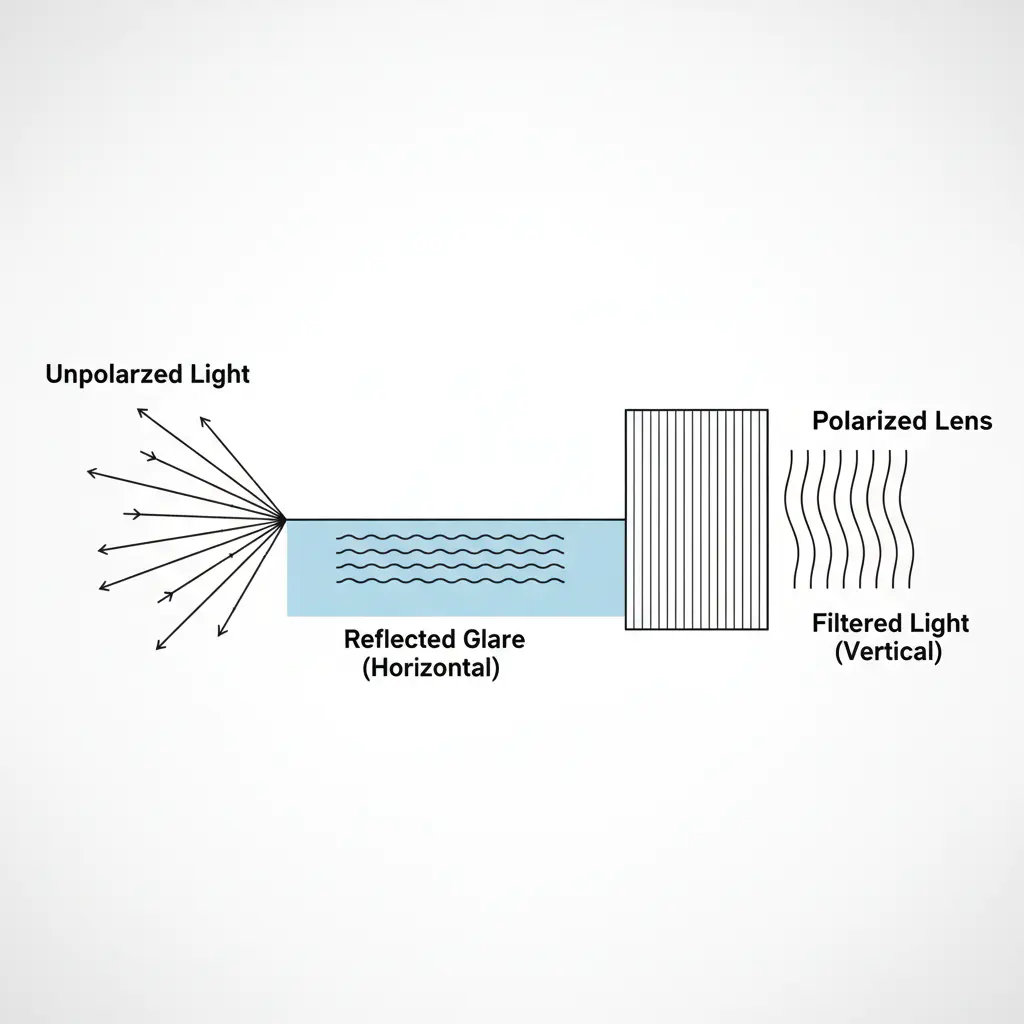
This is incredibly effective for reducing the discomforting glare common during the day, especially in bright, sunny conditions or on wet roads after it rains.
The Critical Difference: Headlights vs. Reflected Sunlight
The key takeaway is that polarization specifically targets horizontally-oriented light. Headlights, streetlights, and traffic signals are different. They are sources of unpolarized light, emitting waves in all directions, much like the sun. A polarized filter does not have a specific orientation of glare to block from these sources. While the tint of the sunglass lens will dim the light, it does so indiscriminately, dimming the entire scene, not just the glare. This is the fundamental reason why the logic of "anti-glare" doesn't translate from day to night.
Three Reasons Why Polarized Lenses Are Unsafe at Night
Using polarized sunglasses after dark introduces several risks that compromise your ability to drive safely. It boils down to reducing necessary light, interfering with modern car technology, and failing to address the actual source of nighttime visual discomfort.
1. Dangerous Reduction in Visible Light
All sunglasses are rated by their Visible Light Transmission (VLT), which is the percentage of light the lenses allow to pass through to your eyes. Typical sunglasses have a VLT between 15-30%. This is excellent for bright daylight but dangerously low for nighttime conditions.
When you are driving at night, your visual system needs as much light as possible to detect hazards, read road signs, and see pedestrians. By wearing any form of tinted lens, you are intentionally starving your eyes of the limited light available, which can delay reaction times and reduce your overall situational awareness. From a safety perspective, you want lenses with a VLT of 85% or higher at night.
2. Interference with Digital Displays
A significant and often overlooked issue is how polarized lenses interact with modern in-car displays. Many dashboard screens, GPS units, and heads-up displays (HUDs) use LCD or OLED technology, which also has a polarizing filter built into it.
When the filter in your glasses is misaligned with the filter on the screen, it can cause the display to appear distorted, dim, or completely blacked out. This is a well-documented phenomenon; the Federal Aviation Administration (FAA) explicitly advises pilots against wearing polarized lenses for this very reason, as it can prevent them from reading critical flight instruments. Losing access to your speedometer or navigation at a critical moment is a serious safety risk.
3. The Myth of Reducing Headlight Glare
As we've established, polarization does not filter the direct, unpolarized light from headlights effectively. The visual discomfort from oncoming traffic is often caused by the sheer intensity of modern LED or HID headlights, as well as internal reflections within your own eyeglasses.
In fact, some wearers report that polarized lenses can increase the "halo" or "starburst" effect around lights at night. The tinted lenses cause your pupils to dilate slightly to let in more light, which can sometimes worsen optical aberrations. The best way to combat this specific type of glare is not by blocking light, but by managing how it passes through your lenses.
The Proven Solution: What Actually Helps with Night Driving?
Forgoing polarized lenses at night doesn't mean you have to endure glare and eye strain. The right solution is to wear glasses that are optimized to transmit as much light as possible while minimizing optical distortions.
The Power of Anti-Reflective (AR) Coating
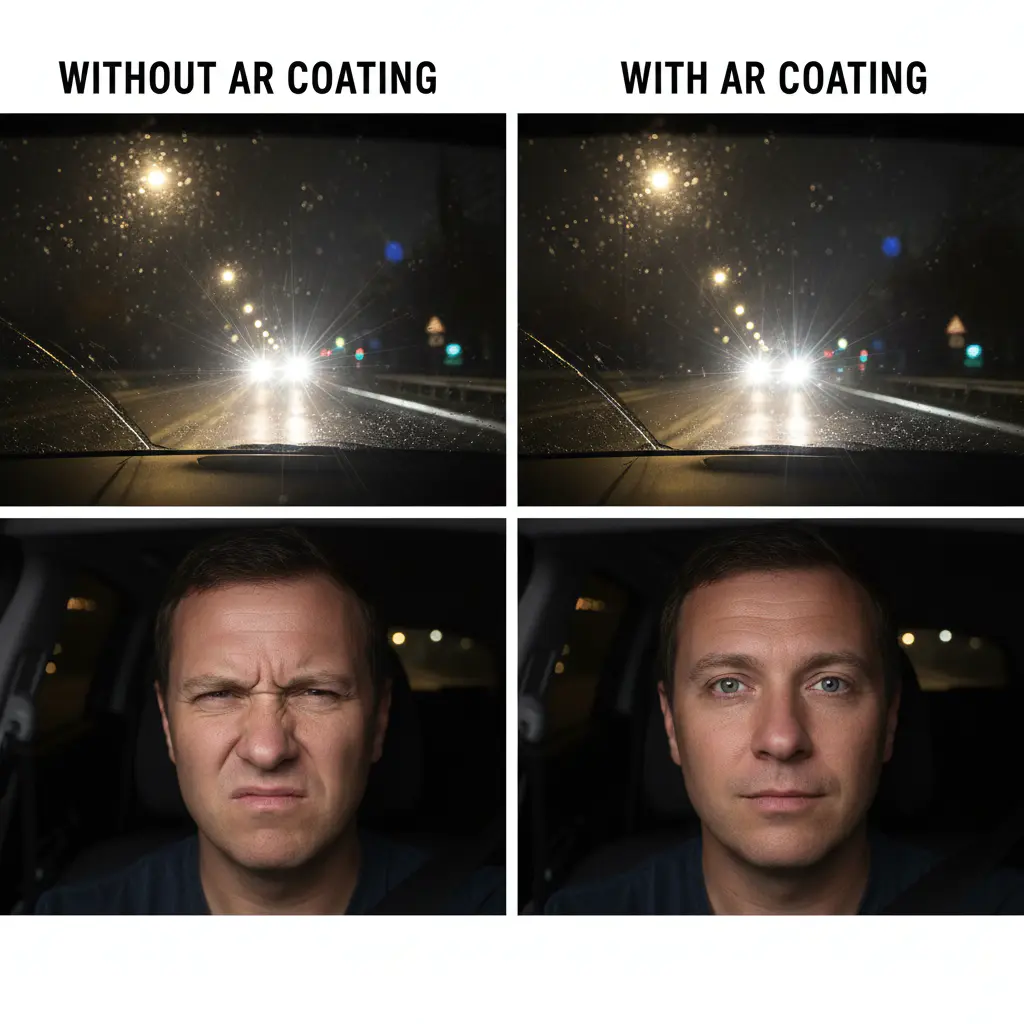
The single most effective feature for night driving glasses is a premium anti-reflective (AR) coating. This is a multi-layer coating applied to both the front and back surfaces of the lens that is engineered to reduce reflections.
Here’s how it helps:
- Reduces Halos and Starbursts: AR coating minimizes the internal reflections that cause the distracting halos and ghost images around headlights and streetlights.
- Increases Light Transmission: By eliminating reflections, AR coatings allow more light to pass through the lens, improving clarity and brightness. A clear lens with a good AR coating can have a VLT of over 99%.
- Improves Visual Acuity: With fewer distracting reflections, your eyes can focus more easily, reducing strain and improving your ability to see fine details on the road.
The Importance of an Accurate Prescription
Visual acuity is paramount at night. Even minor, uncorrected refractive errors like nearsightedness, farsightedness, or astigmatism can become much more pronounced in low-light conditions. These errors can cause light to scatter incorrectly as it enters your eye, which is a primary cause of glare and halos.
Ensuring your prescription is up-to-date is a critical step. For those with stronger prescriptions (typically over ±4.00), it is also vital to have an accurate pupillary distance (PD) and vertex distance measurement to prevent induced prismatic errors that can distort your vision at night.
Your Checklist for Safe Night Driving Eyewear
When choosing glasses for driving after dark, prioritize safety and clarity. This checklist summarizes what to look for and what to avoid.
| Feature | Recommendation | Why It Matters |
|---|---|---|
| Lens Tint | Clear (No Tint) | Maximizes the amount of light reaching your eyes for optimal visibility. Avoid yellow, amber, or any other color. |
| Polarization | No | Ineffective for headlight glare and dangerously reduces light transmission. |
| Coating | Premium Anti-Reflective (AR) | The most important feature. It reduces halos, minimizes reflections, and increases clarity. |
| Prescription | Accurate and Up-to-Date | Corrects refractive errors that are a major source of nighttime glare and blur. |
| Condition | Clean and Scratch-Free | Scratches, smudges, and dirt on your lenses will scatter light and significantly increase glare. |
Wrapping Up: See Clearly and Drive Safely
While polarized lenses are an indispensable tool for combating daytime glare, they are the wrong tool for the job at night. Their light-blocking nature is a liability in the dark, and they don't address the root causes of nighttime visual discomfort.
By understanding the science, you can make an informed choice that enhances your safety. The best approach for comfortable and clear night driving is to use clean, clear lenses—with an accurate prescription if you need one—that feature a high-quality anti-reflective coating. This combination ensures you receive the maximum amount of light, free from distracting reflections, allowing you to focus on what matters most: the road ahead.
Frequently Asked Questions (FAQ)
1. What about yellow-tinted "night driving" glasses? These should be avoided. While some people perceive them as enhancing contrast, they achieve this by filtering out a portion of the visible light spectrum. Any lens that reduces the amount of light reaching your eye at night is a safety concern. The FAA also warns pilots that these lenses can interfere with the ability to recognize color signals correctly, a risk that also applies to traffic lights.
2. Can I wear my polarized sunglasses at dusk? It is not recommended. As ambient light begins to fade, your eyes need to adjust. Wearing tinted lenses during this transitional period can impair your vision more than you realize. It's best to switch to clear glasses as soon as the sun goes down.
3. How can I tell if my glasses have an AR coating? Hold your glasses up to a light source. If you see bright, harsh reflections of the light on the lens surface, they likely do not have an AR coating. If the reflections are very faint and have a slight green or purple hue, they almost certainly have an AR coating.
Disclaimer: This article is for informational purposes only and does not constitute professional medical advice. Always consult with a qualified eye care professional for any questions regarding your vision or to determine the best eyewear solution for your specific needs.