



Eye Exercises for Astigmatism: Managing Strain, Not Curvature
TL;DR: The Straight Answer on Astigmatism Exercises
Eye exercises cannot cure or permanently correct astigmatism. Astigmatism is a structural issue caused by an irregularly shaped cornea or lens, not a problem with eye muscle strength. However, targeted exercises can be highly effective at relieving the eye strain, fatigue, and headaches that often accompany uncorrected or poorly corrected astigmatism. Think of them as physical therapy for your focusing muscles, not a way to reshape the eyeball itself. The definitive solution for clear vision with astigmatism remains correctly prescribed glasses or contact lenses.
Understanding Astigmatism: Why You Can't "Exercise" It Away
Many of us have heard that exercises can strengthen muscles, so it’s natural to wonder if we can strengthen our eyes to see better. While this is true for certain conditions involving eye coordination, it doesn’t apply to refractive errors like astigmatism.
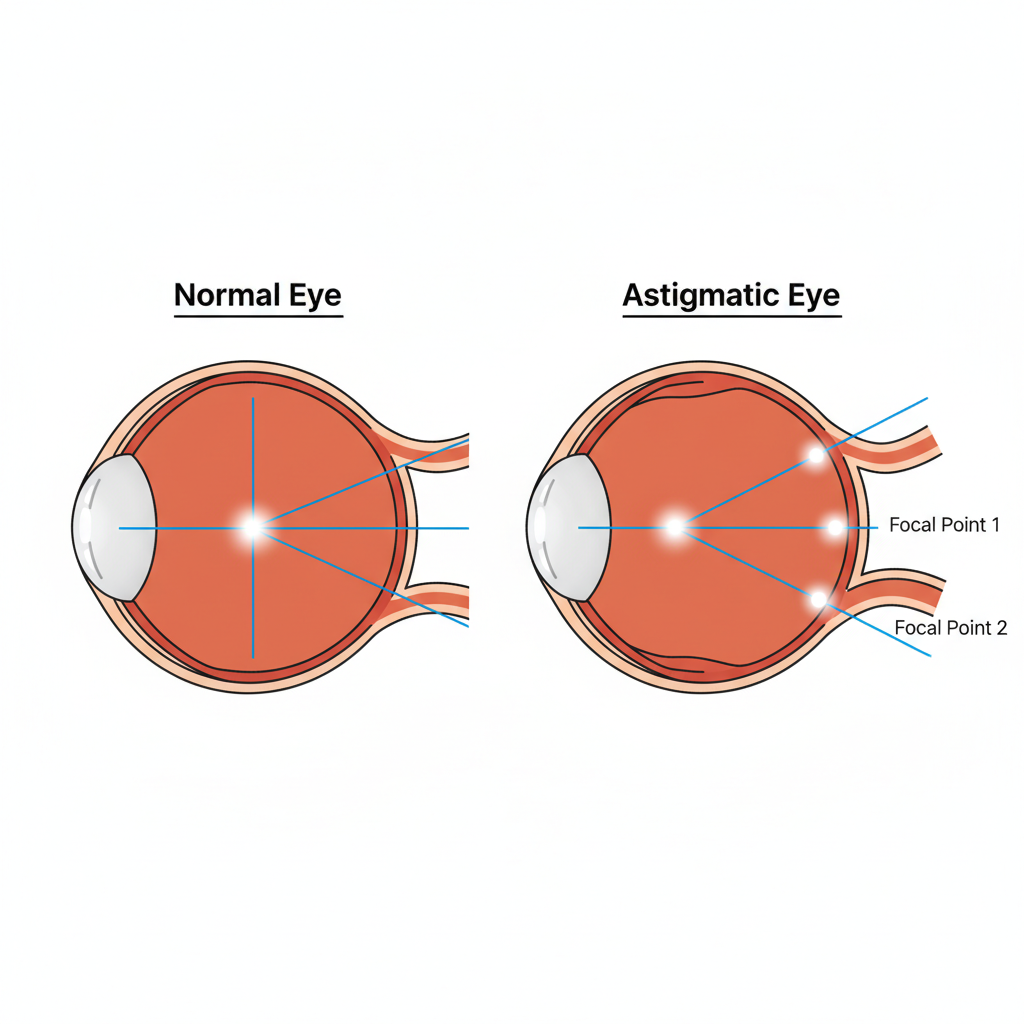
To understand why, we need to look at the eye’s anatomy. A normal cornea has a perfectly round shape, like a basketball. This allows it to bend, or refract, light evenly onto a single focal point on the retina, creating a sharp image.
In an eye with astigmatism, the cornea is shaped more like a football or the back of a spoon. This irregular curve causes light to refract unevenly, creating two separate focal points. Neither of these points lands perfectly on the retina, resulting in vision that is blurry or distorted at all distances.
This is a physical, structural characteristic. No amount of muscle training can change the fundamental shape of your cornea. It’s like trying to fix a dent in a car by revving the engine—the two systems are unrelated. Your prescription reflects this, with specific values for "Cylinder" (the amount of astigmatism) and "Axis" (its orientation), as explained by the Cleveland Clinic. Astigmatism is incredibly common; a large-scale study published in PubMed found it to be a primary type of refractive error, affecting a significant portion of the population, including children.
The Real Goal: Managing Astigmatism-Related Eye Strain
If exercises can't fix the root cause, what is their purpose? The benefit lies in managing the secondary symptoms, primarily eye strain (asthenopia).
When you have uncorrected astigmatism, your eye's internal focusing muscle—the ciliary muscle—works overtime. It constantly tries to adjust and change the shape of the lens to merge the two focal points into one clear image. This constant, and ultimately futile, effort is what leads to:
- Persistent Headaches: Often felt around the temples or behind the eyes.
- Intense Eye Fatigue: Especially after tasks requiring focus, like reading or using a computer.
- Squinting: An unconscious attempt to change the eye's aperture to get a clearer image.
- Fluctuating Blur: Vision may seem to get worse as the day goes on or when you're tired.
In clinical practice, we often see patients with moderate astigmatism develop compensatory habits like tilting their head to find a "clearer" angle. Over time, this can lead to chronic neck, shoulder, and upper back tension. The exercises below are designed to give your overworked focusing system a much-needed break and improve its endurance.
4 Actionable Routines to Alleviate Eye Strain
These exercises are safe, easy to perform, and can be integrated into any daily routine. They are most effective when practiced consistently, especially during long periods of screen use or reading.
1. The 20-20-20 Rule: The Gold Standard for Digital Strain
This is the most crucial habit for anyone who works at a computer. Digital eye strain occurs because our blink rate drops significantly when we stare at screens, and our focusing muscles are locked at a single distance for hours.
- How to Do It: Every 20 minutes, look away from your screen at an object that is at least 20 feet away. Hold your gaze on that distant object for a full 20 seconds.
- Why It Works: This simple action forces your ciliary muscles to relax completely, breaking the cycle of constant near-focus accommodation. It provides an essential "reset" that prevents fatigue from building up.
2. Conscious Blinking: Restoring Your Tear Film
People with astigmatism can be more prone to dry eye because the irregular corneal surface can disrupt the stability of the tear film. Conscious blinking ensures your eyes stay lubricated and comfortable.
- How to Do It: While practicing the 20-20-20 rule, make a point to perform several slow, deliberate blinks. Gently close your eyes as if you’re about to fall asleep, hold for a moment, and then open them again.
- Why It Works: A full, complete blink is necessary to spread a fresh layer of tears over the entire cornea. This clears away debris, improves optical quality, and soothes the eye's surface, which is particularly important for the visual comfort of an astigmatic eye.

3. Pencil Push-Ups: For Coordinated Focusing
This exercise is often misunderstood. It does not reduce astigmatism itself. However, it is highly effective for a commonly co-occurring condition called convergence insufficiency, where the eyes struggle to work together at close distances.
-
How to Do It:
- Hold a pencil (or your thumb) at arm's length.
- Focus on the tip of the pencil.
- Slowly bring the pencil closer to the bridge of your nose, maintaining a single, clear focus on the tip.
- Stop as soon as you see double.
- Move the pencil back slightly until the image is single again.
- Hold your focus there for 10-15 seconds.
- Repeat 5-10 times.
- Why It Works: This routine trains the medial rectus muscles, which are responsible for turning your eyes inward to converge on a near object. By strengthening this coordination, you reduce the overall strain on your visual system during near-work.
4. Palming: A Moment of Deep Relaxation
This is less of an exercise and more of a meditative technique to release tension in and around the eyes.
-
How to Do It:
- Warm your hands by rubbing them together briskly.
- Gently cup your palms over your closed eyes without applying pressure to the eyeballs. Your fingers should rest on your forehead.
- Breathe deeply and evenly for 1-2 minutes, focusing on the darkness and the warmth from your hands.
- Why It Works: The combination of darkness, warmth, and gentle pressure helps the photoreceptors in your retina and the tiny muscles around your eyes to relax fully, offering a soothing break from constant visual input.
The Non-Negotiable: Why Lenses Are the True Solution
While the exercises above are excellent for managing comfort, they are a supplement, not a substitute, for proper vision correction. Attempting to get through the day with uncorrected astigmatism forces your entire visual system—and even your body—to work harder than it needs to.
Corrective lenses, whether in glasses or contacts, do the work your cornea can't. They pre-focus the light, bending it in a way that precisely compensates for your eye's unique curvature. This directs light to a single, sharp focal point on your retina, providing effortless clarity and relieving your focusing muscles from their impossible task.
It is your legal right to have a copy of your prescription after an eye exam. The FTC's Eyeglass Rule mandates that your eye doctor must give you your prescription, whether you ask for it or not, allowing you to purchase glasses from any provider you choose. This is essential for finding a solution that fits both your visual needs and your budget.
Frequently Asked Questions
How do I know if my blurriness is from astigmatism or just eye fatigue? A helpful clinical heuristic is to assess consistency. Blur caused by a refractive error like astigmatism is typically consistent and present at all distances (near and far). Blur that fluctuates significantly, getting worse with fatigue or after long periods of screen time, may be more related to accommodative or muscular strain. However, only a comprehensive eye exam can provide a definitive diagnosis.
Can astigmatism get worse if I don't wear glasses? Not wearing glasses won't structurally worsen the astigmatism itself, but it will perpetuate the symptoms of eye strain, headaches, and fatigue. In children, uncorrected significant astigmatism can lead to amblyopia ("lazy eye"), a condition where the brain doesn't learn to see clearly out of the affected eye.
Why don't cheap, over-the-counter "readers" work for my astigmatism? OTC reading glasses are simple magnifying lenses with the same power in both eyes. As the Cleveland Clinic notes, they contain no correction for astigmatism (Cylinder and Axis). Using them when you have astigmatism can often make eye strain and headaches worse.
Is it possible for eye exercises to make my vision worse? When performed correctly and gently, these exercises are very safe and will not harm your vision. The goal is relaxation and gentle conditioning, not strenuous effort. If you experience any pain or increased discomfort, stop immediately and consult with an eye care professional.
This article is for informational purposes only and does not constitute professional medical advice. Always consult with a qualified eye care professional for any health concerns or before making any decisions related to your vision or treatment.
References
- Cleveland Clinic. (n.d.). How to Read Your Eye Prescription. Retrieved from https://health.clevelandclinic.org/how-to-read-your-eye-prescription
- Hashemi, H., et al. (2021). The prevalence of refractive errors among children and adolescents: a systematic review and meta-analysis. PubMed. Retrieved from https://pubmed.ncbi.nlm.nih.gov/34377043/
- Federal Trade Commission. (n.d.). Buying Prescription Glasses or Contact Lenses: Your Rights. Retrieved from https://consumer.ftc.gov/buying-prescription-glasses-or-contact-lenses-your-rights
- Cleveland Clinic. (n.d.). Are Drugstore 'Cheaters' as Good as Prescription Reading Glasses?. Retrieved from https://health.clevelandclinic.org/are-drugstore-cheaters-as-good-as-prescription-reading-glasses