

Dark Tints vs. UV Coatings: The Truth About Sun Protection
TL;DR: The Truth in 10 Seconds
Your darkest sunglasses might be the most dangerous. True eye protection comes from an invisible UV400 coating or material property, not the color or darkness of the lens. A dark lens without certified UV protection is worse than wearing no sunglasses at all because it causes your pupil to open wider, letting more harmful UV radiation damage your eye.
It’s one of the most persistent myths in eyewear: the darker the lens, the safer the sunglasses. This belief seems intuitive. On a bright, glaring day, slipping on a pair of dark shades provides immediate comfort, cutting down the visible light. But that comfort is dangerously deceptive. The tint of a lens and its ability to protect your eyes from ultraviolet (UV) radiation are two completely separate features.
Many people are surprised to learn that some of the darkest lenses on the market can offer zero UV protection, while a completely clear lens can offer 100%. Understanding this difference is not just a matter of smart shopping; it’s a critical health issue. This guide will debunk the darkness myth, explain the science of true UV protection, and give you the tools to verify that your eyes are actually safe.

The Darkness Fallacy: Why Dark, Uncertified Lenses Are a Health Hazard
The most significant danger of relying on dark tints for protection is a biological mechanism known as the pupil reflex. Your pupil, the black circle at the center of your iris, naturally constricts (gets smaller) in bright light to limit the amount of light entering the eye. In dark conditions, it dilates (gets wider) to let more light in.
When you wear sunglasses with a dark tint but no UV filter, you trick your eyes. The pupil dilates in response to the perceived darkness, but since there is no invisible barrier to stop it, a flood of damaging UV radiation can pass through that widened opening. As oncology experts at MD Anderson Cancer Center warn, this can make wearing cheap, uncertified sunglasses more dangerous than wearing none at all. A study on public awareness confirmed this is a major issue, finding that many consumers purchase from unregulated sources, risking exposure to this very problem.
Cumulative UV exposure is a primary risk factor for several serious eye conditions, including:
- Cataracts: A clouding of the eye's natural lens.
- Pterygium: A growth of tissue on the white of the eye, sometimes called "Surfer's Eye."
- Eyelid Cancers: A significant percentage of skin cancers around the eye are linked to UV exposure.
- Macular Degeneration: Damage to the central part of the retina, which can lead to vision loss.
What is Real UV Protection? Decoding the Specs
If tint doesn’t protect you, what does? True safety lies in the lens material and specialized, invisible coatings that are certified to block UV radiation.
Understanding the UV400 Standard
UV light is invisible electromagnetic radiation with a wavelength shorter than visible light. The two types that reach the earth and affect our eyes are UVA and UVB. To ensure full protection, you need sunglasses that block both.
This is where the "UV400" rating comes in. This standard signifies that the lenses block 99% to 100% of UV rays up to 400 nanometers (nm) in wavelength, which covers the entire spectrum of UVA and UVB rays. Some older or less stringent standards only required protection up to 380 nm, but technical analysis has shown that the 380-400 nm range contains nearly 45% of the sun's UV energy. As such, a UV400 rating is the gold standard for eye protection, a fact supported by the American Optometric Association (AOA).
How Protection is Built In: Materials vs. Coatings
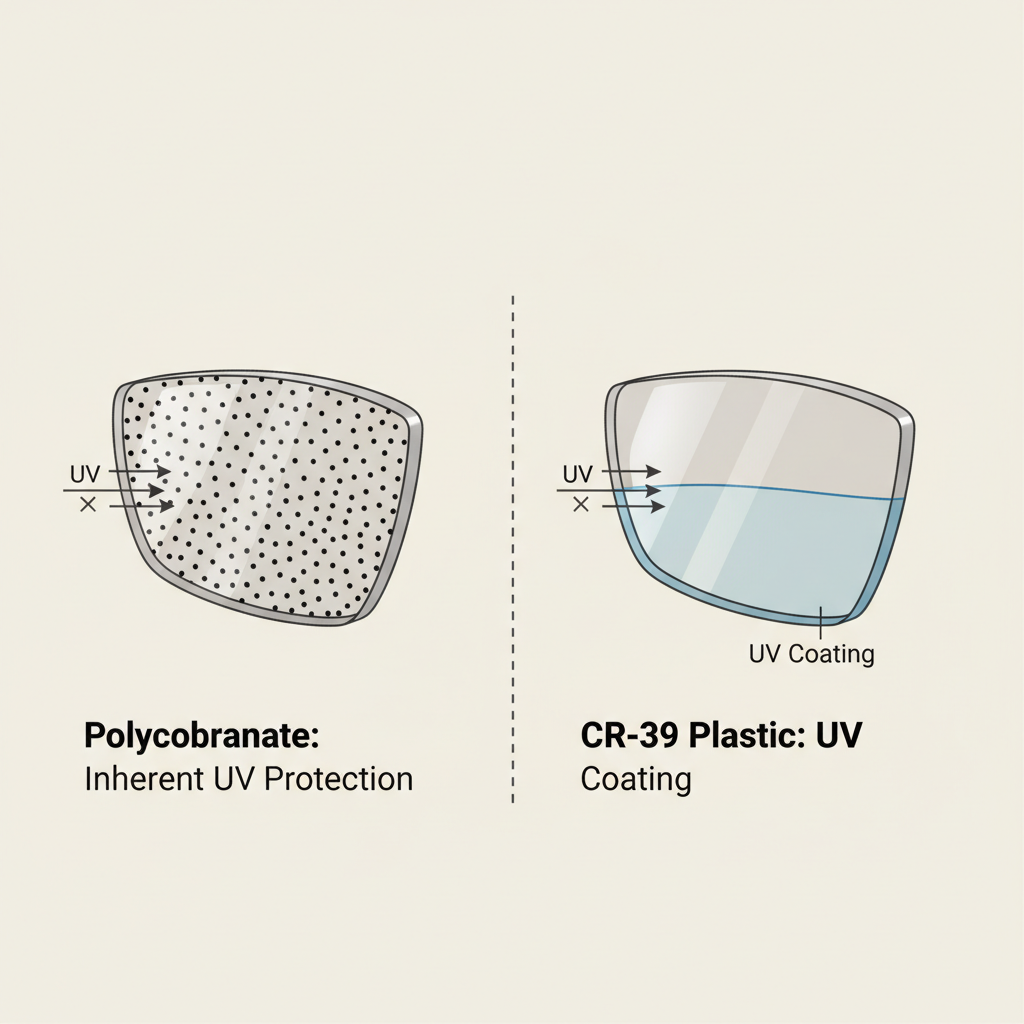
UV protection is achieved in one of two ways, depending on the lens material.
- Inherent Protection: Some lens materials are naturally UV-blocking. Polycarbonate and Trivex, two lightweight and highly impact-resistant plastics, have UV400 protection embedded within the material itself. This protection cannot scratch off or wear away.
- Protective Coatings: Other common materials, like CR-39 plastic, require a UV-protective coating to be applied to the lens surface to reach the UV400 standard. While effective, there is a risk that this coating could degrade or get scratched over time. Research has shown that some lenses can lose their UV-blocking efficacy after prolonged exposure to simulated sunlight, a process called photobleaching.
Buyer's Checklist: How to Verify Your Sunglasses Are Safe
With so much misinformation out there, how can you be sure your sunglasses are truly protective? A study on consumer behavior found that nearly half of people who don't wear sunglasses cited "uncertainty in the efficiency of UV protection" as the main reason, highlighting a massive trust gap. Use this checklist to buy with confidence.
| Feature to Check | Verified Safe Sunglasses | Risky / Uncertified Sunglasses |
|---|---|---|
| Labeling | Clearly marked with "UV400" or "100% UVA/UVB Protection". | Vague terms like "UV absorbing" or no label at all. |
| Material | Often made of Polycarbonate or Trivex with inherent protection. | Unspecified plastic with no guarantee of UV coating. |
| Vendor | Sold by a reputable eyewear retailer that provides compliance info. | Purchased from street vendors, temporary stalls, or online marketplaces without certification. |
| Lens Quality | Lenses are optically clear with no distortion. | Lenses may warp straight lines (see "tile test" below). |
| Polarization | Marketed as a separate feature for glare reduction, not UV safety. | Falsely implies that polarization or a mirror finish equals UV protection. |
1. Always Look for the UV400 Label: This is the most important first step. Reputable manufacturers will always label their products clearly.
2. The Tile Floor Test: The American Academy of Ophthalmology suggests a simple quality test. Hold the glasses at arm's length and look at a rectangular pattern, like a tiled floor. Cover one eye and move the glasses back and forth. If the lines stay straight, the lenses are good quality. If they wiggle or warp, the optics are poor and could cause eye strain.
3. Ask a Professional: If you have doubts about a pair of sunglasses, you can take them to an optical shop. Most have a UV photometer and can test your lenses for free in a matter of seconds. This is the only way to be 100% certain.
Tints, Polarization, and Coatings: What Do They Actually Do?
If tint isn’t for safety, what is it for? Lens color, darkness, and coatings are all about optimizing your vision and comfort in different conditions.
-
Tints and Visible Light Transmission (VLT): The darkness of a tint is measured by its VLT—the percentage of visible light that passes through the lens. A darker lens has a lower VLT. Lens color affects how you perceive other colors and contrast.
- Gray: Offers the most neutral color perception, making it ideal for activities like driving. The AOA often recommends gray lenses for this reason.
- Brown/Amber: Enhances contrast, which can be beneficial for activities like fishing or for patients with certain eye conditions.
- Green: Provides good contrast and color accuracy.
-
Polarization: A polarized filter is a vertical "picket fence" for light. As explained by Harvard Health, it specifically blocks horizontal light waves, which are the primary component of glare bouncing off flat surfaces like water, pavement, or snow. It is a premium feature for comfort and visual clarity, but it does not provide UV protection on its own. A polarized lens must also be rated UV400 to be safe. Furthermore, polarization can cause issues for pilots by interfering with cockpit displays, as noted by the FAA.
-
Mirror Coatings: A mirrored finish is a cosmetic coating that reflects more visible light, making the lens appear darker from the outside. It does not add to UV protection. For more on this, you can explore a guide to mirror coatings.
Key Takeaways: Shop Smart, Stay Safe
Protecting your vision from the sun is a lifelong endeavor, as UV damage is cumulative. The next time you buy a pair of sunglasses, remember these core principles:
- Protection is Invisible: True safety comes from a certified UV400 rating, not the color or darkness of the lens.
- Darkness Can Be Deceptive: Avoid uncertified dark lenses. They are often more harmful than no glasses at all.
- Verify Before You Buy: Look for the UV400 label and purchase from a trusted retailer that can certify its products' safety standards.
- Tints Are for Performance: Choose your lens color and darkness based on your lifestyle and comfort needs, not for safety.
By prioritizing certified protection over simple tint, you invest in the long-term health of your eyes.
Frequently Asked Questions (FAQ)
1. Are more expensive sunglasses automatically better? Not necessarily for UV protection. While price often reflects frame quality, brand name, and advanced features like polarization, a study on sunglasses from various markets found that price does not always correlate with UV protection. A certified, affordable pair of UV400 sunglasses is far safer than an expensive fashion pair without it.
2. Do polarized lenses block more UV rays? No. Polarization and UV protection are different things. Polarization is a filter that reduces glare. A lens must have a separate UV400 coating or inherent material property to block ultraviolet light.
3. How often should I replace my sunglasses? It depends on the lens material and quality. If you have polycarbonate lenses with inherent UV protection, they will remain safe as long as they are not heavily scratched. If your lenses have a UV coating, some research suggests the coating can degrade over time with heavy sun exposure. As a general rule, if your glasses become scratched to the point of distorting vision, it's time for a new pair.
4. Do my clear prescription glasses have UV protection? Many do, but not all. Polycarbonate prescription lenses offer built-in UV protection. However, with other materials, it must be added as a coating. It's also important to have a UV-absorbing anti-reflective coating on the back of the lens to prevent UV rays from reflecting into your eye from behind.
Disclaimer: This article is for informational purposes only and does not constitute medical advice. Please consult with a qualified eye care professional to address your specific vision and health needs. They can perform a comprehensive eye exam and recommend the best eyewear solutions for you.
References
- MD Anderson Cancer Center: 9 Things to Know About Sunglasses
- American Optometric Association (AOA): UV Protection
- American Academy of Ophthalmology (AAO): Choosing the Best Sunglasses
- Harvard Health Publishing: Polarized Sunglasses
- Federal Aviation Administration (FAA): Sunglasses for Pilots
- PMC (Bakkar et al.): Public Awareness of UV Harm