



Color Desaturation: Why One Eye Sees Colors Differently
Color Desaturation: Why One Eye Sees Colors Differently
TL;DR: Noticing that colors, especially reds, appear faded or washed out in one eye is a distinct visual symptom known as color desaturation. It's not an issue with your glasses or a simple eye strain problem; it most often points to a disruption in the optic nerve, the pathway that carries visual information from your eye to your brain. While it can be alarming, it's a known medical sign that requires a prompt and thorough evaluation by an eye care professional.
Have you ever looked at a familiar red stop sign and noticed it appears pale pink or dull orange in one eye compared to the other? This subtle but disorienting experience is called unilateral color desaturation. It’s as if someone turned down the color saturation dial on just one side of your world. This isn't a trick of the light. It's a critical sign that the communication between your eye and your brain has been compromised, and understanding why is the first step toward addressing it.

The Optic Nerve: Your Brain's High-Speed Data Cable
To understand color desaturation, we first need to appreciate how we see color. The back of your eye is lined with a light-sensitive tissue called the retina, which contains millions of specialized cells. Among them are "cone" cells, which are responsible for detecting color—primarily red, green, and blue wavelengths.
When light hits these cones, they generate an electrical signal. But this signal is meaningless until it reaches the brain's visual cortex for processing. The job of transmitting this complex data—shape, motion, brightness, and color—falls to the optic nerve. Think of it as a biological fiber-optic cable containing over a million tiny nerve fibers, bundling everything your eye sees into a coherent signal for your brain to interpret.
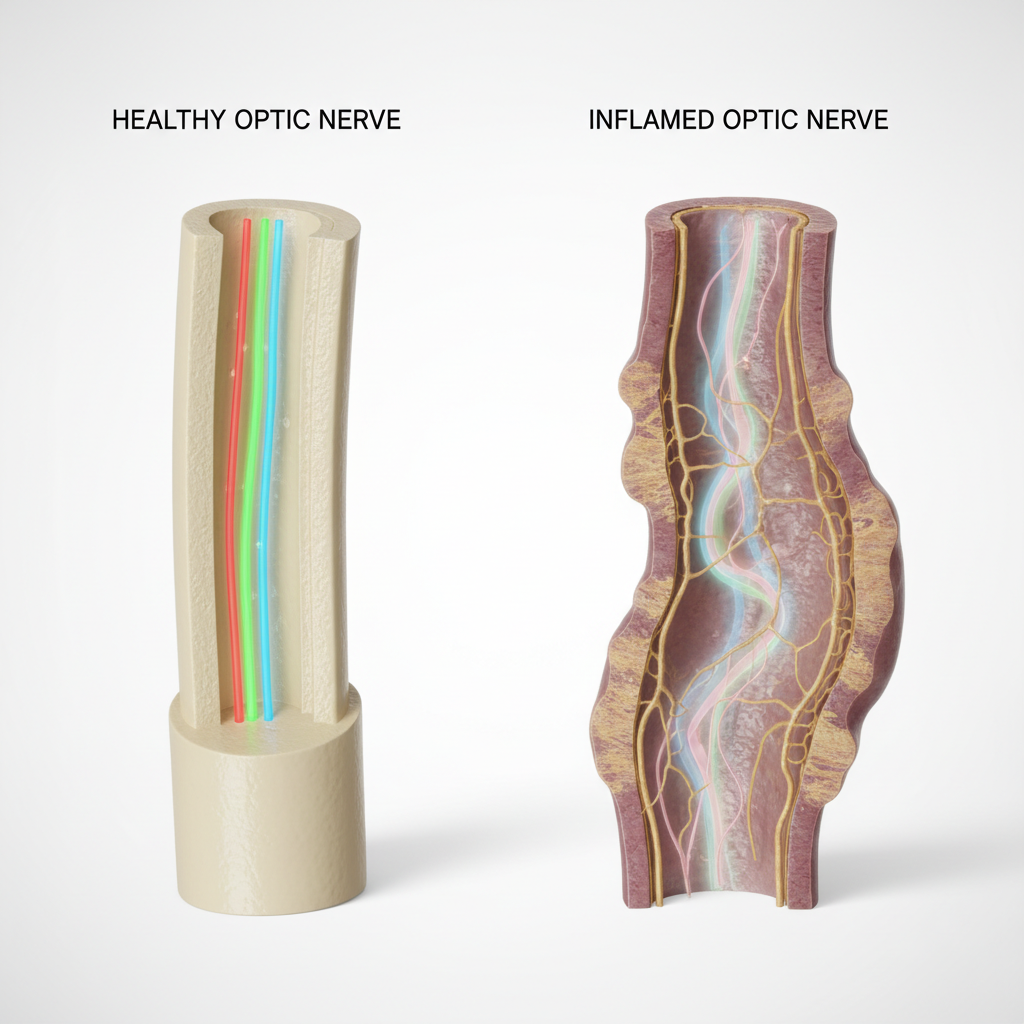
Color desaturation occurs when this "cable" is damaged or inflamed. The signal is still getting through, but its quality is degraded. The information for fine color distinction is particularly sensitive to disruption, which is why it's often one of the first things to be affected.
Optic Neuritis: The Most Common Culprit
The most frequent cause of sudden, unilateral color desaturation is a condition called optic neuritis, which is simply inflammation of the optic nerve. According to clinical guidelines published by StatPearls, this inflammation can damage the protective sheath around the nerve fibers (myelin), disrupting their ability to transmit electrical signals efficiently.
Key Symptoms Associated with Optic Neuritis:
Pain on Eye Movement: This is a classic, tell-tale sign. In up to 92% of cases, individuals experience a dull, aching pain behind the eye that worsens when they look around. This happens because the muscles that move your eye are attached near the optic nerve, and their movement pulls on the inflamed, sensitive nerve.
Vision Dimming or Blurring: Your vision may seem like someone has turned down a dimmer switch, or it might become generally blurry.
Red Desaturation: This is a hallmark symptom. Reds often appear the most washed out, looking pinkish or orange. Clinicians often use a simple test with a red bottle cap, asking a patient to compare its color between the two eyes. A significant difference is a strong indicator of optic nerve pathology.
The Connection to Multiple Sclerosis (MS)
It's important to address the connection between optic neuritis and multiple sclerosis (MS). For many individuals, optic neuritis is the first clinical sign of MS, an autoimmune condition where the body's immune system attacks the myelin sheath of nerves in the brain and spinal cord. The landmark Optic Neuritis Treatment Trial (ONTT) found that about 35% of patients experience a recurrence of optic neuritis in either eye within 10 years, and the condition is a strong predictor for developing MS.
While this link can be a source of significant anxiety, an episode of optic neuritis does not guarantee an MS diagnosis. A thorough neurological workup, including an MRI, is essential to assess the situation fully.
Other Potential Causes for Altered Color Vision
While optic neuritis is a primary suspect, other conditions can also cause colors to appear different in one eye. However, they typically present with a different set of symptoms.
Cataracts: A cataract is a clouding of the natural lens inside your eye. As the lens hardens and yellows with age, it acts like a yellow-brown filter, making colors appear faded and muted. This process is usually very gradual, occurring over years, and is not associated with pain.
Retinal Conditions: Problems with the retina, such as macular degeneration or diabetic retinopathy, can damage the cone cells themselves. This can lead to color vision defects, but it is often accompanied by other significant symptoms like distorted lines, blank spots in the central vision, or difficulty reading.
Optic Nerve Compression: A slow-growing tumor or other lesion can press on the optic nerve, gradually squeezing it and causing a slow, progressive loss of vision and color perception. This is typically painless and develops over a much longer period than optic neuritis.
Visual Snow Syndrome (VSS): This is a neurological disorder where a person's vision is filled with persistent, tiny flickering dots, much like TV static. A comprehensive review in the Journal of Neuro-Ophthalmology notes that patients with VSS often experience other visual disturbances, including photophobia, and the condition is highly comorbid with migraine and tinnitus. While not a direct cause of unilateral desaturation, it represents another form of brain-based visual disruption.
Symptom Clues: A Quick Comparison
Feature Optic Neuritis Cataract Macular Degeneration Onset Sudden (hours to days) Gradual (years) Gradual (months to years) Pain Yes, typically with eye movement No No Primary Symptom Color desaturation, dimming, blur Blurry, cloudy, or yellowed vision Central vision distortion, blank spots Key Differentiator Pain and rapid onset Very slow, painless progression Wavy lines (metamorphopsia)
The Diagnostic Pathway: What to Expect
If you experience sudden color desaturation, it is crucial to see an ophthalmologist or optometrist for an emergency appointment. Do not dismiss it as a "dirty contact lens" or a problem with your glasses. Managing patient anxiety is a key part of the clinical process, as the fear of a serious condition is often the primary concern.
Your eye doctor will perform a comprehensive examination to pinpoint the cause:
Visual Acuity and Color Vision Testing: This includes reading an eye chart and looking at Ishihara plates (the circles with hidden numbers made of colored dots) to formally assess your color perception.
Red Desaturation Test: As mentioned, your doctor will likely use a bright red object to compare the saturation between your eyes.
Pupil Exam: The doctor will check for a Relative Afferent Pupillary Defect (RAPD), a sign that the optic nerve in one eye is not responding to light as robustly as the other.
Visual Field Test: This test maps your peripheral vision to see if there are any blind spots you may not have noticed.
Dilated Fundus Exam: Using drops to widen your pupils, the doctor will look directly at your optic nerve head and retina at the back of your eye to check for swelling or other abnormalities.
Imaging: An MRI of the brain and orbits is the definitive test to confirm inflammation of the optic nerve and check for the characteristic white matter lesions associated with MS. An Optical Coherence Tomography (OCT) scan can also be used to measure the thickness of the nerve fiber layer in the retina.

Treatment, Recovery, and Living with Visual Changes
The treatment for color desaturation depends entirely on its underlying cause. For acute optic neuritis, a course of intravenous or oral steroids may be prescribed to reduce inflammation and speed up visual recovery. For cataracts, surgery is the only effective treatment.
Vision often recovers significantly after an episode of optic neuritis, but it may not return to 100%. Many people report lingering, subtle differences in color vibrancy, contrast sensitivity, or brightness between their eyes. The brain is remarkably adaptable and can learn to compensate for these minor differences over time.
Living with a sudden and unexplained vision change is stressful. Research has shown a link between high cortisol levels from psychosomatic stress and the aggravation of optic nerve conditions, creating a "vicious cycle." Finding ways to manage stress and anxiety is a vital part of the recovery process. Connecting with your healthcare provider and understanding the diagnostic and treatment plan can provide reassurance and a sense of control.
Frequently Asked Questions (FAQ)
Q: Can stress or lack of sleep cause color desaturation?A: While stress and fatigue can cause a variety of temporary visual symptoms like eye twitching or blurry vision, they do not directly cause the kind of distinct, unilateral color desaturation associated with optic nerve issues. However, high levels of systemic inflammation and stress can be triggers for autoimmune responses in susceptible individuals.
Q: Is the change in my color vision permanent?A: In many cases of optic neuritis, color vision improves significantly within a few weeks to months as the inflammation subsides. However, some residual desaturation may remain permanently. The prognosis depends on the severity of the initial event and the underlying cause.
Q: I noticed this after getting new glasses. Could it be the prescription?A: It is highly unlikely. A prescription error affects the focus of light (sharpness), not the fidelity of the color signal being sent to the brain. While certain lens coatings or materials can have a very slight color cast, they would not produce the profound and one-sided loss of color vibrancy characteristic of this symptom.
Q: Could this be a sign of a stroke?A: While a stroke can cause vision loss, it typically presents as a sudden loss of a section of your visual field (like a curtain coming down) and is often accompanied by other neurological symptoms like weakness on one side of the body, slurred speech, or severe dizziness. Isolated, painful color desaturation is not a typical presentation for a stroke.
Disclaimer: This article is for informational purposes only and does not constitute professional medical advice. The information contained herein is not intended to diagnose, treat, cure, or prevent any disease. Always seek the advice of your physician or other qualified health provider with any questions you may have regarding a medical condition. Never disregard professional medical advice or delay in seeking it because of something you have read in this article.
References
StatPearls [Internet]. (2024). Optic Neuritis. Treasure Island (FL): StatPearls Publishing. Available from: https://www.ncbi.nlm.nih.gov/books/NBK557853/
Pu, J., & Cregg, M. (2021). Visual Snow Syndrome: A Review on its Assessment and Management. Journal of Neuro-Ophthalmology, 41(4), e636-e644. Available from: https://pmc.ncbi.nlm.nih.gov/articles/PMC8092638/
University of Iowa Health Care. (n.d.). Optic Neuritis. EyeRounds.org. Available from: https://webeye.ophth.uiowa.edu/eyeforum/cases/159-optic-neuritis.htm
Sabel, B. A., et al. (2018). The Vicious Cycle of Vision Loss and Depression. Seminars in Ophthalmology, 33(6), 735-742. Available from: https://pmc.ncbi.nlm.nih.gov/articles/PMC5972137/
StatPearls [Internet]. (2023). Optic Nerve Compression. Treasure Island (FL): StatPearls Publishing. Available from: https://www.ncbi.nlm.nih.gov/books/NBK560583/