

Why Contact Lens Wearers Still Need UV Sunglasses
It’s a common and logical assumption: you wear contact lenses with built-in UV protection, so your eyes are safe from the sun. Why would you need to add a pair of sunglasses on top? While your contacts are indeed providing a valuable layer of defense for a critical part of your eye, they don’t offer the complete protection required to safeguard your long-term vision.
Think of your UV-blocking contacts as a shield for your cornea, but one that leaves the surrounding territories undefended. The truth is, significant portions of your eyes and the delicate skin around them remain exposed to harmful ultraviolet (UV) radiation. This article explains the gaps in that protection and details why a quality pair of sunglasses is a non-negotiable tool for every contact lens wearer.
The Myth of Complete Protection: What Your UV-Blocking Contacts Don't Cover
While manufacturers have made great strides in incorporating UV absorbers into contact lens materials, it's crucial to understand the physical limitations of this technology. A contact lens, by its very nature, can only protect the area it covers.
The Limits of Coverage
A standard soft contact lens covers the cornea—the transparent dome at the very front of your eye that covers the iris and pupil. While this is essential, it represents only a fraction of your eye’s total surface area. The conjunctiva (the clear membrane covering the white part of your eye, or sclera) and the internal structures of the eye are still vulnerable. Furthermore, the delicate, thin skin of your eyelids and the surrounding periorbital area receive no protection at all from contacts.
The Danger of Peripheral Light
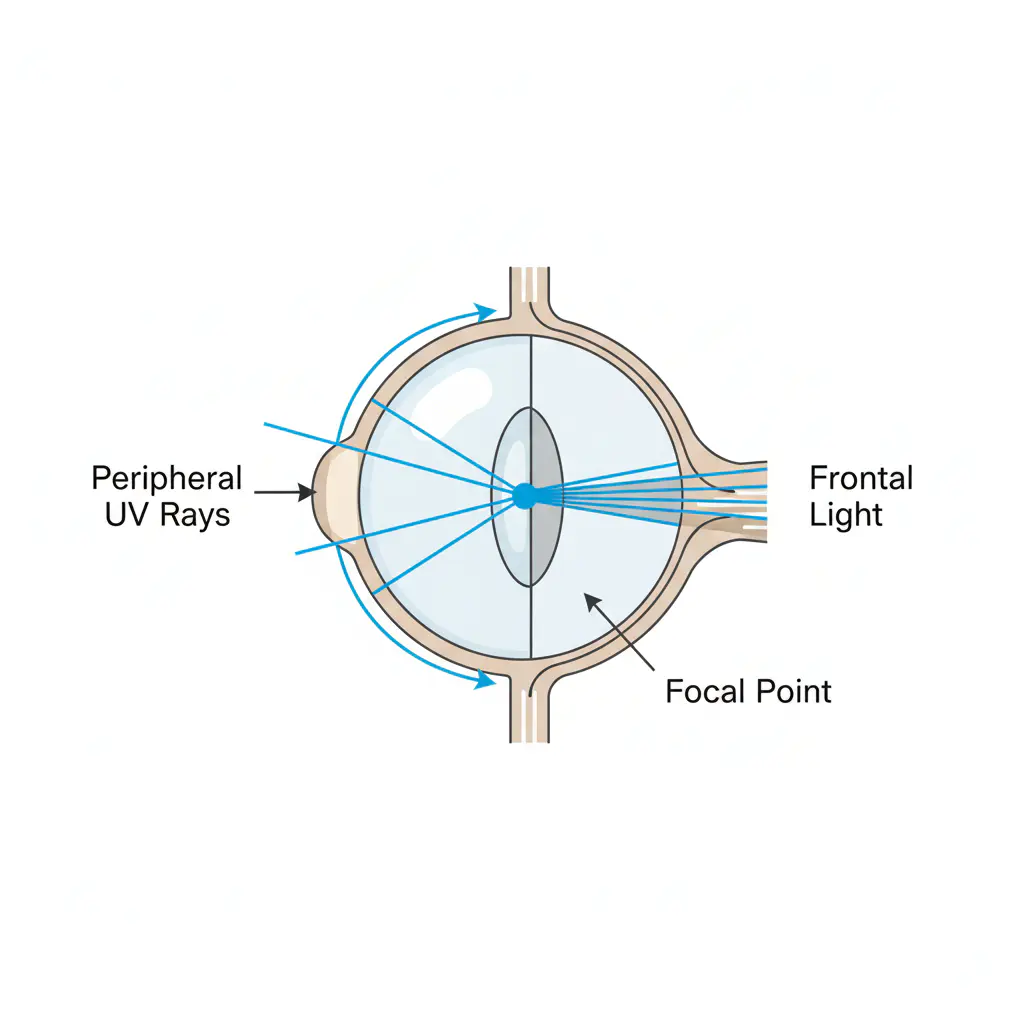
One of the most significant risks that contacts cannot address is peripheral or oblique light exposure. UV rays don’t just hit your eyes straight on; they reflect off surfaces like water, pavement, and snow, entering your eye from the sides, top, and bottom.
Research has identified a phenomenon known as the "Coroneo Effect," where UV rays entering from the side are focused onto the nasal limbus (the area where the cornea meets the sclera on the side of your eye closer to your nose). As detailed in a comprehensive review on eye photoprotection published in Photochemical & Photobiological Sciences, this focusing effect is a primary contributor to the development of growths like pterygia. Your contact lens offers no defense against this laterally-entering radiation.
Long-Term Risks of Incomplete UV Protection
Cumulative, lifelong exposure to UV radiation is a proven factor in several serious ocular diseases. Relying solely on contacts leaves you under-protected and increases your risk over time.
Pterygium ("Surfer's Eye")
A pterygium is a fleshy, wedge-shaped growth of the conjunctiva that can extend onto the cornea, potentially causing irritation, redness, and even vision obstruction if it grows large enough. Its common name, "Surfer's Eye," points directly to its primary cause: chronic exposure to sun, wind, and dust. Sunglasses, especially wraparound styles, are the most effective way to block the peripheral UV rays that contribute to this condition.
Cataracts
Cataracts are a clouding of the eye’s natural lens, leading to blurry vision, faded colors, and increased glare sensitivity. The link between UVB radiation and the formation of cortical cataracts is incredibly strong. Groundbreaking research from the National Eye Institute (NEI) has even uncovered the specific chemical process at play. In the low-oxygen environment of the lens, UV light triggers a process called glycation, causing proteins to clump together and form the cloudy opacities we know as cataracts. A large-scale epidemiological study found that individuals who did not wear sunglasses had a 57% increased risk of cataracts. Wearing sunglasses that block 100% of UV rays is one of the most effective preventative measures you can take.
Cancers of the Eyelid
The skin on your eyelids is among the thinnest and most delicate on your entire body, making it highly susceptible to UV damage. According to experts at the MD Anderson Cancer Center, approximately 90% of eyelid cancers are Basal Cell Carcinomas, directly linked to sun exposure. Because contact lenses provide zero protection for this area, sunglasses with large lenses and a close-fitting frame are your first and best line of defense.
Macular Degeneration (AMD)
Age-Related Macular Degeneration (AMD) is a leading cause of vision loss in older adults, affecting central vision needed for reading and driving. While the link between UV light and cataracts is definitive, the evidence for AMD is more nuanced. However, chronic exposure to high-energy visible (HEV) light, or "blue light," particularly the 400-440 nm wavelengths, is believed to contribute to retinal damage. While the science is still evolving, ophthalmologists consider wearing sunglasses that filter both UV and some blue light to be a prudent and simple precaution against a potentially devastating disease.
Your Comprehensive UV Defense Strategy: A Practical Guide
Pairing your contacts with the right sunglasses creates a dual-defense system that provides truly comprehensive protection. But not all sunglasses are created equal. Here’s how to choose wisely.
Common Misconception: Darkness and Polarization Do Not Equal UV Protection
A critical mistake is assuming that a dark tint or polarization guarantees UV safety. In reality, they are entirely separate features.
- Tint/Darkness: The darkness of a lens only reduces the amount of visible light passing through (VLT), which eases squinting but does nothing to block invisible UV rays. In fact, as a study in PubMed highlights, wearing dark lenses without certified UV protection can be more dangerous than wearing no sunglasses at all. The dark tint causes your pupils to dilate, allowing more damaging UV radiation to enter the unprotected eye. For more detail, you can explore the relationship between UV protection and dark sunglass lenses.
- Polarization: This feature is a special filter that blocks horizontal glare reflected off flat surfaces like water or roads. While excellent for reducing eyestrain and improving visual comfort, it is not inherently a UV filter. Most quality polarized lenses do include UV protection, but you must always verify.
Checklist: How to Choose Protective Sunglasses
Use this checklist to ensure you’re getting sunglasses that offer maximum safety and performance.
| Feature | What to Look For | Why It Matters |
|---|---|---|
| UV Protection | A label stating "100% UVA/UVB Protection" or "UV400." | This is the absolute must-have. UV400 blocks all light rays with wavelengths up to 400 nanometers, covering the entire spectrum of UVA and UVB rays. |
| Frame Fit & Style | Wraparound, oversized, or close-fitting frames. | A study using 3D head forms published in the PMC journal found that medium-sized, fashionable frames offered the least protection due to significant peripheral light leakage. Close-fitting styles can block up to 99% of UV rays. |
| Lens Material | Polycarbonate or Trivex. | These materials are not only highly impact-resistant, making them safer for active use, but they also inherently block 100% of UV rays without needing a special coating. |
| Visible Light Transmission (VLT) | 8-20% for bright conditions; 20-40% for general use. | This indicates the lens darkness. Lower percentages are better for intense sun (beach, snow), while mid-range is suitable for everyday wear. |
| Lens Color | Neutral Gray or Green. | The American Optometric Association (AOA) recommends gray lenses, especially for driving, as they provide true color perception. Amber and brown are good for enhancing contrast. |
Special Considerations for At-Risk Individuals
Certain groups have an even greater need for diligent sun protection.
- Children: UV damage is cumulative over a lifetime. According to the Mayo Clinic, children’s eyes are more vulnerable because their crystalline lenses are clearer than an adult’s, allowing more UV to penetrate deeper into the eye. It is crucial to start good habits early.
- Outdoor Workers & Enthusiasts: People who spend significant time outdoors receive a much higher dose of UV radiation. High-risk environments noted by the American Academy of Ophthalmology include high altitudes and snowy or watery landscapes, where reflection can nearly double UV exposure.
- Users of Photosensitizing Medications: Certain common medications, including some antibiotics (like tetracyclines), diuretics, and retinoids, can increase your body’s sensitivity to UV light, raising the risk of damage to both skin and eyes.
Wrapping Up: Your Eyes Deserve Double Coverage
Your UV-blocking contact lenses are an excellent starting point for eye safety, but they are not a complete solution. By leaving your conjunctiva, eyelids, and the surrounding skin exposed, they leave you vulnerable to a host of sun-related damage, from cosmetic aging to serious conditions like cataracts and cancer.
Viewing your sunglasses not as an optional accessory but as a necessary companion to your contact lenses is a critical shift in mindset. Together, they form a synergistic system where your contacts provide clear, corrected vision, and your sunglasses provide a broad, protective shield for the entire ocular region. This two-part approach is the most effective investment you can make in preserving your vision for a lifetime.
Frequently Asked Questions (FAQ)
Do I still need sunglasses on a cloudy day? Yes. According to the American Academy of Ophthalmology, up to 80% of the sun's UV rays can pass through clouds. The risk remains significant even on overcast days.
How often should I replace my sunglasses? While there is no hard-and-fast rule, some research suggests that the UV-protective coatings on lenses can degrade over time with prolonged exposure to the sun. A good practice is to inspect your lenses regularly for scratches, which can compromise protection, and consider replacing them every 2-3 years if you wear them frequently.
Are more expensive sunglasses always better? Not necessarily. Price does not always correlate with UV protection. A cheap pair of sunglasses with a certified UV400 label is safer than an expensive designer pair without it. However, price often does reflect the quality of the frame materials, lens optics (less distortion), and durability of coatings.
Disclaimer: This article is for informational purposes only and does not constitute professional medical advice. Always consult with a qualified eye care professional for any health concerns, before making any decisions about your vision care, and to determine what is appropriate for your individual needs. If you have pre-existing conditions, it is especially important to seek professional guidance.
References
- American Academy of Ophthalmology (AAO): Sun Safety Tips
- American Optometric Association (AOA): UV Protection
- MD Anderson Cancer Center: 9 Things to Know About Sunglasses
- Mayo Clinic: Why Sunglasses are a Must-Wear
- National Eye Institute (NEI): New research sheds light on how UV rays may contribute to cataract
- PMC (NCBI): Ocular UV Dosimetry & Frame Geometry
- PMC (NCBI): Photoprotection of the Eye (Review)
- PMC (NCBI): Taiwan Cataract & Protection Study
- PubMed: Sunglasses Standards Compliance (Cole BL)