

Why 100% UV Protection is Mandatory After Cataract Surgery.
The Post-Surgery Eye: Why Your Natural Shield is Gone
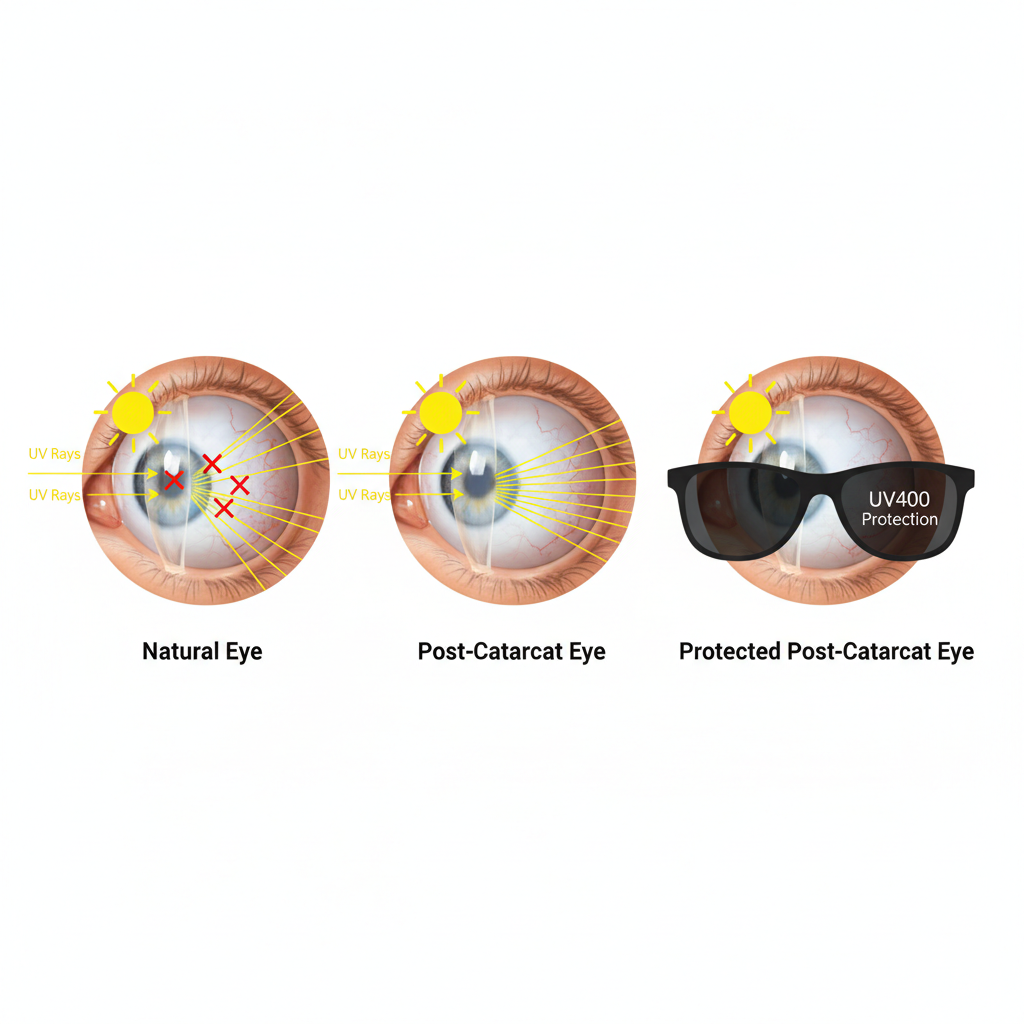
Before cataract surgery, your eye had a powerful, built-in defense mechanism: the natural crystalline lens. This lens, which becomes clouded by cataracts over time, is remarkably effective at absorbing a significant portion of the sun’s harmful ultraviolet (UV) radiation, protecting the delicate retina at the back of your eye. Research from the National Eye Institute (NEI) has even detailed the specific chemical process, known as glycation, where UV light triggers protein clumping that leads to cataracts—a testament to the damage your natural lens intercepted for decades.
When a surgeon removes the cataract, they remove this natural, UV-blocking shield. It is replaced with a clear, artificial intraocular lens (IOL). While modern IOLs are a medical marvel, and most incorporate UV-absorbing materials, this protection isn't always comprehensive. The primary function of an IOL is to restore clear vision, not to shield the entire ocular region.
This leaves the eye in a state of new vulnerability for two key reasons:
- Incomplete Retinal Protection: Depending on the specific type of IOL implanted, its UV filtering capabilities might not match the lifelong protection your natural lens provided. This potential gap leaves the retina, the light-sensitive tissue responsible for sight, more susceptible to UV damage, which is linked to conditions like age-related macular degeneration (AMD).
- No Protection for Surrounding Tissues: An IOL sits inside the eye. It offers no protection for the eyelids, cornea, or conjunctiva. According to experts at the MD Anderson Cancer Center, 90% of eyelid cancers are linked to UV exposure. Furthermore, constant UV irritation can lead to growths on the eye’s surface, such as pterygium (also known as "Surfer's Eye").
Therefore, thinking of sunglasses as an optional accessory after cataract surgery is a critical mistake. They are an essential piece of medical equipment required to compensate for your eye’s altered natural defenses.
Decoding UV Protection: What "100% UV400" Truly Means
Understanding the language of UV protection is the single most important step in choosing the right sunglasses. Markings on a lens are not just marketing jargon; they are indicators of a specific safety standard. For a post-cataract patient, these details are non-negotiable.
- The UV Spectrum: The sun emits different types of ultraviolet light, primarily UV-A and UV-B, that reach the Earth's surface. Both are invisible and both are harmful. UV-B is primarily responsible for sunburn and is strongly linked to cataracts, while UV-A penetrates deeper and is associated with retinal damage and skin aging.
- The Gold Standard: UV400: The label "UV400" means the lenses are engineered to block virtually all light rays with wavelengths up to 400 nanometers. This covers the entire spectrum of both UV-A and UV-B rays. Some older or lower-quality standards may only protect up to 380 nm, which is not sufficient. A technical report from a leading expert, B.L. Cole, criticized these lesser standards, noting that the 380-400 nm band contains significant high-energy light that poses a risk to the eye.
The Darkness Myth: A Dangerous Misconception One of the most dangerous mistakes patients make is assuming that a darker lens offers more protection. This is incorrect. The darkness of a lens (its tint) is related to the amount of visible light it blocks, which affects comfort and glare, but has no bearing on its UV protection. In fact, as MD Anderson Cancer Center experts warn, wearing dark sunglasses that lack certified UV400 protection is more dangerous than wearing no glasses at all. The dark tint causes your pupils to dilate, opening them up to allow more damaging, invisible UV radiation to enter the eye.
- UV Protection vs. Polarization: It's also vital to understand that polarization is not the same as UV protection. As explained by Harvard Health, polarized lenses contain a special filter that blocks horizontal light waves, which are the primary cause of glare reflecting off surfaces like water or roads. While incredibly useful for reducing eye strain and improving visual comfort, polarization itself does not block UV rays. You must ensure that your polarized lenses are also rated for 100% UV400 protection.
Beyond the Lens: Why Frame Fit and Coverage Are Critical
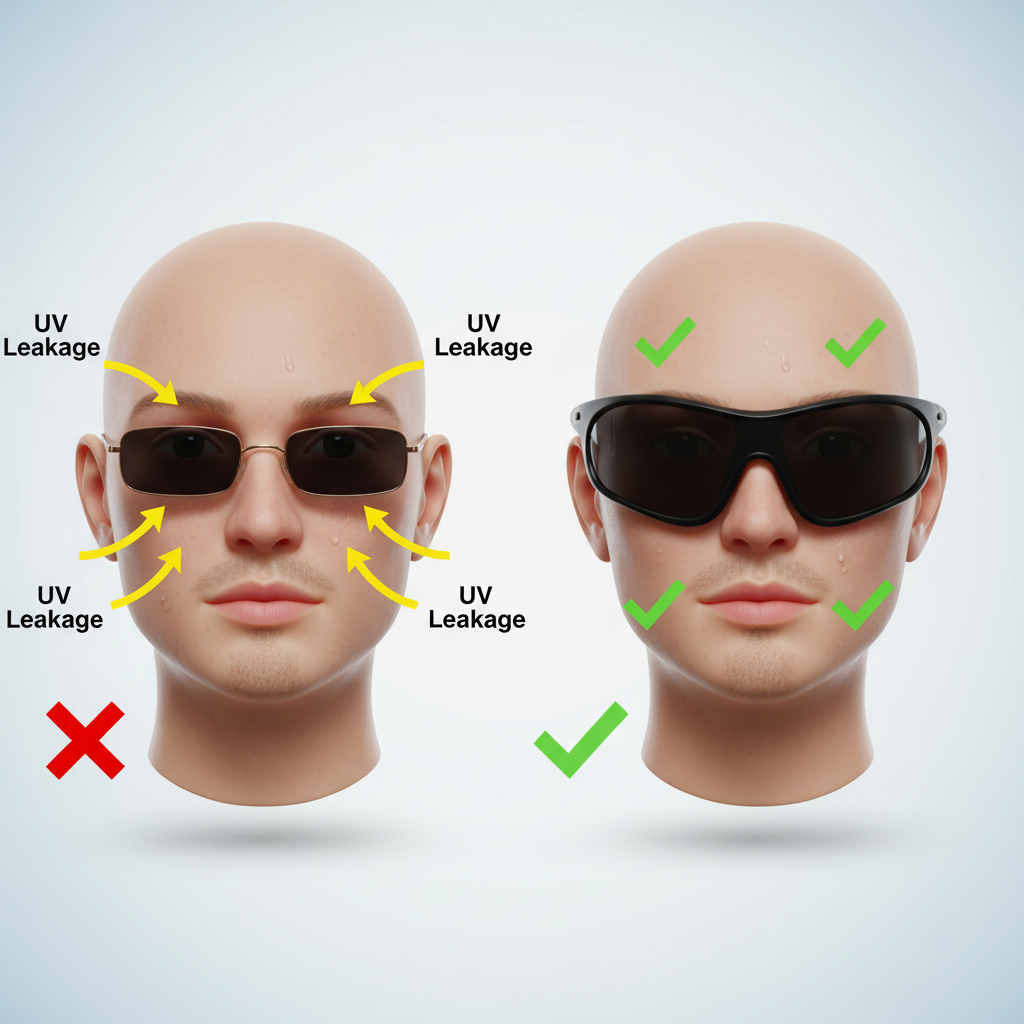
Even a lens with perfect UV400 protection can fail if the frame isn't doing its job. A significant amount of UV radiation doesn't hit the eye straight-on; it leaks in from the sides, top, and bottom of the glasses. For a post-surgical eye, this peripheral exposure can defeat the purpose of wearing protection.
One 3D head-form study that used UV sensors to measure actual ocular exposure revealed a startling fact: standard, "middle-sized" sunglasses often provided the least protection precisely because of this peripheral light leakage. The most effective shields were wraparound styles or goggles that fit snugly against the face.
This is explained by a phenomenon known as the "Coroneo Effect," or peripheral light focusing. As described in a review on ocular photoprotection, UV rays entering from the side (temporal) of your head are focused by the cornea onto the nasal side of the eye—the exact area where pterygia (growths on the conjunctiva) commonly form. This underscores the need for frames that provide excellent side coverage.
A Practitioner's Rule of Thumb: The 20-Degree Rule Based on extensive clinical experience, many opticians use a simple heuristic: if light can easily enter from the sides or top at an angle greater than 20 degrees, your protection is significantly compromised. This makes a close-fitting, large, or wrap-around frame a medical necessity, not a style choice. The goal is to create a seal around the orbit of your eye.
The American Academy of Ophthalmology (AAO) reinforces this, recommending "oversized" or "wraparound" styles to prevent UV rays from entering the eye from around the lens edges. When choosing a frame, prioritize coverage over fashion trends.
A Practical Checklist for Post-Cataract Sunglasses
Armed with this knowledge, selecting the right pair of sunglasses becomes a straightforward process of verifying key features. Use this checklist to ensure you are getting the absolute protection you need.
-
Look for the 100% UV400 Label: This is the most critical feature. The sticker or label should explicitly state "100% UV Protection," "UV400," or "Blocks 100% of UVA & UVB Rays." If it doesn't, put them back.
-
Prioritize High-Quality Lens Materials: The material itself can be a source of protection. According to the American Optometric Association (AOA), polycarbonate and Trivex lenses are top choices because they are lightweight, highly impact-resistant (a great safety feature), and they inherently block 100% of UV rays without needing a special coating.
-
Verify the Frame Fit and Coverage: Choose large, oversized, or wraparound styles that sit close to your face and cover the delicate skin of your eyelids. Check for gaps at the top and sides where light could leak in.
-
Choose the Right Tint: While tint doesn't block UV, it manages visible light. For driving and general use, the AOA and Cleveland Clinic recommend neutral gray or green lenses because they provide the most accurate color perception. This is a crucial safety factor for recognizing traffic signals.
-
Insist on a UV Anti-Reflective Coating: Standard anti-reflective (AR) coatings are designed to reduce glare from the back surface of the lens. However, research has shown that some of these coatings can actually reflect UV rays from behind you into your eye. To prevent this, opt for a lens that includes a UV-absorbing backside AR coating. This ensures you are protected from all angles.
-
Handle with Care: UV coatings, especially on lower-quality lenses, can be scratched or damaged by abrasive cleaners or rough cloths. This creates micro-scratches that scatter light and can reduce the coating's effectiveness over time. Always use a microfiber cloth and a lens-safe cleaning solution. For more details on this, you can explore whether sunglasses expire and the longevity of their UV coatings.
The Lifelong Commitment to Vision Health
Cataract surgery is a remarkable procedure that restores sight, but it also marks the beginning of a new chapter in your eye care. The choices you make in the weeks, months, and years that follow are critical to preserving that newfound vision for a lifetime. UV damage is cumulative, and protecting your eyes is not a short-term, post-operative task—it is a permanent necessity.
Failing to protect your eyes from UV radiation after surgery not only exposes you to the risks of pterygium and eyelid cancers but also potentially increases the long-term risk for retinal conditions. A study of residents in a high-UV region in Taiwan found that participants who did not wear glasses had a 57% increased risk of cataracts—the very condition you just had treated. This powerfully illustrates the direct, measurable impact of UV exposure on eye structures.
Your vision is a precious gift. After cataract surgery, protecting it is your responsibility. By investing in certified, high-coverage UV400 sunglasses, you are not just buying an accessory; you are investing in a medical tool that is indispensable for safeguarding your sight for all the years to come.
This article is for informational purposes only and does not constitute professional medical advice. Always consult with your ophthalmologist or a qualified eye care professional regarding your specific needs after cataract surgery.
References
- National Eye Institute (NEI). "New research sheds light on how UV rays may contribute to cataract." https://www.nei.nih.gov/about/news-and-events/news/new-research-sheds-light-how-uv-rays-may-contribute-cataract
- MD Anderson Cancer Center. "9 things to know about sunglasses, eye protection and cancer." https://www.mdanderson.org/cancerwise/9-things-to-know-about-sunglasses--eye-protection-and-cancer.h00-159699123.html
- Cole, B.L. "Solar UV protection by sunglasses: a technical report." PubMed. https://pubmed.ncbi.nlm.nih.gov/31274741/
- Harvard Health Publishing. "Polarized sunglasses: Protecting your eyes from harmful glare." https://www.health.harvard.edu/staying-healthy/polarized-sunglasses-protecting-your-eyes-from-harmful-glare
- Alfawaz, A. et al. "Ocular UV Dosimetry & Frame Geometry." PMC. https://pmc.ncbi.nlm.nih.gov/articles/PMC6803516/
- Sliney, D.H. "Photoprotection of the Eye." PMC. https://pmc.ncbi.nlm.nih.gov/articles/PMC3872277/
- American Academy of Ophthalmology (AAO). "Choosing the Best Sunglasses." https://www.aao.org/eye-health/glasses-contacts/sunglasses-3
- American Optometric Association (AOA). "UV Protection." https://www.aoa.org/healthy-eyes/caring-for-your-eyes/uv-protection
- Wang, T.J. et al. "Taiwan Cataract & Protection Study." PMC. https://pmc.ncbi.nlm.nih.gov/articles/PMC8321156/