

Should You Wear Sunglasses in the Shade? Indirect UV Risks
The Hidden Danger: Why Shade Doesn't Guarantee Eye Safety
It’s a common reflex: on a bright day, we seek the cool comfort of a leafy tree, a wide-brimmed hat, or a beach umbrella. We assume that by blocking the direct glare of the sun, we’ve protected ourselves. While this provides relief from heat and visible light, it fosters a dangerous misconception regarding ultraviolet (UV) radiation. The truth is, your eyes are still under significant threat from UV rays, even when you are completely in the shade.
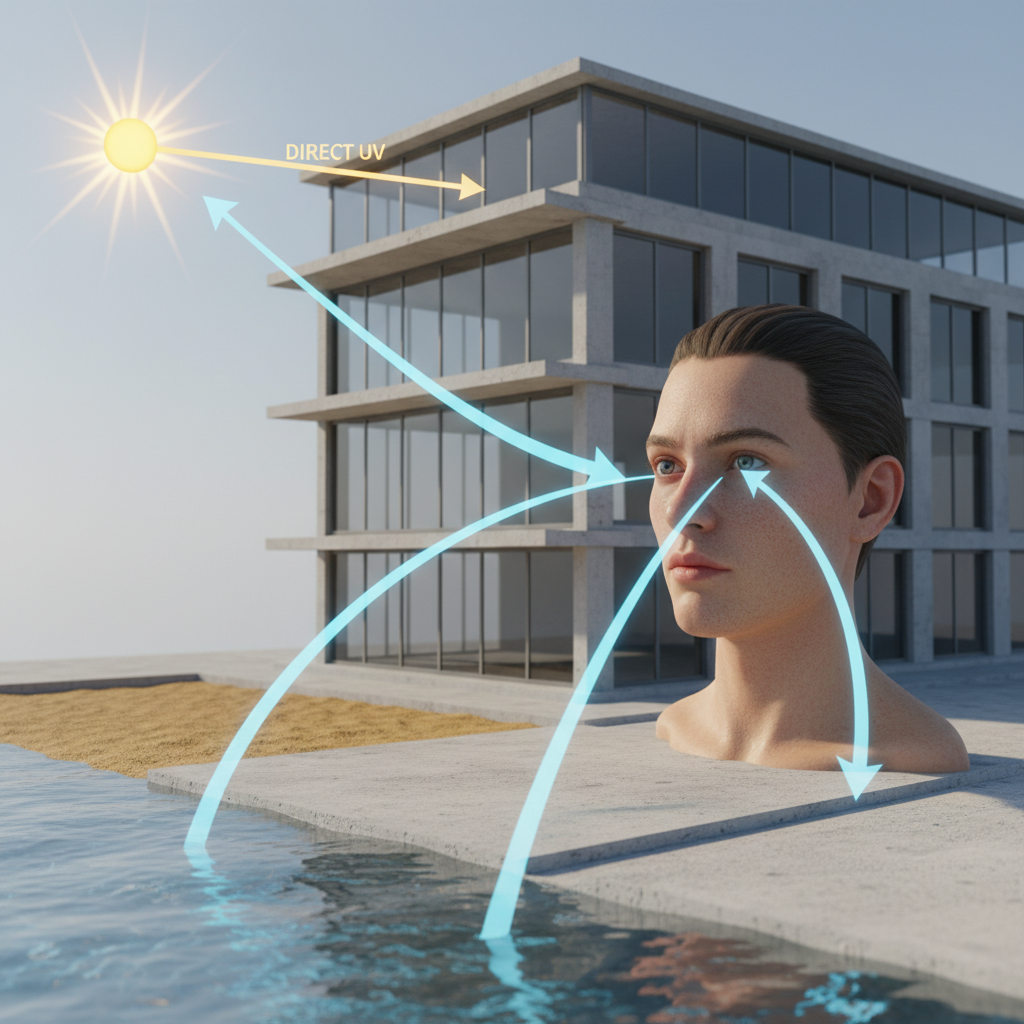
UV radiation doesn't just travel in a straight line from the sun to your eyes. It bounces, reflects, and scatters off nearly every surface around you. This indirect exposure is a pervasive and often underestimated risk factor for serious, long-term eye conditions. Understanding this hidden danger is the first step toward adopting a truly effective sun protection strategy for your vision.
The Science of Indirect UV: An Invisible Barrage
The sun’s rays that reach your eyes are a mix of direct and indirect light. While shade structures effectively block the direct path, they do little to stop the barrage of indirect UV radiation reflecting from your environment. The intensity of this reflected radiation can be surprisingly high.
- Water can reflect up to 100% of UV radiation.
- Snow is even more potent, reflecting as much as 80-90%, effectively doubling your exposure.
- Sand reflects about 15-25%.
- Concrete and pavement can reflect up to 12%.
A crucial rule of thumb is that if you can see the bright reflection of the sky in a puddle or on a car window, you are receiving a measurable dose of UV radiation. This reflected light often comes from below and from the sides, angles that are not protected by a hat or an overhead canopy.
This phenomenon is compounded by what ophthalmologists call the Coroneo Effect, or peripheral light focusing. As described in a comprehensive review on ocular photoprotection, UV rays entering from the side of your head are focused by the cornea onto the nasal side of the eye. This concentrated exposure is a primary factor in the development of conditions like pterygium ("surfer's eye") and cortical cataracts, which are frequently observed in individuals who spend significant time outdoors, such as fishermen and golfers, even when they wear hats.
Why Shade Can Create a False Sense of Security
Seeking shade without proper eyewear can paradoxically increase your risk. This is due to a physiological response known as the "Darkness Fallacy."
When you move into a shaded area, your pupils naturally dilate to let in more light. As experts from the MD Anderson Cancer Center warn, if you are not wearing sunglasses that block 100% of UV radiation, these wider pupils create a larger entryway for reflected UV to penetrate deep into your eyes. A dark, non-UV-protective lens is more dangerous than wearing no sunglasses at all, because it tricks your eye into a state of higher vulnerability.
The damage from this exposure is cumulative and often painless, developing over a lifetime.
- Cataracts: A 2021 study in Taiwan found that individuals who did not wear sunglasses had a 57% increased risk of developing cataracts. The National Eye Institute further explains this mechanism: UV light can trigger a process called glycation within the eye's lens, causing proteins to clump together, leading to the clouding that defines a cataract.
- Eyelid Cancers: The delicate skin on and around the eyelids is highly susceptible to UV damage. According to oncologists, about 90% of eyelid cancers are basal cell carcinomas, directly linked to sun exposure.
- Macular Degeneration (AMD): While the link is still being studied, research published in PubMed suggests that high-energy visible blue light (400-440 nm), which is adjacent to the UVA spectrum, contributes to photooxidative stress on the retina, a key driver of AMD.
Children are especially vulnerable. A 3D head-form study published in Photochemical & Photobiological Sciences found that due to clearer natural lenses, children’s retinas can receive 2-5% of ambient UV, compared to just 1% in adults.
The Anatomy of True Protection: Frame and Lenses
Effective eye protection goes beyond simply having a "UV400" sticker on the lens. The design of the sunglasses and the material of the lenses are just as critical.
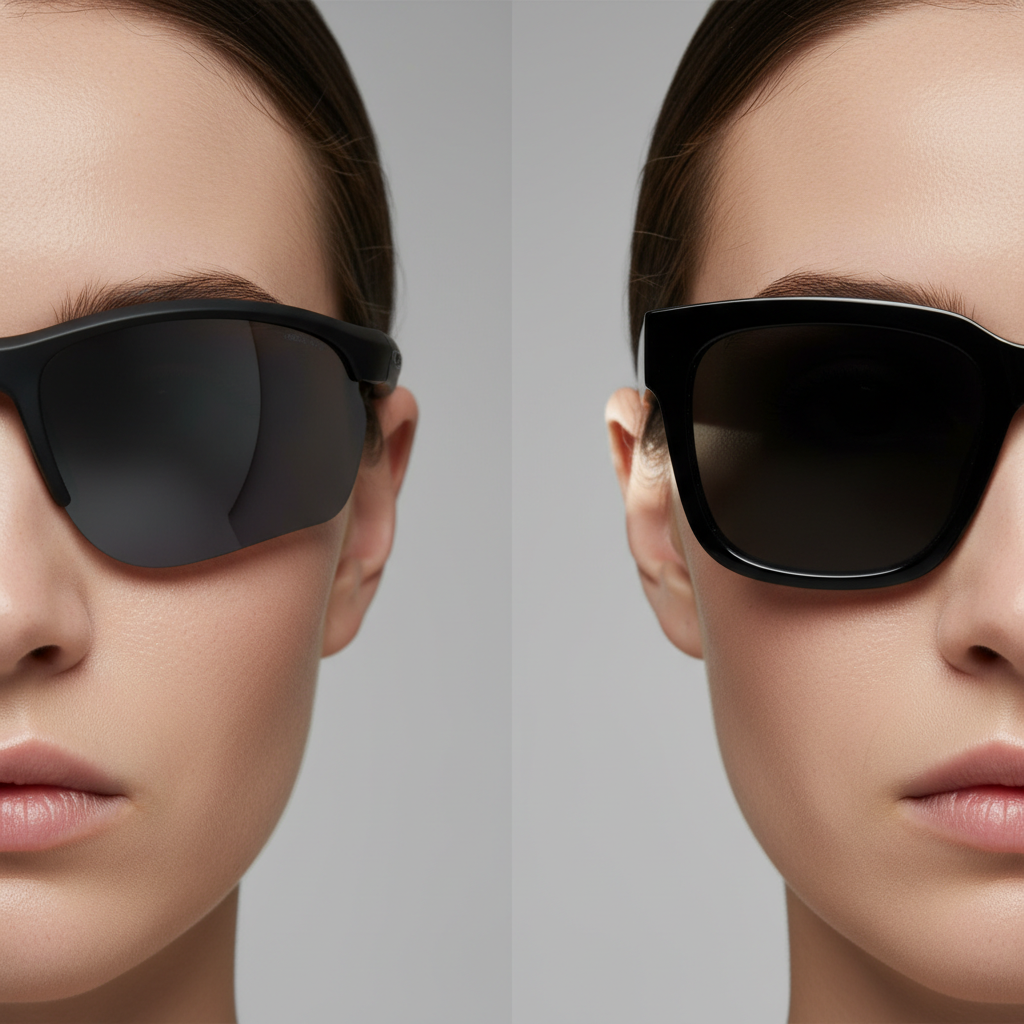
1. Frame Geometry is Non-Negotiable The single most common mistake in eyewear selection is prioritizing fashion over fit. The aforementioned 3D head-form study revealed that "middle-sized" sunglasses—typical fashion frames—offered the least protection due to significant peripheral light leakage from the sides, top, and bottom.
- Look for Wraparound Styles: Choose frames that curve to follow the contour of your face. This design is the most effective at blocking indirect UV from all angles.
- Ensure a Close Fit: The frames should sit close to your face without your eyelashes touching the lenses. Large gaps between the frame and your skin are entry points for damaging radiation. Oversized frames that sit far from the face may look stylish, but their effective protection zone is often less than 50% of the lens area.
2. Lens Material Matters Not all lenses are created equal. The material itself can provide a baseline of defense that coatings enhance.
- Inherent vs. Coated Protection: Polycarbonate and Trivex lenses are the gold standard for safety and health. These materials inherently block 100% of UV rays without the need for any additional coating. Standard plastic lenses (CR-39), however, must have a UV-blocking coating applied, which can scratch or degrade over time with improper cleaning.
- Beyond the Label: The American Optometric Association recommends sunglasses that block 75-90% of visible light and 100% of UVA and UVB rays. A "UV400" label indicates the lens blocks rays up to 400 nanometers, covering the entire spectrum. This is crucial because, as technical reports have noted, the 380-400 nm band contains 45% more UV energy than the 280-380 nm range covered by older standards.
Debunking Myths That Put Your Vision at Risk
Misinformation about sun protection is rampant. Let's clear up a few common but dangerous myths.
- Myth: "Darker lenses offer more protection." Fact: Lens tint has no bearing on UV protection. The protective element is a clear chemical filter applied to or embedded within the lens. As discussed, very dark lenses without certified UV400 protection are exceptionally dangerous.
- Myth: "Clouds block UV rays, so I don't need sunglasses on overcast days." Fact: This is false. According to the American Academy of Ophthalmology, clouds do not block UV rays effectively. Up to 80% of UV radiation can penetrate cloud cover, meaning the risk to your eyes remains high.
- Myth: "My clear prescription glasses protect my eyes." Fact: Not necessarily. While some clear lens materials like polycarbonate offer inherent UV protection, many do not. Furthermore, a critical and often overlooked danger is back-surface reflection. A study in PMC found that standard anti-reflective coatings can actually reflect UV radiation from behind you into your eye. For all-day protection, you need clear lenses with a specialized UV-absorbing anti-reflective coating on the back surface.
Your Vision Deserves Consistent Defense
Treating sunglasses as a health necessity rather than a seasonal accessory is a critical mindset shift. The threat of UV radiation is constant, present on cloudy days, in the winter, and most deceptively, in the shade.
The cumulative impact of indirect and reflected UV exposure poses a direct threat to your long-term vision, contributing to debilitating conditions that are largely preventable. Protecting your eyes requires a conscious strategy: choosing certified UV400 lenses made from inherently protective materials, housed in close-fitting or wraparound frames that leave no gaps for peripheral rays. By understanding that shade is not a substitute for proper eyewear, you empower yourself to preserve your sight for a lifetime.
Disclaimer: This article is for informational purposes only and does not constitute professional medical advice. Please consult with a qualified eye care professional for any health concerns or before making any decisions related to your eye health.
References
- Cole, B. L. (2019). Solar ultraviolet radiation protection by sunglasses: a technical report. Clinical and Experimental Optometry, 102(5), 451–461. https://pubmed.ncbi.nlm.nih.gov/31274741/
- Sliney, D. H. (2013). Ocular dosimetry for ultraviolet radiation and the potential for occupational cataracts. Photochemistry and Photobiology, 89(4), 779–786. https://pmc.ncbi.nlm.nih.gov/articles/PMC6803516/
- Di Girolamo, L. V., & Coroneo, M. T. (2013). Photoprotection of the eye. Photodermatology, Photoimmunology & Photomedicine, 29(6), 284–295. https://pmc.ncbi.nlm.nih.gov/articles/PMC3872277/
- Wang, S. Y., et al. (2021). Sun Protection Behaviors and Cataract in a Rural Population in Taiwan: The Tianliao Old People (TOP) Study. Journal of Clinical Medicine, 10(15), 3329. https://pmc.ncbi.nlm.nih.gov/articles/PMC8321156/
- MD Anderson Cancer Center. (2020). 9 things to know about sunglasses, eye protection and cancer. https://www.mdanderson.org/cancerwise/9-things-to-know-about-sunglasses--eye-protection-and-cancer.h00-159699123.html
- National Eye Institute. (2021). New research sheds light on how UV rays may contribute to cataract. https://www.nei.nih.gov/about/news-and-events/news/new-research-sheds-light-how-uv-rays-may-contribute-cataract
- Walsh, J. E., et al. (2018). UV protection by clear lenses and the potential for back surface reflection. Optometry and Vision Science, 95(5), 425–432. https://pmc.ncbi.nlm.nih.gov/articles/PMC5905936/
- American Academy of Ophthalmology. (n.d.). Sun Safety. https://www.aao.org/eye-health/tips-prevention/sun