

A Guide to Sunglass Safety Standards (ANSI & CE)
When you pick up a pair of sunglasses, you might notice a small "CE" mark on the temple arm or a sticker claiming "ANSI Z80.3 Compliance." For many, these codes are just alphabet soup—regulatory fine print that gets peeled off and forgotten. However, if you are a value-conscious buyer navigating the world of affordable eyewear, these acronyms are your only tangible proof of safety.
There is a pervasive myth in the optical world that price equals protection—that you must spend hundreds of dollars to guarantee your eyes are safe from UV radiation or shattering. This is false. Safety is a matter of physics and engineering, not branding. Whether a frame costs $20 or $200, the biological safety requirements remain the same.
In this guide, we will decode the two most critical international safety standards: the American ANSI Z80.3 and the European CE (EN ISO 12312-1). We will explain exactly what they test for, why "UV400" is a non-negotiable medical necessity, and how you can verify that your next pair of glasses is a legitimate medical device rather than a dangerous toy.
The Alphabet Soup of Safety: ANSI vs. CE
To the uninitiated, safety standards can seem interchangeable. However, the United States and Europe approach eye safety from slightly different angles. Understanding these differences helps you choose the right eyewear for your specific lifestyle—whether you are driving on a highway or skiing down a mountain.
ANSI Z80.3: The American Standard for Impact
The American National Standards Institute (ANSI) sets the Z80.3 standard, which is the benchmark for non-prescription sunglasses and fashion eyewear in the United States. While ANSI compliance covers UV protection and traffic signal recognition, its most rigorous component—and the one that matters most for active users—is impact resistance.
Under FDA regulations (specifically 21 CFR 801.410), all eyewear sold in the U.S. must be impact-resistant. This is not a suggestion; it is federal law.
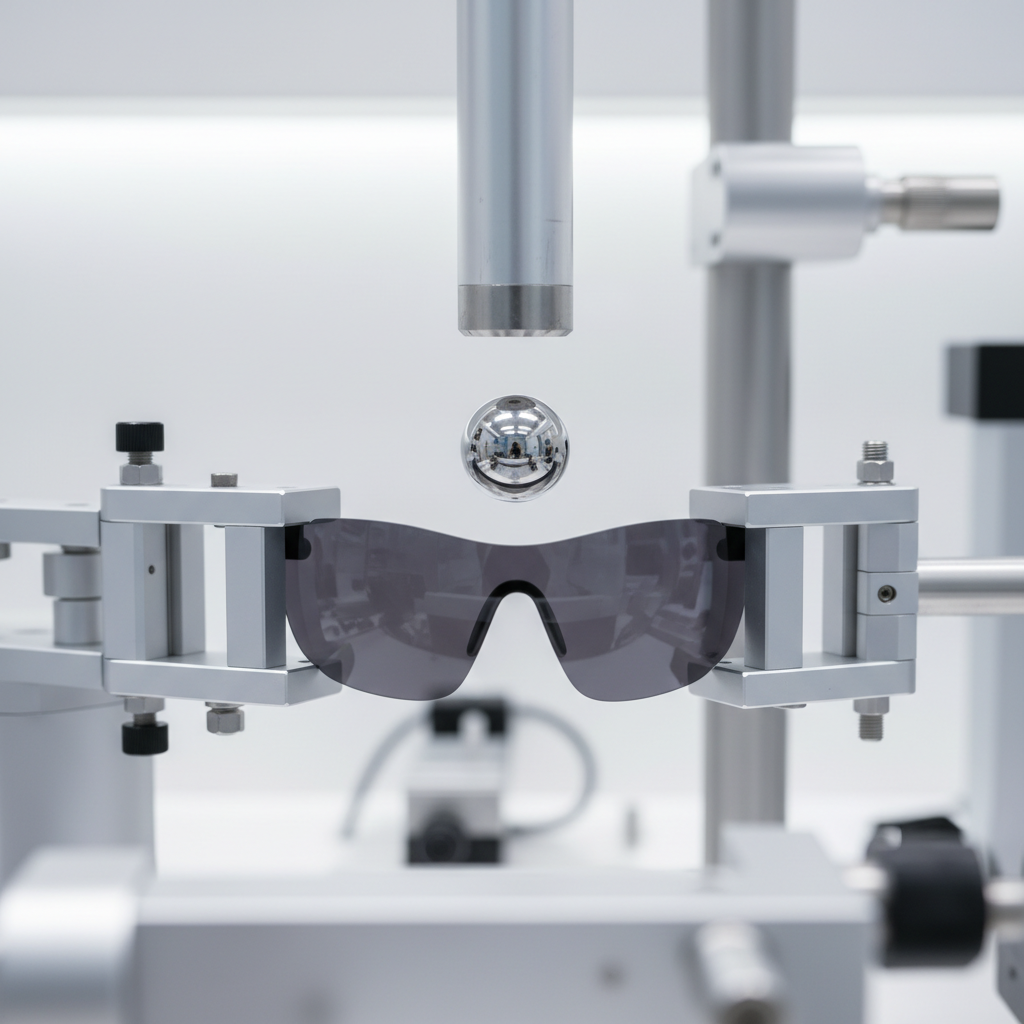
- The "Drop Ball" Test: To pass, a lens must withstand the impact of a 5/8-inch steel ball dropped from a height of 50 inches without shattering.
- Why It Matters: This standard ensures that if a pebble kicks up while you are biking, or an airbag deploys while driving, your sunglasses won't shatter into dangerous shards that could injure your eyes.
CE (Conformité Européenne): The European Filter Standard
The "CE" mark indicates conformity with European Union health, safety, and environmental protection standards. For sunglasses, the specific standard is EN ISO 12312-1.
While the CE standard also includes mechanical strength tests, its primary focus is on optical precision and filter categorization. It rigorously classifies lenses based on how much visible light they block (VLT - Visible Light Transmission), ensuring consumers know exactly how dark a lens is and what conditions it is suitable for.
Comparison: What Are You Actually Getting?
| Feature | ANSI Z80.3 (USA) | CE / EN ISO 12312-1 (Europe) |
|---|---|---|
| Primary Focus | Impact Resistance & Safety | Optical Quality & Glare Reduction |
| Mandatory Test | FDA Drop Ball Test (Impact) | Filter Category Labeling (0-4) |
| UV Requirement | Must block UVB (280-315nm) & UVA (315-380nm) | Must block UV up to 380nm (often 400nm) |
| Traffic Safety | Strict traffic signal color recognition rules | Strict limits on lens darkness for driving |
| Best For... | Active wear, sports, general safety | Fashion, driving, high-glare environments |
UV Protection: The "Invisible Shield"
The most critical function of any sunglass lens is invisible. Ultraviolet (UV) radiation is high-energy light that can cause immediate damage (photokeratitis, or "sunburn of the eye") and long-term pathology (cataracts, macular degeneration).
The "Darkness Fallacy" (Myth Debunking)
A common misconception is that darker lenses offer better protection. This is a dangerous myth.
- The Mechanism: When you wear dark glasses, your pupils dilate (open wider) to let in more light.
- The Risk: If those dark lenses do not have effective UV filters, your dilated pupils will allow more UV radiation to enter the eye than if you were wearing no sunglasses at all.
- The Evidence: According to a study on sunglass standards, "darkness" is purely cosmetic regarding safety. The chemical UV absorber in the lens material is clear. You can have a clear lens that blocks 100% of UV, and a pitch-black lens that blocks 0%.
UV400 vs. UV380: Why the Gap Matters
You will often see labels claiming "100% UV Protection" or "UV400."
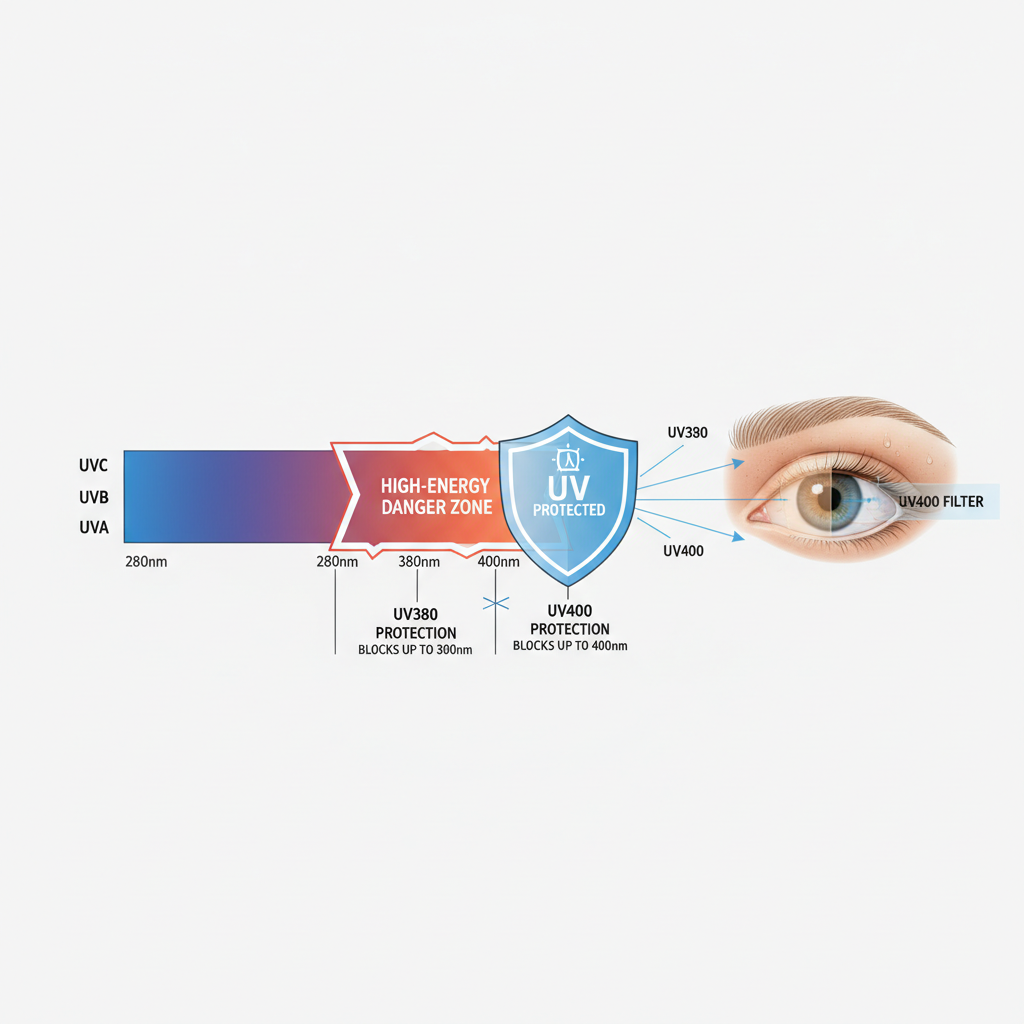
- UV380: Many basic standards only require blocking UV rays up to 380 nanometers (nm).
- UV400: This standard extends protection up to 400 nm, covering the highest energy portion of the UVA spectrum.
Pro Tip: Always look for UV400. According to a technical analysis of solar UV protection, the spectral band between 380 nm and 400 nm contains roughly 45% more UV energy than the lower bands. Lenses that stop at 380 nm leave you vulnerable to a significant amount of high-energy radiation. At reputable retailers, UV400 is the baseline standard, not an upgrade.
The Trust Gap
A study on public awareness of UV harm found that 47% of people who don't wear sunglasses cited "uncertainty in the efficiency of UV protection" as their main reason. They simply didn't trust that the glasses would work.
- Solution: Look for transparency. Reliable manufacturers will cite their testing standards (ANSI/CE) directly on the product page. If a seller cannot tell you which standard their lenses meet, walk away.
Impact Resistance: Material Science in Action
While UV protection saves your sight over decades, impact resistance saves it in milliseconds.
The Material Hierarchy
Not all plastics are created equal.
- Polycarbonate: The gold standard for safety. It is naturally impact-resistant and is the material of choice for safety glasses and children's eyewear. In standard impact testing, polycarbonate lenses can withstand energy levels significantly higher than standard plastic without cracking.
- CR-39 (Standard Plastic): Offers excellent optical clarity and takes tint well, but is more brittle than polycarbonate. It passes the FDA drop ball test but is not rated for high-impact sports.
- Glass: Superior scratch resistance and clarity, but heavy and can shatter. Glass lenses must be chemically hardened to pass ANSI standards.
Industry Insight: The Drop Ball Test
The FDA's requirement (21 CFR 801.410) mandates that every lens type must be statistically sampled and tested.
- The Procedure: A 5/8-inch steel ball weighing approximately 0.56 ounces is dropped from 50 inches onto the lens.
- The Failure Rate: Research into online eyewear accuracy has shown that unverified or "street vendor" eyewear often fails this test. In one study, 22.7% of ordered samples failed to meet impact or optical tolerance standards. This highlights the importance of buying from established retailers who perform batch testing (typically sampling 5–10% of production runs) rather than random marketplaces.
Understanding Lens Categories (Filter Levels)
Under the European standard (EN ISO 12312-1), sunglasses are assigned a "Filter Category" ranging from 0 to 4. This number tells you how much visible light passes through the lens (VLT).
- Category 0 (80-100% VLT): Clear or very lightly tinted. Used for safety glasses or fashion specs. No glare reduction.
- Category 1 (43-80% VLT): Light tint. Good for overcast days or fashion wear.
- Category 2 (18-43% VLT): Medium tint. The standard "average" sunglass. Good for partly cloudy to sunny days.
- Category 3 (8-18% VLT): Dark tint. The most common category for general purpose sunglasses. excellent for bright sunlight, driving, and beach use.
- Category 4 (3-8% VLT): Very dark. Specialized for high-altitude mountaineering, glaciers, or desert trekking. Dangerous for Driving: These lenses are too dark for driving, especially entering tunnels or shadows.
Expert Warning for Pilots & Drivers: If you operate heavy machinery or aircraft, be careful with polarization. According to the FAA Pilot Safety Brochure, polarized lenses can interfere with digital screens (LCDs) in cockpits or dashboards, causing them to appear black. For these users, a neutral gray Category 3 lens without polarization is often the safest choice. For more on this, see our guide on Polarized vs. Non-Polarized Rx Sunglasses.
How to Verify Quality Yourself
You don't need a spectrometer to spot poor quality. Here are three practical checks you can do at home:
-
The Tile Floor Test (Optical Clarity): Hold the sunglasses at arm's length and look at a square tiled floor through the lenses. Move the glasses slowly from side to side. If the straight lines of the tiles wave, wiggle, or distort, the lenses have poor optical quality. This "prism" effect can cause headaches and eye strain.
-
The Reflection Check (Backside Coating): Stand with your back to a light source. If you see a bright, blinding reflection of your own eye or the light on the inside of the lens, it lacks an Anti-Reflective (AR) coating.
- Why it matters: Research on UV protection by clear lenses shows that up to 50% of UV exposure can come from light reflecting off the back of the lens into your eye. Quality sunglasses often have a backside AR coating to prevent this.
-
The Fit Check (Peripheral Leakage): Even the best lens cannot protect you if light leaks in from the sides. A study on ocular UV dosimetry found that "middle-sized" sunglasses often offer the least protection because they sit far from the face.
- The Fix: Look for "wraparound" styles or large frames that sit close to the brow bone. This minimizes the "Coroneo Effect," where peripheral light is focused by the cornea onto the nasal side of the eye, a common cause of pterygium (surfer's eye).
Wrapping Up: Safety is Verified, Not Expensive
The most important takeaway for any eyewear buyer is that safety is a standardized metric, not a luxury feature. A pair of sunglasses that carries the "UV400" and "ANSI Z80.3" designation provides 100% protection against UV radiation and shatter resistance, regardless of whether it costs $30 or $300.
When shopping, look past the brand name and check the specs. Demand transparency about impact testing and UV ratings. By understanding these certifications, you empower yourself to buy affordable eyewear that doesn't just look good—it acts as a genuine medical device for your long-term eye health.
Frequently Asked Questions (FAQ)
Q: Do cheap sunglasses damage your eyes? A: Not necessarily. "Cheap" refers to price, not performance. However, unverified sunglasses (like those from street vendors) are risky because they may be dark without having UV filters, which dilates the pupil and increases UV damage. Always buy from reputable retailers that certify ANSI/CE compliance.
Q: Does UV protection wear off over time? A: Yes, it can. Research suggests that UV-absorbing dyes can "photobleach" or degrade after prolonged exposure to sunlight (roughly 2 years of heavy daily use). If you have an old pair of sunglasses you wear daily, it might be time to replace them to ensure maximum protection.
Q: Is "Polarized" the same as "UV Protection"? A: No. Polarization filters out glare (horizontal light) from water or roads, while UV protection blocks invisible radiation. You can have polarized lenses with zero UV protection (dangerous) and UV-protected lenses without polarization (safe). Always ensure your polarized lenses are also rated UV400.
Q: Can I wear blue light glasses as sunglasses? A: Generally, no. Most blue light glasses are clear or pale yellow and do not block enough visible light to be comfortable in the sun. For a deep dive on this, read What Do Blue Light Filtering Percentages Really Mean?.
Disclaimer: This article is for informational purposes only and does not constitute professional medical advice. If you have specific eye conditions or concerns about UV damage, please consult a qualified optometrist or ophthalmologist.
References
- Federal Trade Commission (FTC) | Buying Prescription Glasses or Contact Lenses: Your Rights
- PubMed | Sunglasses Standards Compliance (Cole BL)
- FDA Guidance | Impact Resistant Lenses
- FAA Pilot Safety Brochure | Sunglasses
- PMC | Public Awareness of UV Harm (Bakkar et al.)
- PubMed | Solar UV Protection Technical Report
- PMC | Ocular UV Dosimetry & Frame Geometry
- PMC | UV Protection by Clear Lenses
- PubMed | Online Eyewear Accuracy