

Sun Hats vs. Sunglasses: Which Offers Better UV Protection?
The Illusion of Shade: Why a Sun Hat Isn't Enough
It’s a familiar scene on a bright day: before heading out, you grab a wide-brimmed hat. It feels like the responsible choice, casting a comforting shadow over your face. But while that shade provides relief, it also creates a dangerous illusion of safety for your eyes. The truth is, a hat alone is an incomplete solution against the complex threat of ultraviolet (UV) radiation.
The most significant danger comes not from the sky, but from the ground. Surfaces like water, sand, snow, and even concrete pavement act like mirrors, reflecting UV rays directly into your eyes from below and the sides. This reflected glare can increase your total ocular UV exposure by up to 85%, completely bypassing the protection offered by a hat’s brim. This article will explore the science behind different types of UV exposure, compare the protective mechanisms of hats and sunglasses, and explain why combining them is the only medically sound strategy for preserving your long-term vision.
Understanding the Invisible Threat: How UV Radiation Reaches Your Eyes
Protecting your eyes effectively begins with understanding that UV radiation is not a single, direct beam from the sun. It’s a pervasive environmental stressor that reaches you through multiple pathways. According to a comprehensive review in the Photochemistry and Photobiology journal, this exposure is cumulative and irreversible over a lifetime.
There are three primary ways UV radiation assaults your eyes:
- Direct UV Radiation: This is the sunlight that travels in a straight line from the sun. A hat is primarily designed to block this, casting a shadow that covers the eyes when the sun is high in the sky.
- Scattered or Diffuse UV Radiation: UV rays are scattered by particles in the atmosphere, like clouds and haze. This is why you can still get a sunburn on an overcast day, a fact highlighted by the American Academy of Ophthalmology (AAO). This scattered light comes from all directions, meaning a hat’s brim offers limited protection.
- Reflected UV Radiation: This is the most insidious threat to your eyes. Common surfaces act as powerful reflectors. Snow can reflect over 80% of UV radiation, dry sand about 15%, and seafoam about 25%. This light bounces up from the ground, striking the eye from an angle where a hat provides no defense.
A 3D modeling study published in Photochemistry and Photobiology revealed a critical flaw in relying on physical barriers alone. Researchers found that factors like frame geometry are paramount because of peripheral light. A phenomenon known as the "Coroneo Effect" describes how light entering from the side (the temporal periphery) is focused onto the nasal side of the eye, a common site for growths like pterygium ("surfer's eye"). A hat does nothing to prevent this.

The Limits of Physical Blocking: A Sun Hat's True Role
A wide-brimmed hat is an excellent first line of defense for your skin. It significantly reduces the direct UV dose to your scalp, ears, and face—areas highly susceptible to skin cancers. For this reason, it remains an essential piece of sun safety equipment.
However, when it comes to eye protection, its limitations are severe and non-negotiable.
- Failure Against Reflected Rays: As established, a hat is completely ineffective against UV radiation reflected from the ground and other surfaces. For anyone near water, on a boat, at the beach, or skiing, a hat alone leaves the eyes critically exposed.
- Inadequate Peripheral Protection: The Coroneo Effect demonstrates that side-exposure is a significant risk factor for certain eye diseases. A hat's brim, no matter how wide, cannot block light entering from the horizontal plane.
- Variable Protection: The amount of protection a hat offers is entirely dependent on the sun's position in the sky. When the sun is lower in the morning or afternoon, a brim offers far less protection to the eyes than it does at midday.
Relying solely on a hat gives a false sense of security. While it reduces direct glare and protects the skin, it leaves the delicate structures of the eye vulnerable to the most damaging forms of indirect UV exposure.
The Science of Optical Filtration: How Sunglasses Provide Superior Eye Protection
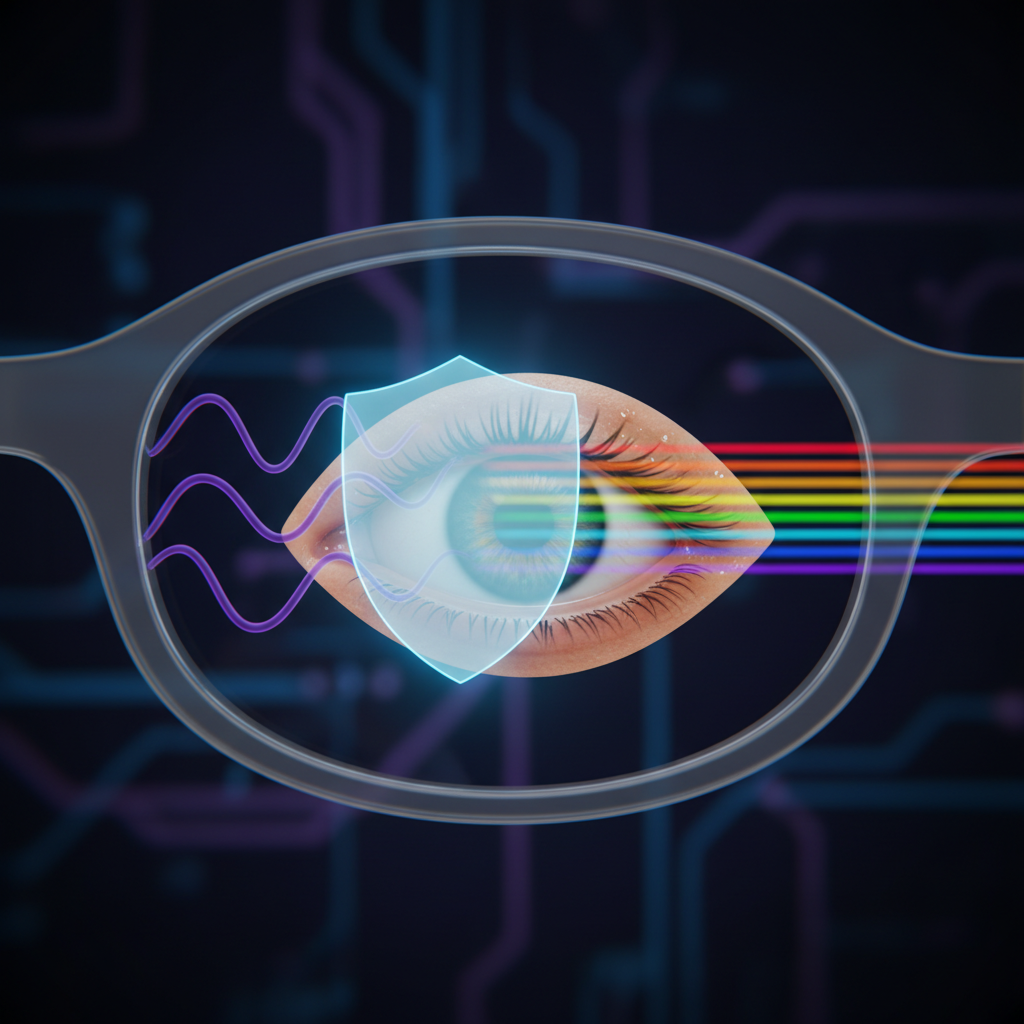
Unlike a hat, which simply casts a shadow, sunglasses work at a molecular level. They are a form of personal protective equipment (PPE) that uses advanced optical filtering to absorb or reflect harmful UV radiation before it can reach your eye.
The key to effective sunglasses is not the darkness of the tint, but the presence of a UV-blocking filter. In fact, wearing dark lenses without certified UV protection is more dangerous than wearing no sunglasses at all. As MD Anderson Cancer Center experts warn, the dark tint causes your pupils to dilate, opening the door for more UV radiation to enter the unprotected eye. This "darkness myth" is one of the most critical misconceptions in sun safety, a topic further explored in our article on whether darker sunglass lenses are more UV protective.
Here’s what makes sunglasses the superior tool for eye protection:
- Comprehensive UV Spectrum Blocking: Look for a label that says "UV400" or "100% UV Protection." This signifies that the lenses block all light rays with wavelengths up to 400 nanometers. This covers all of UVA and UVB rays. A technical report in PubMed criticized older standards that only protected up to 380 nm, noting the 380-400 nm band contains significant energy that can harm the eye.
- 360-Degree Protection: Well-fitting, oversized, or wraparound sunglasses block UV rays from entering the eye from the front, sides, top, and bottom, offering protection from direct, scattered, and reflected light. This directly counters the peripheral exposure that hats miss.
- Material Science: Modern polycarbonate and Trivex lenses have UV protection embedded directly into the material itself, as noted by University of Utah Health. This means the protection won't scratch off over time, unlike the cheap coatings found on low-quality lenses.
It is also vital to understand that polarization is a separate feature from UV protection. As Harvard Health Publishing explains, polarized lenses contain a filter that blocks the intense horizontal glare from reflective surfaces. While this dramatically improves comfort and visual clarity, it does not inherently block UV. Always verify that a polarized lens is also rated for UV400 protection.
The Gold Standard: Why You Need Both a Hat and Sunglasses
The debate should not be "hats or sunglasses," but rather "hats and sunglasses." The two items serve different but complementary functions, creating a synergistic system for maximum safety.
- The Hat's Role: Reduces the total overhead UV load on the face and scalp and minimizes the amount of light that can leak in over the top of your sunglass frames.
- The Sunglasses' Role: Act as the final, comprehensive filter, blocking the reflected and scattered UV that bypasses the hat's brim and providing 360-degree protection directly at the eye.
This combined approach is especially critical for certain high-risk populations:
- Children: The lens inside a child's eye is much clearer than an adult's, allowing more UV to penetrate deep to the retina. Research indicates that a child's retina receives 2-5% of ambient UV, compared to just 1% in adults. Despite this, a German study found that only 12.5% of children wear sunglasses regularly. Given that UV damage is cumulative, protecting children's eyes from a young age is essential for preventing future cataracts and other diseases.
- Outdoor Enthusiasts and Workers: Individuals who spend extended time near water, snow, or at high altitudes face the highest levels of reflected UV and require the dual protection of a hat and wraparound, UV400-rated sunglasses.
- Post-Cataract Surgery Patients: After cataract surgery, the eye is particularly vulnerable to UV and blue light. Proper protection is not just for comfort; it's a medical necessity, as discussed in our guide to sunglasses after cataract surgery.
Final Takeaways: Adopting a Health-First Approach to Sun Protection
Thinking of sunglasses as a medical device rather than a fashion accessory is the first step toward better eye health. A sun hat is a valuable tool, but it is not a substitute for the targeted, comprehensive optical filtration that quality sunglasses provide.
When choosing your next pair of sunglasses, prioritize function over fashion. Look for these non-negotiable features:
- The UV400 Label: This is the most crucial feature, guaranteeing protection from 99-100% of UVA and UVB rays.
- Generous Coverage: Opt for oversized or wraparound styles. The AAO recommends these designs to cut down on UV radiation entering from the sides.
- Quality Materials: Choose lenses made from polycarbonate or other materials with inherent UV protection that cannot be scratched off.
Ultimately, the most effective strategy is the simplest: wear both. A wide-brimmed hat and a pair of certified UV400 sunglasses work together to provide a near-impenetrable barrier against the full spectrum of solar radiation. This isn't just about comfort on a sunny day; it's a lifelong investment in preventing cataracts, macular degeneration, and other serious, vision-stealing conditions.
Disclaimer: This article is for informational purposes only and does not constitute professional medical advice. Please consult with a qualified eye care professional for any health concerns or before making any decisions related to your eye health.
References
- Roberts, J. E. (2011). Ocular phototoxicity. Journal of Photochemistry and Photobiology B: Biology, 103(2), 1-19.
- Sliney, D. H. (2016). Ocular dosimetry and the Coroneo Effect. Photochemistry and Photobiology, 92(1), 16-21.
- American Academy of Ophthalmology (AAO). (n.d.). Sun Safety. Retrieved from https://www.aao.org/eye-health/tips-prevention/sun
- MD Anderson Cancer Center. (2020). 9 things to know about sunglasses, eye protection and cancer. Retrieved from https://www.mdanderson.org/cancerwise/9-things-to-know-about-sunglasses--eye-protection-and-cancer.h00-159699123.html
- Cole, B. L. (2019). Solar ultraviolet radiation protection by sunglasses: A technical report. Clinical and Experimental Optometry, 102(4), 332-343.
- Harvard Health Publishing. (2021). Polarized sunglasses: Protecting your eyes from harmful glare. Retrieved from https://www.health.harvard.edu/staying-healthy/polarized-sunglasses-protecting-your-eyes-from-harmful-glare
- Citek, K., et al. (2019). Ocular UV dosimetry: The effect of frame geometry and lens size on the extent of ocular protection from solar ultraviolet radiation. Photochemistry and Photobiology, 95(5), 1265-1275.
- Sachsenweger, M., et al. (2023). Sunglasses Use in Children and Adults: A Population-Based Study in Germany. Ophthalmic Research, 66(1), 896-902.