


Will Strong Prescription Lenses Distort My Eyes?
TL;DR: How to Avoid Eye Distortion with Strong Prescriptions
Worried about your glasses making your eyes look too big or small? You can significantly minimize this effect. The solution lies in a combination of modern lens technology and smart frame choices. Opt for high-index aspheric lenses to get the thinnest and flattest profile possible. Pair them with smaller, rounder, or oval frames that keep the lens size to a minimum. Finally, ensure you have an accurate pupillary distance (PD) measurement and always add an anti-reflective (AR) coating to reduce glare that accentuates lens thickness.
It's not about the prescription itself, but how you craft the glasses around it.
For anyone with a strong prescription, there's a common fear: "Will my new glasses distort my eyes?" It's a valid concern. You may have seen others with thick lenses that create a "bug-eye" (magnified) or "tiny-eye" (minified) effect. This can be a significant cosmetic issue, making some people reluctant to wear their glasses.
The good news is that modern optical technology provides powerful solutions to prevent this. The dreaded "coke bottle" look is no longer an inevitability. By understanding the science behind the distortion and making informed choices about your lenses and frames, you can wear your strong prescription with confidence.
This article will explain why this distortion happens and provide a practical, step-by-step guide to choosing glasses that look great and feel comfortable, no matter your prescription numbers.
The Science Behind Lens Distortion: Why "Big" and "Small" Eyes Happen
The magnifying or minimizing effect of prescription lenses isn't an illusion; it's a direct result of how lenses bend light to correct your vision. The type and power of your prescription determine the outcome.
Understanding Your Prescription: Plus vs. Minus Powers
First, it helps to know what the numbers on your prescription mean. As the Cleveland Clinic explains, the key number is the Sphere (SPH). This indicates the main power of the lens needed to correct your vision.
Farsightedness (Hyperopia): If your SPH number is positive (e.g., +4.00), you are farsighted. Your lenses are "plus power" lenses. These are convex (thicker in the center, thinner at the edge) and converge light. This convex shape acts like a magnifying glass, making your eyes appear larger to others.
Nearsightedness (Myopia): If your SPH number is negative (e.g., -6.00), you are nearsighted. Your lenses are "minus power" lenses. These are concave (thinner in the center, thicker at the edge) and diverge light. This concave shape has a minifying effect, making your eyes appear smaller.
The further the number is from zero (in either the plus or minus direction), the stronger the prescription and the more pronounced the distortion will be with basic lenses.
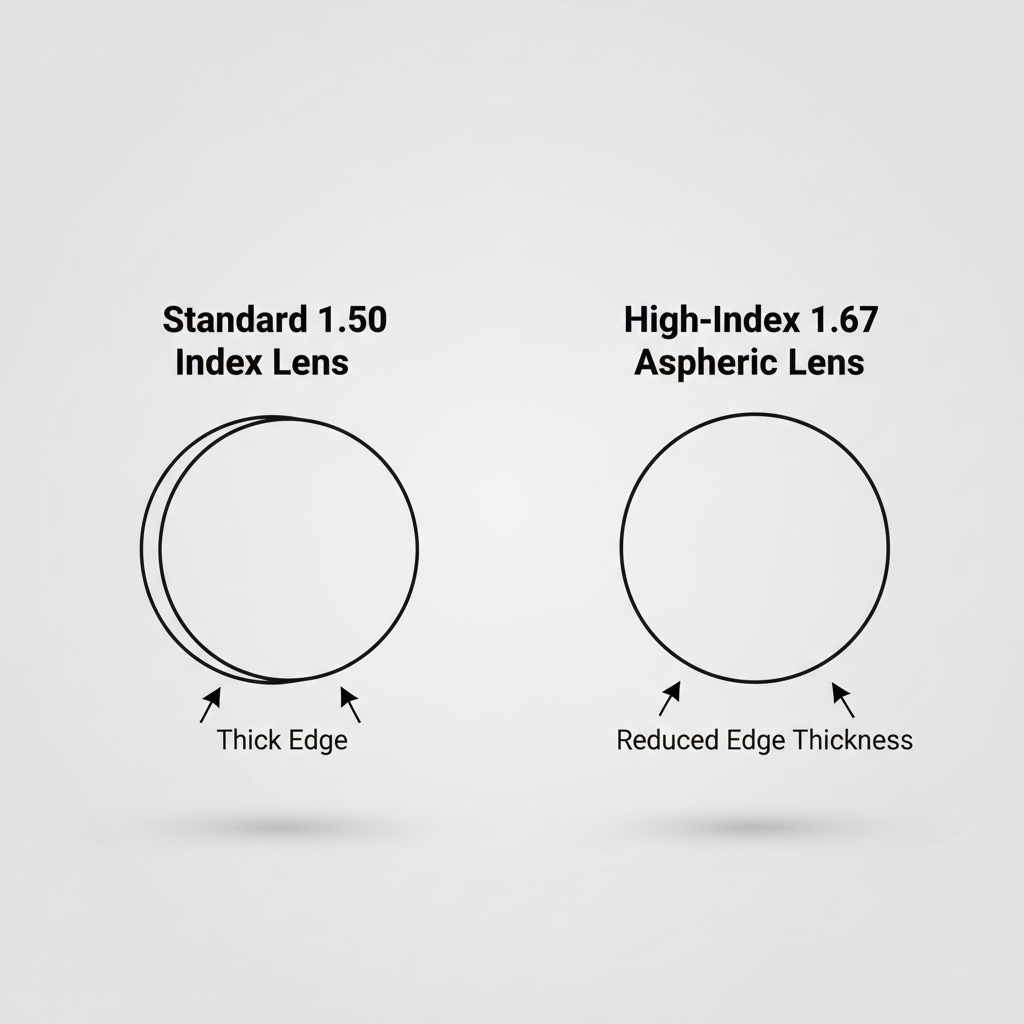
The Solution: Aspheric and Atoric Lens Designs
For decades, the only option was a simple, spherical lens curve. This design works well for lower prescriptions but causes significant distortion and adds thickness and weight in stronger powers.
This is where aspheric lenses come in. Instead of a perfectly round, basketball-like curve, an aspheric lens has a more complex, flatter curve that gradually changes from the center to the edge. This sophisticated design offers several key advantages:
Reduces Magnification/Minification: The flatter profile significantly lessens the "bug-eye" or "tiny-eye" effect.
Thinner and Lighter: Aspheric designs help to reduce the overall volume of the lens material, making the final glasses lighter and more comfortable.
Wider Field of Clear Vision: They reduce the peripheral distortion that can make vision feel unnatural in standard lenses.
For those with astigmatism (indicated by the CYL and Axis values in a prescription), an atoric lens is an even more advanced version, applying aspheric principles in multiple directions to provide the clearest and most cosmetically appealing result.
High-Index Lenses: The Foundation for Slimmer, More Attractive Glasses
While lens design is crucial, the material itself plays an equally important role. This is where high-index lenses become essential for anyone with a moderate to strong prescription.
What Is a High-Index Lens?
The "index" of a lens refers to its refractive index—a measurement of how efficiently it bends light. According to Ferris State University's College of Optometry, a higher refractive index means the material can bend light more effectively. Because it's more efficient, less material is needed to achieve the same prescription power.
This results in a lens that is both thinner and lighter than one made from a conventional material like standard plastic (CR-39), which has a refractive index of around 1.50.
High-index lenses are typically available in the following materials:
1.61 Index: A great starting point for moderate prescriptions, offering a noticeable reduction in thickness.
1.67 Index: A popular choice for stronger prescriptions, providing a significant cosmetic improvement. It's often considered the sweet spot for performance and cost.
1.74 Index: The thinnest and lightest plastic lens material available, recommended for the very strongest prescriptions.
Pro Tip: A Practical Guide to Choosing Your Lens Index
Opticians and lab technicians often use a simple heuristic to recommend a lens index. While your personal preference for thinness matters, this provides a solid starting point:
| Prescription Power (Strongest value in SPH or CYL) | Recommended Lens Index |
|---|---|
| 0 to ±2.00 | 1.50 (Standard Plastic) |
| ±2.25 to ±4.00 | 1.61 (High-Index) |
| ±4.25 to ±6.00 | 1.67 (High-Index) |
| Above ±6.00 | 1.74 (High-Index) |
This framework ensures you get a tangible benefit from the upgrade. Using a 1.67 index for a -1.00 prescription, for instance, would offer almost no visible difference and would not be a cost-effective choice.
Debunking a Common Misconception
A common myth is that high-index lenses eliminate all distortion. In reality, their primary benefit is reducing thickness and weight. While this contributes significantly to a better cosmetic appearance—especially for nearsighted prescriptions where edge thickness is the main concern—the aspheric design of the lens is what directly tackles the magnification or minification effect. For the best results, you need both: a high-index material combined with an aspheric design.
Frame Choice: The Unsung Hero for High Prescriptions
You can have the most advanced lenses in the world, but if you put them in the wrong frame, you can undo many of their benefits. Frame selection is not just about style; it's a critical technical decision.
Why Smaller is Better
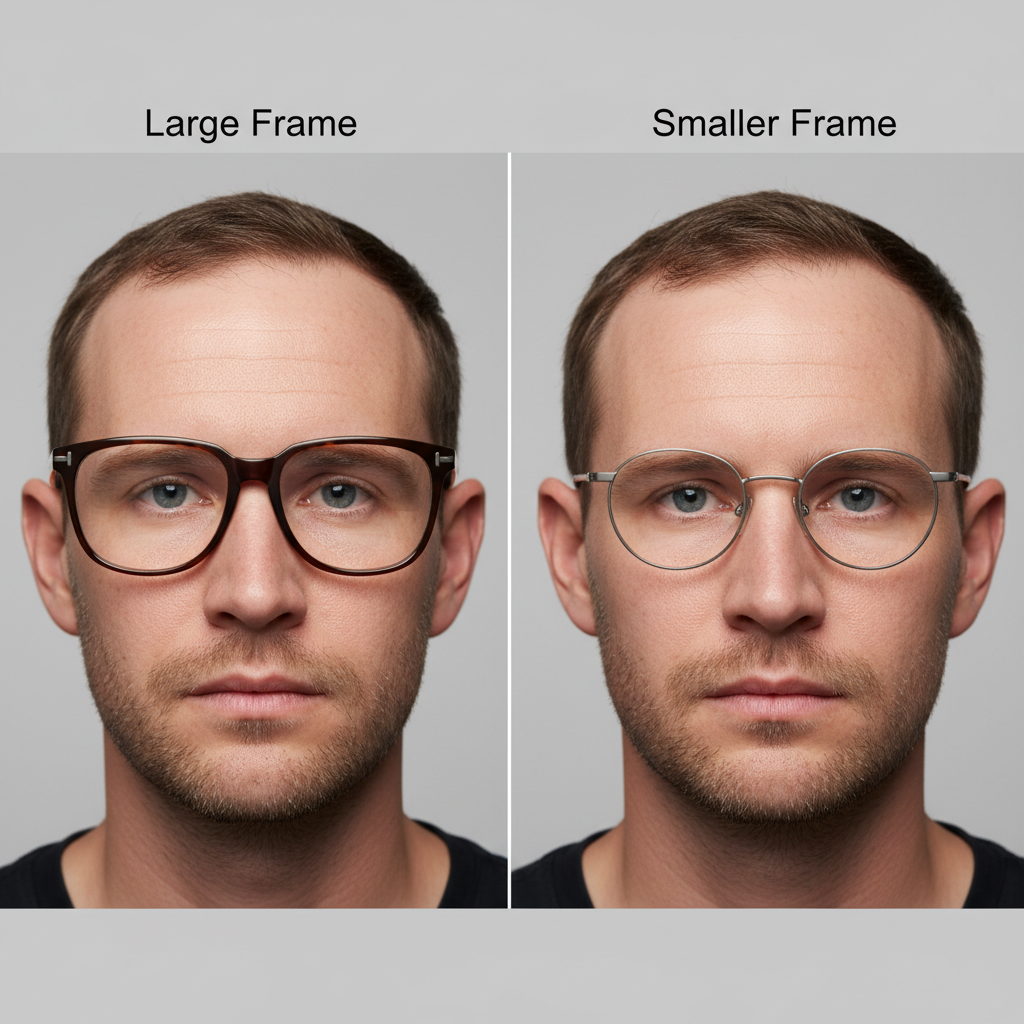
For a minus (nearsighted) prescription, the lens is thinnest in the center and thickest at the very edge. The larger the frame, the more of that thick outer edge you will use, resulting in a "coke bottle" effect.
By choosing a smaller, narrower frame, the lab can cut away the thickest parts of the lens blank, leaving only the thinner central portion. This is the single most effective way to ensure your finished glasses have the thinnest edges possible.
Round and oval shapes are particularly effective because they eliminate the sharp corners of square or rectangular frames, which often create unnecessary thickness and width.
The Critical Role of Fit: PD and Vertex Distance
A proper fit is essential for both vision and aesthetics. Two measurements are particularly important for strong prescriptions:
Pupillary Distance (PD): This is the distance between the centers of your pupils. It dictates where the optical center of your lenses should be placed. An incorrect PD can induce prism and eye strain. With strong prescriptions, even a small error can be problematic, as highlighted in our guide on whether a small PD error matters. Ensuring this measurement is precise is a foundational step. If you're ordering online, using a reliable method to measure your PD at home is crucial.
Vertex Distance: This is the distance from the back surface of the lens to the front of your cornea. For prescriptions stronger than ±4.00 D, even a few millimeters of change in this distance can alter the effective power of the glasses. A frame that sits too far from your face can make your prescription feel "off." Choosing a frame with an adjustable bridge or one that sits naturally close to your face helps maintain optical accuracy.
Final Touches: Coatings and Quality Standards
Beyond the lens and frame, a few final details ensure your glasses perform and look their best.
Anti-Reflective (AR) Coating: A Non-Negotiable Add-On
High-index materials reflect more light than standard plastic. According to Ferris State University, this can cause distracting glare for the wearer and create reflections on the lens surface that are highly visible to others. These reflections call attention to the thickness of the lens.
An Anti-Reflective (AR) coating minimizes these reflections, allowing more light to pass through the lens for clearer vision and making the lenses appear nearly invisible. This enhances your visual comfort and dramatically improves the cosmetic appearance of your glasses. For high-index lenses, AR coating is not just an option; it's a necessity.
Ensuring Safety and Quality
No matter the prescription, all eyewear sold in the United States must comply with specific safety standards. The U.S. Food and Drug Administration (FDA) mandates that all prescription lenses pass an impact resistance test, as detailed in 21 CFR 801.410. This ensures your lenses, whether they are standard plastic or high-index, are durable enough for daily wear.
Furthermore, all glasses should provide adequate protection from the sun's harmful rays. A study published in PubMed found that plastic lenses inherently block a significant amount of UV radiation. Adding a UV-protective coating ensures you have comprehensive protection.
Key Takeaways: Your Checklist for Distortion-Free Glasses
Navigating a strong prescription doesn't have to be daunting. By focusing on the right combination of technology and fit, you can achieve clear vision without compromising on aesthetics. If you're worried about your new glasses making your eyes look distorted, remember these key principles:
Choose High-Index Lenses: Select an appropriate index (1.61, 1.67, or 1.74) based on your prescription strength to make your lenses thinner and lighter.
Insist on an Aspheric Design: This is the key to directly reducing the magnification or minification effect that causes eye distortion.
Pick Smaller Frames: Opt for smaller, rounder, or oval-shaped frames to minimize the lens diameter and reduce edge thickness.
Prioritize an Accurate Fit: Ensure you have a precise Pupillary Distance (PD) and choose a frame that sits at a proper vertex distance.
Always Add AR Coating: This essential coating reduces reflections, improves visual clarity, and makes your lenses look nearly invisible.
By following this checklist, you can work with your optician or online retailer to create a pair of glasses that you'll love to wear. If you ever receive new glasses and the prescription feels off, consult our guide on what to do if your new online prescription feels wrong for troubleshooting steps.
Frequently Asked Questions (FAQ)
Will wearing a strong prescription make my eyes weaker?
No, this is a common myth. Your prescription glasses are designed to correct a refractive error caused by the shape of your eye. Wearing them helps you see clearly and reduces eye strain, but it does not change your eye's underlying structure or make it more dependent on correction.
Why are high-index and aspheric lenses more expensive?
These lenses involve more advanced materials and a more complex manufacturing process. The raw materials for high-index plastics are more costly to produce, and grinding a precise aspheric curve requires more sophisticated equipment and quality control than producing a simple spherical lens. The result is a premium product with significant visual and cosmetic benefits.
Can I use any frame I want for my high prescription?
While you technically can, it is highly discouraged. Putting a strong prescription into a very large or wrap-around frame will result in extremely thick, heavy, and cosmetically poor lenses. It can also introduce peripheral distortions. Following the advice to choose smaller, well-fitting frames will lead to a much better outcome. You can explore how even thin, stylish frames can work with a high Rx if the size and shape are right.
Disclaimer: This article is for informational purposes only and does not constitute professional medical advice. The information provided is intended to help you make informed decisions about your eyewear in consultation with a qualified eye care professional. Always consult your optometrist or ophthalmologist for any health-related concerns, for a comprehensive eye exam, and before making any decisions about your vision care.