

Starbursts and Halos After ICL Surgery: What’s Normal?
Understanding Starbursts and Halos: A Common Post-Surgery Experience
If you've recently had Implantable Collamer Lens (ICL) surgery, you might be noticing new patterns of light, especially at night. Seeing starbursts (rays radiating from lights) or halos (rings around lights) is a common and usually temporary experience during the recovery period. While often startling at first, these visual phenomena are typically a predictable part of your eye's adjustment process.
This article will walk you through why starbursts and halos happen, what to consider a normal part of healing, the warning signs of a potential issue, and practical ways to manage these effects as your eyes adapt to a new, clearer world.
The Science Behind the Light Show: Pupil Dilation and ICL Optics
The fundamental reason for post-ICL starbursts and halos lies in the relationship between your pupil and the ICL itself. The ICL is an advanced, micro-thin lens placed inside your eye to correct vision, but like any lens, it has a finite size.
Here’s the mechanism:
- The ICL's Optic Zone: The central part of the ICL that provides vision correction is called the optic. This zone is designed to be large enough to cover your pupil in most lighting conditions.
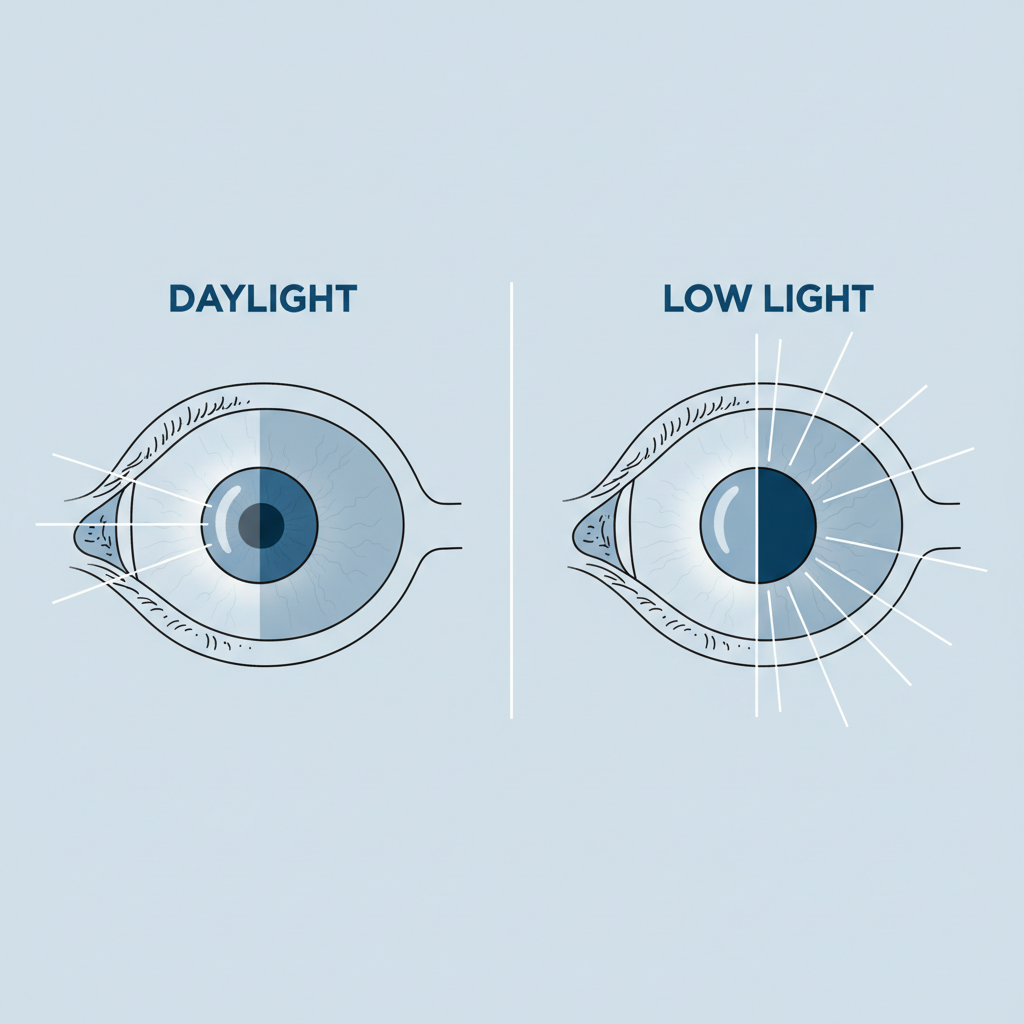
- Pupil Dilation: In low-light environments, such as driving at night, your pupil naturally dilates (expands) to let in more light.
- Light Bending at the Edge: If your pupil dilates wider than the ICL’s optic zone, light rays that pass through the very edge of the optic can bend differently than rays passing through the center. This peripheral light scatter is what your brain interprets as a halo or starburst.
This phenomenon is a well-understood aspect of many types of refractive surgery. For instance, studies following LASIK patients, such as a meta-analysis of FDA trials published in Ophthalmology, found that post-operative glare and halos were reported by 19.7% and 17.5% of patients respectively. While the mechanism is different (tissue ablation vs. an implant), it highlights that light-related side effects are an expected trade-off for many in achieving spectacle independence.
Your brain is incredibly adaptable. This process, known as neuroadaptation, involves your brain learning to filter out these new, extraneous visual signals over time. For most people, what is initially a noticeable distraction eventually fades into the background or disappears completely.
What’s Normal? The Healing and Adaptation Timeline
Patience is crucial during the first few months after ICL surgery. The visual system needs time to heal and adapt. Here’s a typical timeline for what to expect:
- First 1-2 Weeks: This is when halos and starbursts are often most intense. Your eyes are still healing from the procedure, and inflammation can contribute to light scatter. Consistent use of prescribed anti-inflammatory eye drops is critical during this phase.
- 1 to 3 Months: You should notice a significant reduction in the frequency and intensity of these visual effects. Night driving becomes more comfortable, and the halos may appear less dense. This is a strong sign that neuroadaptation is well underway.
- 3 to 6 Months: For the majority of patients, starbursts and halos have either resolved completely or are only minimally noticeable in very specific low-light situations. They no longer interfere with daily activities.
It's important to remember that this timeline can vary based on individual factors, including pupil size, age, and the specific prescription corrected.
When to Contact Your Doctor: Identifying Potential Red Flags
While most instances of halos and starbursts are benign, certain symptoms warrant an immediate call to your ophthalmologist. These can be signs of a complication that requires medical attention.
1. Sudden Worsening or Change in Symptoms: If you notice a sudden increase in the intensity or frequency of halos, especially if they were previously improving, it’s important to get it checked.
2. Accompanied by Pain or Headaches: Halos combined with eye pain, severe headaches, or nausea can be a symptom of a sudden spike in intraocular pressure (IOP). High IOP is a serious condition that needs to be addressed urgently to prevent damage to the optic nerve.
3. Persistent and Severe Symptoms Beyond 6 Months: If the starbursts and halos are not improving after six months and continue to significantly impact your ability to function (especially driving at night), it could indicate an issue with the ICL sizing. If the ICL’s optic is too small for your pupil’s maximum dilation size, the symptoms may not resolve on their own. This is a topic to discuss in-depth with your surgeon.
4. Blurry Vision or a "Foggy" View: If the light disturbances are accompanied by a general decrease in vision clarity that isn't improving, it could be a sign of persistent inflammation or, in rare cases, other complications like early cataract formation.
Regular follow-up appointments are a standard part of the post-operative process. Never hesitate to raise your concerns during these visits.
Practical Tips for Managing Halos and Starbursts
As you navigate the adaptation period, there are several strategies you can use to minimize the impact of starbursts and halos on your daily life.
- Optimize Your Lighting: Use dimmers on indoor lights to create softer ambient lighting in the evenings. Turning on a small lamp in a dark room can help keep your pupils slightly smaller, reducing the halo effect when watching TV.
- Wear Anti-Reflective Glasses: It may seem counterintuitive to wear glasses after vision correction surgery, but a pair of non-prescription glasses with a high-quality anti-reflective (AR) coating can be incredibly helpful for night driving. As documented in studies on night driving, AR coatings significantly reduce glare from headlights and streetlights, making the starbursts you experience less intense.
- Choose the Right Frames: If you do get glasses for night driving, consider the advice for post-operative patients. Opt for lightweight frames made of titanium or flexible memory metals. These materials put less pressure on a healing nasal bridge. Ensure the frames have adjustable nose pads for a perfect, comfortable fit.
- Use Prescribed Eye Drops: Faithfully use your lubricating and anti-inflammatory eye drops. A healthy, smooth tear film on the surface of your cornea is essential for clear vision and minimizing light scatter.
- Be Cautious at Night: In the first few weeks, be extra careful when driving at night. If you feel uncomfortable, try to arrange travel at other times or take routes that are better lit.
Frequently Asked Questions (FAQ)
Q: Will the starbursts and halos after ICL surgery ever go away completely? A: For the vast majority of patients, these symptoms significantly diminish over 3 to 6 months to the point where they are no longer bothersome or noticeable. In a small number of cases, particularly in individuals with very large pupils, a minor degree of halo or starburst may persist in very dark conditions.
Q: Can another surgery fix the halos? A: This is generally a last resort and only considered if the symptoms are debilitating and traced to a clear cause, such as a significantly undersized ICL. In such rare cases, an ICL exchange procedure might be an option, but this carries its own set of risks. Most often, the solution is patience and neuroadaptation.
Q: Do halos mean I have night blindness? A: No. Night blindness (nyctalopia) is a condition where you have difficulty seeing in low light, often related to retinal issues. Starbursts and halos are optical phenomena of light being scattered, not an inability to see.
Ultimately, adjusting to ICLs is a journey. The appearance of starbursts and halos is a common bump in the road, but one that your brain is well-equipped to smooth out. By understanding the cause, knowing the timeline for adaptation, and recognizing the few critical warning signs, you can confidently navigate your recovery toward a life of clear, unaided vision.
This article is for informational purposes only and does not constitute professional medical advice. Always consult with a qualified ophthalmologist regarding your eye health and any symptoms you may be experiencing after surgery. Pre-existing conditions and individual anatomy can affect outcomes.
References
- Bailey, M. D., & Zadnik, K. (2007). Outcomes of LASIK for myopia with FDA-approved lasers. Ophthalmology, 114(4), 845-851.
- García-Juidías, P., et al. (2022). Impact of Anti-reflective Coating on Night Driving Safety. Journal of Ophthalmology.
- American Academy of Ophthalmology. (2021). Refractive Management/Intervention. Preferred Practice Pattern Guidelines.
- Villani, E., et al. (2013). Adaptation to Progressive Lenses: A Study of Neuroplasticity. Vision Research.