



Why You Can't Use Standard Progressives for Golf: A Guide to Sports Multi-focals.
The Frustration of the Fairway: Why Your Everyday Progressives Fail at Golf
If you wear progressive lenses, you likely appreciate the seamless transition from reading a menu to seeing across the street. But if you've tried to take those same glasses to the golf course, you've probably experienced a unique set of frustrations. The ball at your feet is blurry, the ground seems to ripple when you turn your head, and you're forced into an awkward "chin-up" posture just to see the ball, wrecking your carefully practiced swing mechanics.
TL;DR: Your standard progressive lenses are not designed for the dynamic visual demands of golf. Their optical layout, optimized for a static, indoor lifestyle, actively works against you on the course. The solution lies in specialized sports multifocal lenses, engineered specifically for the unique angles and distances of the game.
This guide will break down why your office glasses are a handicap on the fairway and how a dedicated pair of "golf progressives" can provide the stable, clear vision you need to play your best.

Anatomy of a Swing: The Three Visual Zones Your Glasses Must Master
Golf isn't a single-distance sport. During a single hole, your eyes need to perform three distinct tasks:
- Distance Vision: Spotting the landing zone on the fairway or seeing the flag on the green.
- Near Vision: Reading and writing on your scorecard.
- Intermediate Vision: This is the most critical and problematic zone—the view of the ball at your feet as you address it.
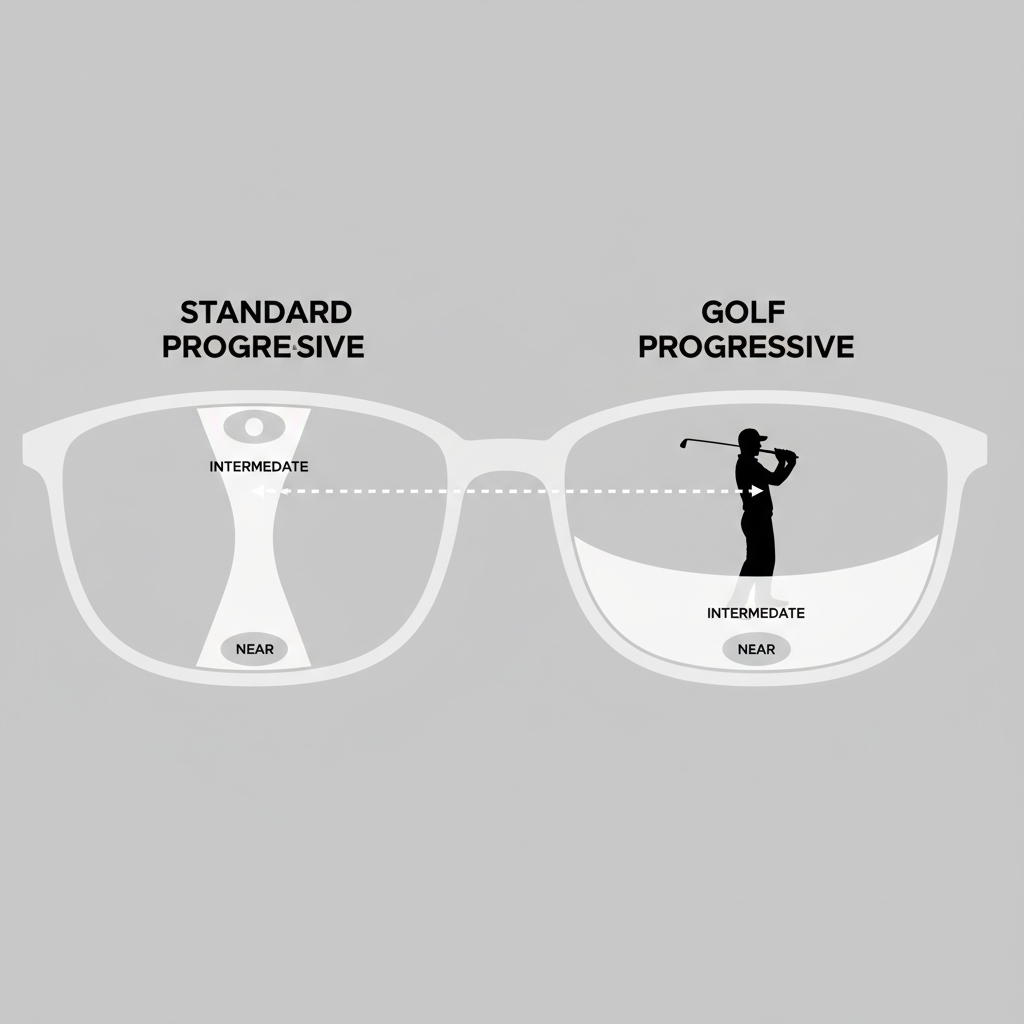
Standard progressive lenses, designed for tasks like reading a book and looking at a computer monitor, place the intermediate viewing zone relatively high in the lens. This works perfectly when you're sitting at a desk. However, a golfer's address posture requires a steep downward gaze angle, often 15-20 degrees below the horizon. Your standard lenses force you to tuck your chin down unnaturally to find the small "sweet spot," disrupting your posture and alignment.
Furthermore, standard progressives often feature "hard" designs that prioritize a wide reading area. The trade-off is significant peripheral distortion, an effect opticians call "swim." As you scan the green or turn your head during your backswing, this distortion can make the ground appear to move or warp, which can severely impact balance and confidence. This "swim effect" is a primary reason wearers struggle to adapt to new progressives, and its effects are amplified in a dynamic environment like a golf course.
The Solution: How Sports Multifocals Are Engineered for the Game
A sports multifocal, or "golf progressive," is a digitally surfaced lens custom-designed to solve these problems. It's not just a different coating; it's a fundamentally different optical map.
- Optimized Corridor: The key difference is a much lower and wider intermediate zone. The lens is engineered to provide a broad, stable field of view precisely where you look at the ball. This eliminates the need to alter your stance or head position, allowing for a natural, repeatable swing.
- Distortion Control: Golf progressives typically use "soft" designs. According to research, the majority of progressive wearers (about 75%) prefer lenses that minimize peripheral distortion, even if it means a slightly narrower central view. For golf, this is crucial. A soft design reduces the swim effect, providing stable peripheral vision so the ground stays put when you move, giving you a reliable sense of your surroundings.
- Frame Compensation: Golfers prefer wraparound frames for stability and protection. However, the high curvature and tilt (pantoscopic tilt) of these frames can induce unwanted prism and blur in standard lenses. As expert fitters know, sports multifocals are surfaced using advanced digital calculations that compensate for the specific wrap and tilt of your chosen frame, ensuring the optics are correct for how you actually wear them.
The Fitter is Your Caddy: Why an Expert Fitting is Non-Negotiable
Even the most advanced lens technology is useless if it's not fitted correctly. Research has shown that even minor fitting errors, like an incorrect pupil height measurement, can drastically shrink the effective reading zone and negate the benefits of a premium lens.
An experienced optician will go beyond a standard prescription check. For a golfer, the process should involve:
- Postural Analysis: They will observe your typical head posture and address position to understand your unique line of sight.
- Gaze Mapping: They will measure the specific gaze angles you use for distance, intermediate (the ball), and near (the scorecard) vision.
- Frame Measurement: They will precisely measure the pantoscopic tilt and wrap angle of your chosen sports frame.
This data is fed into the lens design software to create a truly customized lens. For materials, impact-resistant options like Polycarbonate or Trivex are essential for safety on the course. While both offer 100% UV protection and are shatter-resistant, Trivex often provides superior optical clarity with less chromatic aberration (color fringing), which can be beneficial for those sensitive to visual distortions.

Getting in the Swing: Your Adaptation Guide
Just like breaking in a new pair of golf shoes, adapting to sports multifocals takes a little time. The brain needs to learn the new layout of the lenses and the new head-eye coordination patterns required. Studies on progressive lens adaptation show that wearers naturally develop a "Head Gain" strategy, learning to point their nose more directly at what they want to see clearly.
Expect an adaptation period of two to three rounds. Here is a simple plan to make the transition smooth:
- Start Small: Begin on the putting green. Practice looking from the ball to the hole, getting used to the clear vision by pointing your nose toward your target.
- Move to the Short Game: Progress to the chipping and pitching area. This will help your brain adapt to the crucial ground-to-ball view in a controlled setting.
- Head to the Range: Once you feel comfortable with shorter shots, take your new glasses to the driving range. Work your way through your clubs, from short irons to your driver.
- Play a Full Round: After a few successful sessions, you're ready to take them onto the course for a full game.
A Clearer Game Awaits
Trying to play golf in standard progressive lenses is like trying to putt with a driver—it’s the wrong tool for the job. The resulting blur, distortion, and postural compromises can add strokes to your score and frustration to your game.
By investing in a pair of sports multifocals, custom-fitted by an expert who understands the demands of the sport, you are equipping yourself with a piece of high-performance gear. It’s an investment not just in your vision, but in your comfort, your confidence, and your enjoyment of the game. You’ll gain a stable view of the ball, a true sense of the terrain, and the freedom to focus on your swing, not your sight.
Frequently Asked Questions
Q: Can't I just use bifocals for golf? A: Bifocals lack an intermediate zone entirely. You would have clear distance and near vision, but the ball at your feet would likely fall in the blurry area between the two segments, creating the same problem as progressives.
Q: What about wearing single-vision distance glasses? A: This is a viable option for many, but it means you won't be able to read your scorecard, phone, or GPS watch without switching to a pair of reading glasses.
Q: Are golf-specific progressive lenses expensive? A: They are a premium product due to the advanced digital design and customization required. It's best to think of them as an investment in your equipment, similar to a new driver or putter, that directly enhances performance.
Q: Can I wear my golf progressives for driving or office work? A: While you can, it’s not ideal. These lenses are optimized for the specific downward gaze angle of golf. For driving or computer use, where your gaze is more straight-ahead, a standard or occupational progressive lens will provide wider and more comfortable viewing zones.
This article is for informational purposes only and does not constitute professional medical advice. Consult with a qualified eyecare professional to determine the best vision solution for your specific needs, especially if you have pre-existing eye conditions.
References
- Giffond, C., et al. (2020). Progressive Addition Lenses for VDT and Office Work: A review. BMJ Open Ophthalmology.
- Han, S. C., et al. (2014). Influence of progressive addition lens design on peripheral vision and adaptation. Journal of the Korean Ophthalmic Optics Society.
- Hoya Vision Care. (2016). Polycarbonate vs. Trivex Lenses: A Technical Comparison. Hoya Vision Technical Resources.
- IOT Lenses. (n.d.). Manufacturing Errors in Progressive Lenses and Their Impact on Patient Satisfaction. IOT Technical Blog.
- Sullebarger, G. (2008). Head and Eye Coordination in Progressive Addition Lens Wearers. Optometry and Vision Science.