

Retinal Pigment Epithelium: Irreversible UV Cellular Damage
The Silent Crisis in Your Retina: How UV Radiation Causes Irreversible Damage
Decades of public health campaigns have taught us to protect our skin from the sun. Yet, the most sophisticated lens we own—the one in our eye—is often left exposed to the same invisible threat. Ultraviolet (UV) radiation damage to the eye is not an acute event like a sunburn; it is a silent, cumulative crisis that unfolds over a lifetime. The primary target of this slow assault is a single layer of cells deep within the eye, the Retinal Pigment Epithelium (RPE). This microscopic layer is the life-support system for your vision, and its gradual degradation by UV light is a direct pathway to irreversible sight loss, most notably Age-Related Macular Degeneration (AMD).
This article explores the precise mechanisms by which UV radiation, particularly UVA rays, bypass the eye's natural defenses to inflict lasting cellular damage on the RPE. We will examine the biochemical chain reaction that leads to cell death, identify who is most at risk, and provide an evidence-based strategy to protect your vision for the long term.
The Eye's Multi-Layer Defense: A System Under Constant Siege
The human eye has an impressive, multi-layered defense system against UV radiation. The cornea, the eye's outermost clear layer, acts as the first barrier. Research published in Investigative Ophthalmology & Visual Science (IOVS) confirms that the cornea absorbs the majority of high-energy UVB rays. Following this, the crystalline lens inside the eye filters out most of the remaining UV radiation. A study using porcine models found that the cornea absorbs approximately 63.6% of UV light, while the combined action of the cornea and lens blocks an astonishing 99.3% of total UV.
However, this natural fortress has critical vulnerabilities:
- UVA Penetration: A small but significant amount of lower-energy UVA radiation (320-400 nm) can still penetrate these layers and reach the retina. This is the wavelength most responsible for the slow, oxidative damage that undermines the RPE.
- Age-Related Decline: As we age, the natural protective filters within the lens, composed of kynurenine derivatives and glutathione, begin to decline. An IOVS study on age-related UV filters shows that these protective compounds decrease linearly with age, weakening the retina's shield when it needs it most.
- Childhood Vulnerability: The crystalline lens in a child's eye is significantly clearer than in an adult's. This transparency allows a much higher percentage of UV radiation to pass through to the retina. The Royal Australian and New Zealand College of Ophthalmologists (RANZCO) warns that by age 15, up to 80% of children already exhibit signs of UV-induced eye damage, underscoring that the most significant exposure occurs early in life.

Cellular Sabotage: The Step-by-Step Destruction of the RPE
The Retinal Pigment Epithelium is a monolayer of pigmented cells nestled between the photoreceptors (the rods and cones that detect light) and the choroid (the network of blood vessels that nourishes the retina). The RPE's role is indispensable; it transports nutrients, removes waste products, and recycles photopigments essential for vision. When UVA photons strike this vital layer, they trigger a cascade of destructive events.
The Onset of Oxidative Stress
UVA radiation initiates photo-oxidation, a process that generates highly reactive molecules called free radicals. These molecules steal electrons from other molecules in the cell, destabilizing cellular structures. The RPE, with its high metabolic rate and rich concentration of fatty acids, is exceptionally vulnerable to this oxidative stress.
The "Dark Toxic" Effect of Lipofuscin
A primary consequence of this oxidative damage is the accumulation of a cellular waste product called lipofuscin. Lipofuscin is essentially a collection of oxidized proteins and fats that the RPE cells cannot break down. As these yellow-brown granules build up, they clog the cell's machinery, impairing its ability to nourish the photoreceptors.
Worse still, research has uncovered a phenomenon known as the "lipofuscin-mediated dark toxic effect." A study in the International Journal of Molecular Sciences revealed that oxidized components of lipofuscin can continue to leak into the cell and cause damage for days after the initial UV exposure has ended. This means the harm doesn't stop when you go indoors.
Triggering Cellular Apoptosis
The final stage in this process is programmed cell death, or apoptosis. Advanced research has identified a specific "ceramide-ER stress-AMPK" signaling pathway that is activated in UV-treated RPE cells. In simple terms, the overwhelming stress caused by UV exposure and lipofuscin accumulation triggers an internal self-destruct sequence. Once an RPE cell dies, it is not replaced. As more cells are lost, the support system for the photoreceptors collapses, leading to their death and the formation of blind spots characteristic of geographic atrophy, the advanced stage of dry AMD.
Identifying High-Risk Individuals: Genetics, Age, and Lifestyle
While everyone is susceptible to RPE damage from UV radiation, certain factors dramatically increase an individual's risk profile. Understanding these factors is key to adopting the right level of protection.
The Melanin Shield: Why Eye Color Matters
The pigment melanin is a natural photoprotectant. Darker irises contain a higher concentration of eumelanin, which absorbs and dissipates UV energy. Light-colored eyes (blue, green, hazel) have significantly less of this protective pigment. A comprehensive review in the International Journal of Molecular Sciences identified light eye color as a significant risk factor for Uveal Melanoma, a rare but deadly eye cancer, with studies showing a 1.5-fold or higher risk. The cancer cells in light-eyed individuals were found to have up to 31 times less eumelanin than normal melanocytes, demonstrating a profound lack of natural defense. This same principle applies to UV damage to the RPE, where less melanin means more radiation gets through.

The Cumulative Factor: When Exposure Starts
UV damage is a disease of accumulation. An individual's total lifetime exposure is the most critical determinant of their risk for conditions like cataracts and AMD. The World Health Organization (WHO) estimates that up to 10% of the 15 million cases of blindness due to cataracts globally can be attributed to UV exposure.
The risk begins accumulating much earlier than most people realize. A study published in IOVS on university students with a mean age of just 19.7 found a pinguecula (a UV-related growth on the eye's surface) prevalence of over 40%. For students reporting more than six hours of daily outdoor activity, that figure skyrocketed to 75%. This is a clear indicator that significant, tissue-altering UV exposure is happening in the first two decades of life.
A Comprehensive Defense Strategy: Beyond "UV400"
Effective protection for the RPE requires a strategy that goes beyond simply choosing lenses with a "100% UV Protection" sticker. The physical design of your eyewear and the materials used are just as critical as the UV filter itself.
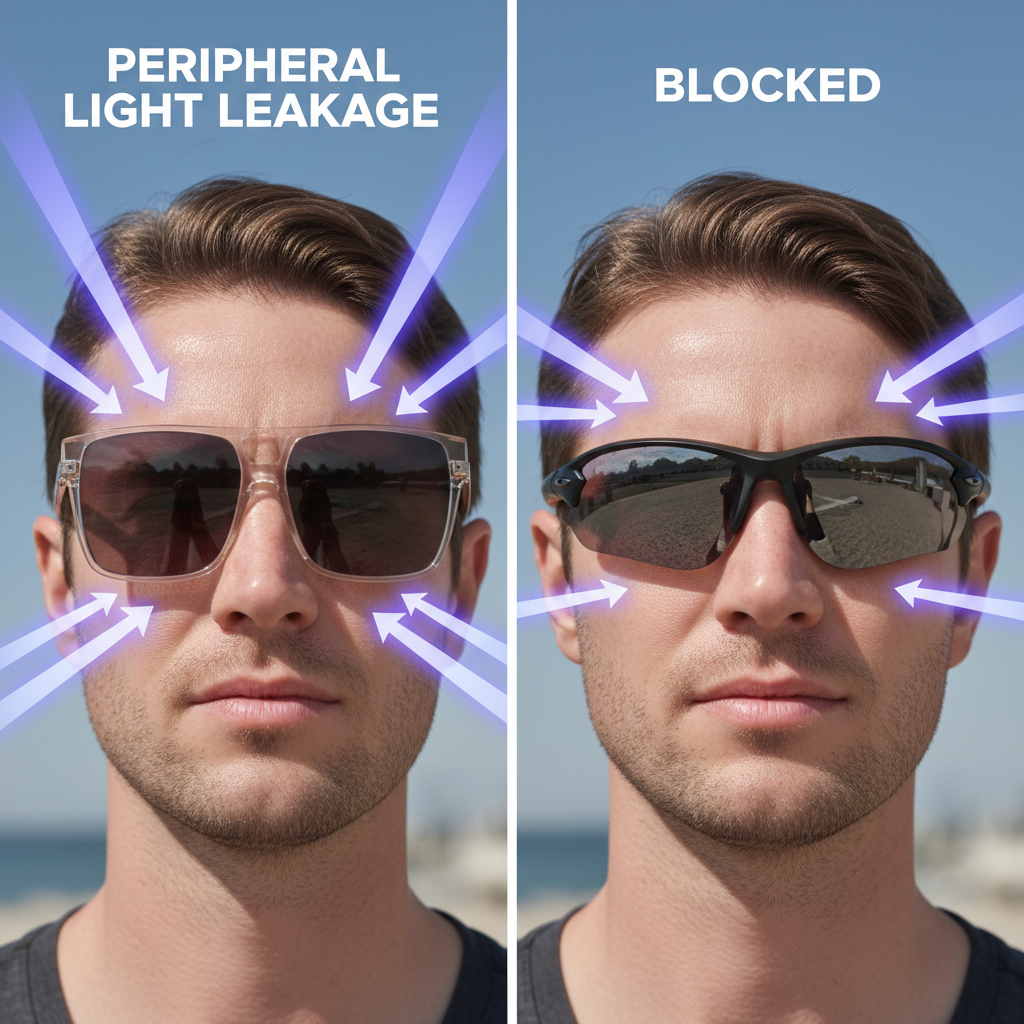
The Critical Flaw of Fashionable Frames: Peripheral Light Leakage
In clinical practice, a key heuristic is that frame coverage is as important as lens filtration. Standard flat-front sunglasses, no matter how dark or how high their UV rating, leave significant gaps at the top, bottom, and sides. UV rays entering from these angles can bypass the lens entirely or, through the "Coroneo Effect," focus onto sensitive parts of the eye.
This is why eye care professionals consistently recommend close-fitting, wraparound-style frames. These designs create a physical barrier that minimizes peripheral light leakage, providing a much higher degree of real-world protection for the retina.
Lens Material Science: Inherent vs. Coated Protection
Not all lens materials offer the same long-term security.
- Polycarbonate: This impact-resistant material is an excellent choice because it inherently blocks 100% of UV radiation. The protection is part of the material itself and cannot scratch off or degrade over time.
- CR-39 Plastic: Standard plastic lenses require a separate UV-blocking coating to be applied. While effective when new, this coating can become compromised by scratches or harsh cleaning, potentially reducing its protective capabilities over the lifespan of the glasses. For more details on this topic, you can explore whether sunglasses' UV coatings expire.
A Holistic Approach to Sun Safety
While high-quality sunglasses are the cornerstone of eye protection, a complete strategy includes other measures. According to StatPearls, a wide-brimmed hat can reduce the amount of UV light reaching the eyes by as much as 30%. Combining a hat with wraparound sunglasses provides the most robust defense against direct and reflected radiation.
Protecting your eyes from the sun is not a matter of seasonal comfort; it is a year-round medical necessity. The damage inflicted upon the Retinal Pigment Epithelium is a gradual, painless process that only becomes apparent when vision is already lost. By understanding the mechanisms of this silent crisis and adopting a comprehensive protection strategy—prioritizing frame coverage and material integrity—you are making a critical investment in preserving your sight for a lifetime.
Disclaimer: This article is for informational purposes only and does not constitute professional medical advice. The information provided should not be used for diagnosing or treating a health problem or disease. Always seek the advice of your physician or other qualified health provider with any questions you may have regarding a medical condition.
References
- StatPearls: Pinguecula. (NCBI Bookshelf).
- UV-B absorption in the human cornea. (Investigative Ophthalmology & Visual Science).
- The Impact of Ultraviolet Radiation on the Aetiology and Development of Uveal Melanoma. (International Journal of Molecular Sciences, PMC).
- Ceramide-ER Stress signaling in RPE. (Cell Death & Disease, PMC).
- UV Penetrance through eye structures. (Photochemical & Photobiological Sciences, PMC).
- Lipofuscin-Mediated Dark Toxic Effect. (International Journal of Molecular Sciences, PMC).
- Pinguecula in Young People. (Investigative Ophthalmology & Visual Science).
- Age-related UV filters in Human Lens. (Investigative Ophthalmology & Visual Science).