



Residual Astigmatism After Surgery: Do I Still Need Glasses?
TL;DR: Why Your Vision Isn't Perfect After Surgery
You underwent refractive surgery like LASIK or PRK expecting crystal-clear vision, but now you're noticing glare at night or blurriness when reading. This is a common experience, often caused by residual astigmatism—a small, leftover imperfection in your corneal shape.
- It's Not a Failure: A minor residual error is normal and doesn't mean the surgery failed. The eye is living tissue, and healing isn't always 100% predictable.
- Night vs. Day: The issue is most obvious at night, causing starbursts and halos around lights. During the day, you might not notice it for distance vision.
- The Solution is Simple: A pair of precisely prescribed glasses is the safest and most effective way to correct this, acting as a "finishing touch" for your vision.
- Key Lens Features: For post-surgical glasses, an Anti-Reflective (AR) coating is essential to combat glare, and photochromic lenses can help with new light sensitivity.
The Goal vs. The Reality of Refractive Surgery
The promise of refractive surgery is a life free from corrective lenses. For millions, this becomes a reality. Procedures like LASIK, SMILE, or PRK work by precisely reshaping the cornea—the eye's clear front surface—to correct refractive errors like nearsightedness, farsightedness, and astigmatism. The goal is to make light focus perfectly on the retina, producing sharp, clear vision.
However, the human body is not a machine. The healing process plays a significant role in the final outcome. According to patient-reported data collected for the FDA, three months after LASIK, while satisfaction is high, up to 19.7% of patients report issues with glare and 17.5% notice halos. This doesn't indicate a failed procedure; rather, it highlights that the biological response to surgery can leave behind minor optical imperfections.
It is crucial to wait for the eye to fully stabilize before determining the final visual outcome. This healing and stabilization phase typically takes at least three to six months. During this time, your prescription can fluctuate, so it's not the right time for a final pair of glasses.
What is Residual Astigmatism and Why Does It Happen?
Astigmatism occurs when the cornea is shaped more like an American football than a perfectly round basketball. This irregular shape causes light to focus on multiple points instead of one, resulting in blurry or distorted vision at all distances. Refractive surgery aims to sculpt the cornea into a more spherical shape.
"Residual" astigmatism is simply a small amount of this irregularity that remains after the eye has healed from surgery. Here are the primary reasons it occurs:
- The Healing Response: The cornea is living tissue. As it heals, the epithelial cells on the surface can regenerate in a pattern that is slightly different from the laser's perfectly smooth ablation. This microscopic variation is enough to induce a small amount of astigmatism.
- Incomplete Correction: Sometimes, the initial surgery may not fully correct the entire amount of pre-existing astigmatism, especially in complex or high prescriptions.
- Long-Term Regression: Over many years, the eye can continue to change. A 12-year study on myopic LASIK patients showed a mild trend of myopic regression over time. This slow change can reintroduce a small refractive error.
For most people, the amount of residual astigmatism is very small, often less than 0.75 diopters. While this might sound insignificant, it can have a noticeable impact on your quality of vision, particularly in specific situations.
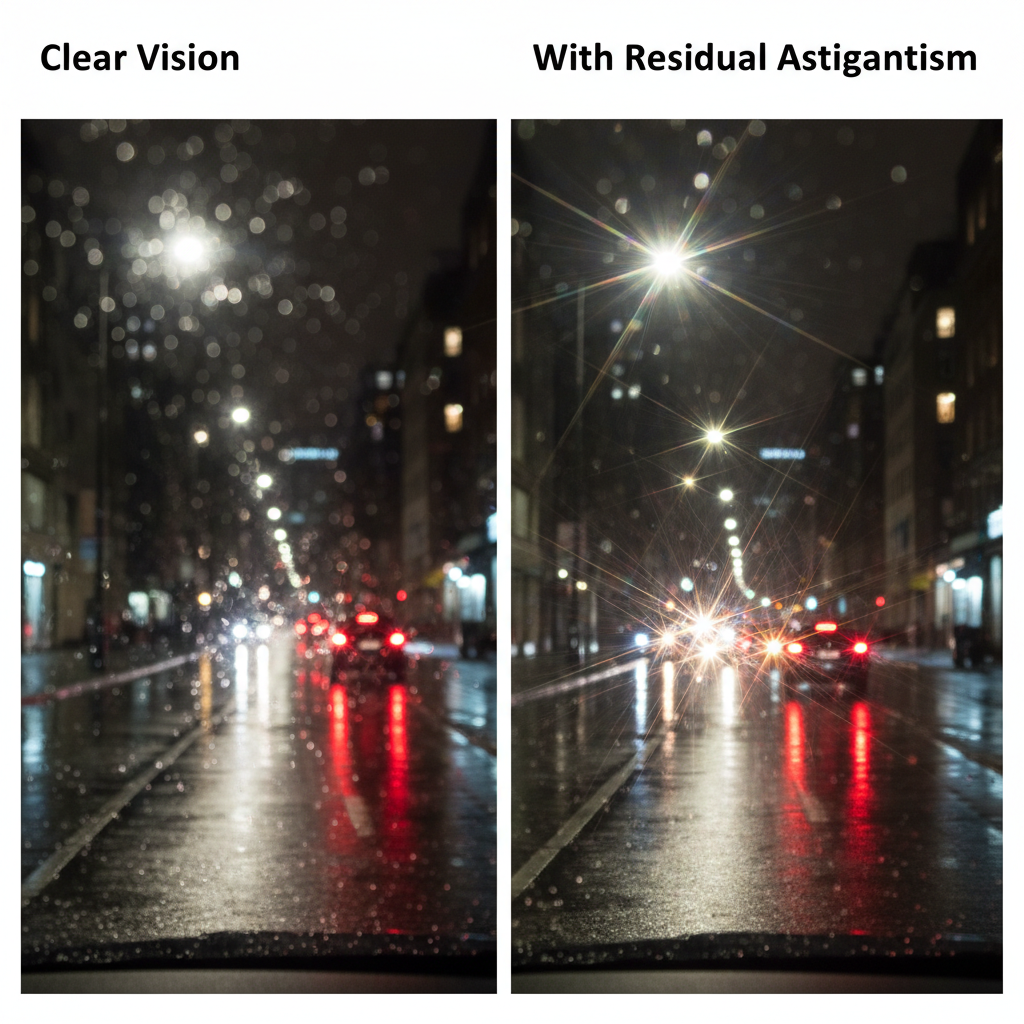
Key Symptoms: The Telltale Signs of Post-Surgical Astigmatism
The experience of having residual astigmatism is often a story of two different scenarios: day and night.
The Night Driving Problem: Glare, Halos, and Starbursts
This is the most common complaint. At night, when your pupils dilate to let in more light, the full periphery of your cornea is exposed. Any minor irregularities from the surgery, like residual astigmatism, become much more apparent. Instead of focusing light into a single sharp point, the cornea scatters it, creating distinct visual distortions:
- Starbursts: Oncoming headlights or streetlights appear to explode into streaks of light.
- Halos: You see glowing rings around sources of light.
- Glare: A general haziness or "smear" of light that reduces contrast and makes it hard to see.
These symptoms can make night driving not just uncomfortable but also challenging. This happens because the small, uncorrected error has a much greater effect in low-light, high-contrast environments.
The Desk Job Dilemma: Eye Strain and Near-Task Blur
During the day, you might see perfectly fine when looking at distant objects. However, when you sit down at your computer or try to read a book, you may experience:
- Digital Eye Strain: A feeling of fatigue, soreness, or general discomfort in your eyes.
- Headaches: A dull ache around your temples or forehead after prolonged near work.
- Fluctuating Blur: Your vision may seem to blur intermittently as your eyes struggle to maintain focus.
Even a small amount of astigmatism forces your eye's internal focusing muscles to work overtime to try and compensate for the blur. While you can manage this for short periods, a full day of near tasks exhausts the system, leading to significant discomfort. If you find yourself struggling with your screen, you may find helpful strategies in our guide to maximizing the 20-20-20 rule for prescription lens wearers.

The Solution: Why Glasses Are the "Finishing Touch"
If you're experiencing the symptoms of residual astigmatism, the most reliable, safest, and most precise solution is often a new pair of glasses. While an "enhancement" or "touch-up" surgery is an option for some, it carries additional risks and is typically not recommended for very small errors where the potential benefit is minimal.
Think of glasses as the final, perfecting step in your vision correction journey. They are custom-built to address the exact, unique curvature of your healed cornea. Here’s what to look for in a pair of post-surgery glasses:
-
A Precise, Updated Prescription: After the 3-6 month healing period, visit your optometrist for a new refraction exam. This will determine the exact power needed to correct any leftover error.
-
Anti-Reflective (AR) Coating: This is non-negotiable. Post-surgical eyes are already prone to glare and halos. An AR coating allows more light to pass through the lens and dramatically reduces the internal reflections that cause these distortions. It is the single most important lens feature for improving nighttime vision and screen comfort.
-
Photochromic Lenses: Many people report increased light sensitivity (photophobia) after refractive surgery. Photochromic lenses, which automatically darken in sunlight, provide 100% UV protection and adapt to changing light conditions, reducing squinting and eye strain both indoors and out.
-
Aspheric Lens Design: For those who still have a relatively strong prescription, modern aspheric lens designs can help reduce the eye distortion that some wearers worry about. These lenses are flatter and thinner, providing a more natural look and wider field of clear vision.
Frequently Asked Questions (FAQ)
Q: Can I just use over-the-counter reading glasses?
A: No. OTC "cheaters" are simply magnifiers with the same power in both lenses and no astigmatism correction. As noted by experts at the Cleveland Clinic, they cannot correct the specific irregularity of astigmatism and may even worsen eye strain and headaches.
Q: Do I need a new prescription, or can I use my old one?
A: You absolutely need a new prescription. Your pre-surgery prescription is now completely irrelevant. An eye exam after your cornea has stabilized is the only way to get an accurate measurement of the residual error.
Q: Will the astigmatism get worse?
A: For most patients, the refractive error is stable after the initial healing period. While minor age-related changes or long-term regression can occur over a decade or more, it is typically a very slow process.
Q: Is needing glasses a sign my surgery failed?
A: Not at all. The goal of surgery is to significantly reduce your dependence on glasses, and for most, it succeeds. Needing a light prescription for specific tasks like night driving or intense computer work is a very common and normal outcome. It represents a fine-tuning of your vision, not a failure of the initial procedure.
Your Vision, Perfected
Realizing you still need glasses after investing in refractive surgery can be disheartening, but it’s important to reframe your perspective. The surgery likely corrected the vast majority of your prescription, freeing you from heavy dependence on lenses for most of your day. A pair of post-surgical glasses is not a step backward; it is a specialized tool designed to perfect your vision for the moments that matter most—ensuring your safety on the road at night and your comfort during a long workday.
By working with your eye doctor and choosing the right lens technologies, you can effectively eliminate the frustrating symptoms of residual astigmatism and enjoy the full, crisp, and comfortable vision you set out to achieve.
This article is for informational purposes only and does not constitute professional medical advice. Always consult with a qualified healthcare provider for any questions you may have regarding a medical condition or treatment. After any eye surgery, follow the specific instructions and follow-up schedule provided by your surgeon and optometrist.
References
- U.S. Food & Drug Administration (FDA). (n.d.). What are the risks and how can I find the right doctor for me? https://www.fda.gov/medical-devices/lasik/what-are-risks-and-how-can-i-find-right-doctor-me
- Bailey, M. D., & Zadnik, K. (2007). Outcomes of LASIK for myopia with FDA-approved lasers. Cornea, 26(3), 246–254. https://pubmed.ncbi.nlm.nih.gov/17413947/
- Reinstein, D. Z., et al. (2014). Long-term (12-year) follow-up of LASIK for myopia. Journal of Refractive Surgery, 30(6), 340-345. https://pmc.ncbi.nlm.nih.gov/articles/PMC5449750/
- Cleveland Clinic. (2022). Are Drugstore ‘Cheaters’ as Good as Prescription Reading Glasses? https://health.clevelandclinic.org/are-drugstore-cheaters-as-good-as-prescription-reading-glasses