


Are Your Reading Glasses Causing Dizziness or Nausea?
The Unsettling Feeling: Understanding Dizziness from New Reading Glasses
You expect new reading glasses to bring clarity, not confusion. While a minor headache or a brief period of eye strain is a common part of adapting to a new prescription, feeling dizzy, nauseous, or experiencing a sense of vertigo is more alarming. It’s a sign that something is likely wrong with the power, fit, or type of lenses you're using. This isn't just a matter of comfort; persistent dizziness can affect your balance and overall well-being.
This article provides a clear, in-depth guide to understanding why your new reading glasses might be causing these unsettling symptoms. We will explore the technical reasons—from incorrect lens power to subtle fitting errors—and provide a practical, step-by-step framework to help you identify the problem and find a solution.
TL;DR: Why Your Reading Glasses Cause Dizziness
- Incorrect Power: Lenses that are too strong or too weak force your eyes and brain to work overtime to focus, leading to nausea.
- PD Mismatch: If the optical center of the lenses doesn't align with your pupils (your Pupillary Distance), it creates a prism effect that can cause disorientation.
- Uncorrected Astigmatism: Over-the-counter readers are "one-size-fits-all" and cannot correct for astigmatism, a common condition that can cause distorted vision and dizziness if left unaddressed.
- Poor Frame Fit: The distance the lens sits from your eye (vertex distance) and the specific placement of corridors in progressive lenses can induce vertigo if not precisely calibrated.

The Mismatch: Why Your Brain and Eyes Are in Conflict
Dizziness from eyeglasses is fundamentally a communication breakdown between your eyes and your brain. Your brain expects a clear, stable image, and when the glasses deliver a distorted or misplaced one, the resulting conflict can manifest as motion sickness or vertigo. Here are the primary culprits.
Incorrect Lens Power: More Isn't Always Better
The most straightforward cause of dizziness is an incorrect lens power. This can happen in two ways:
- Over-Plussing: The lenses are too strong (e.g., you received a +2.50 when you only needed a +2.00). This forces your eyes' focusing muscles to work against the lens, causing a "pulling" sensation, headaches, and nausea.
- Over-Minusing: The lenses are too weak. This causes you to strain to see clearly, leading to fatigue and disorientation.
I have found in practice that prescription jumps greater than 0.50 diopters at one time can be difficult for many people, especially older individuals, to adapt to. If your new glasses feel overwhelmingly strong, it’s a significant red flag.
The Problem of Optical Centers: A PD Mismatch
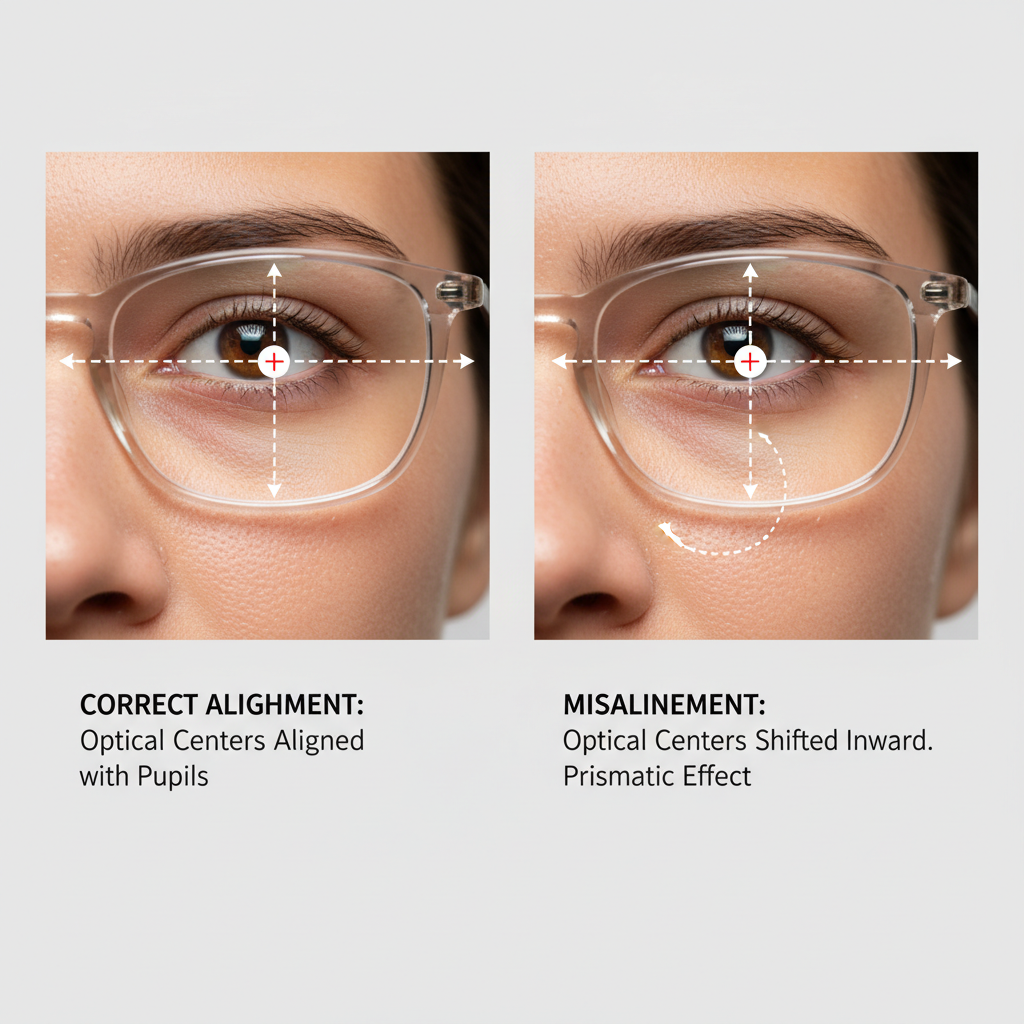
Every prescription lens has an "optical center," the single point on the lens that provides the truest vision. For your glasses to work correctly, this point must be aligned directly in front of the center of your pupil. The distance between your two pupils is called the Pupillary Distance (PD).
When you buy glasses with an incorrect PD, the optical centers are misplaced. This forces you to look through a different part of the lens, which induces an unwanted "prismatic effect." In simple terms, the light is bent incorrectly, making your brain think objects are in a slightly different location than they truly are. This mismatch between what your eyes see and what your body feels is a classic recipe for vertigo.
A common fitting error is using a PD measured for distance viewing for glasses intended only for reading. Near work requires a slightly narrower PD, and a small error can make a big difference. If you're feeling off-balance, it's worth investigating if a small PD error could be the cause.
Uncorrected Astigmatism: The Overlooked Variable
Astigmatism is an imperfection in the curvature of your eye's cornea or lens, causing vision to be blurry at all distances. Custom prescription glasses correct this with a "Cylinder" (CYL) and "Axis" value. However, over-the-counter (OTC) "readers" you buy at a drugstore are simple spherical lenses and contain no astigmatism correction.
As the American Academy of Ophthalmology (AAO) points out, this is a major limitation of ready-made readers. If you have even a mild amount of astigmatism, wearing non-corrective lenses can cause visual distortion, headaches, and a persistent sense of being off-balance.
Frame Fit and Lens Design Complications
Sometimes, the prescription is correct, but the way the lenses are situated in the frame is the source of the problem. This is especially true for those with stronger prescriptions or more complex lens designs like progressives.
Vertex Distance: How Far the Lens Sits from Your Eye
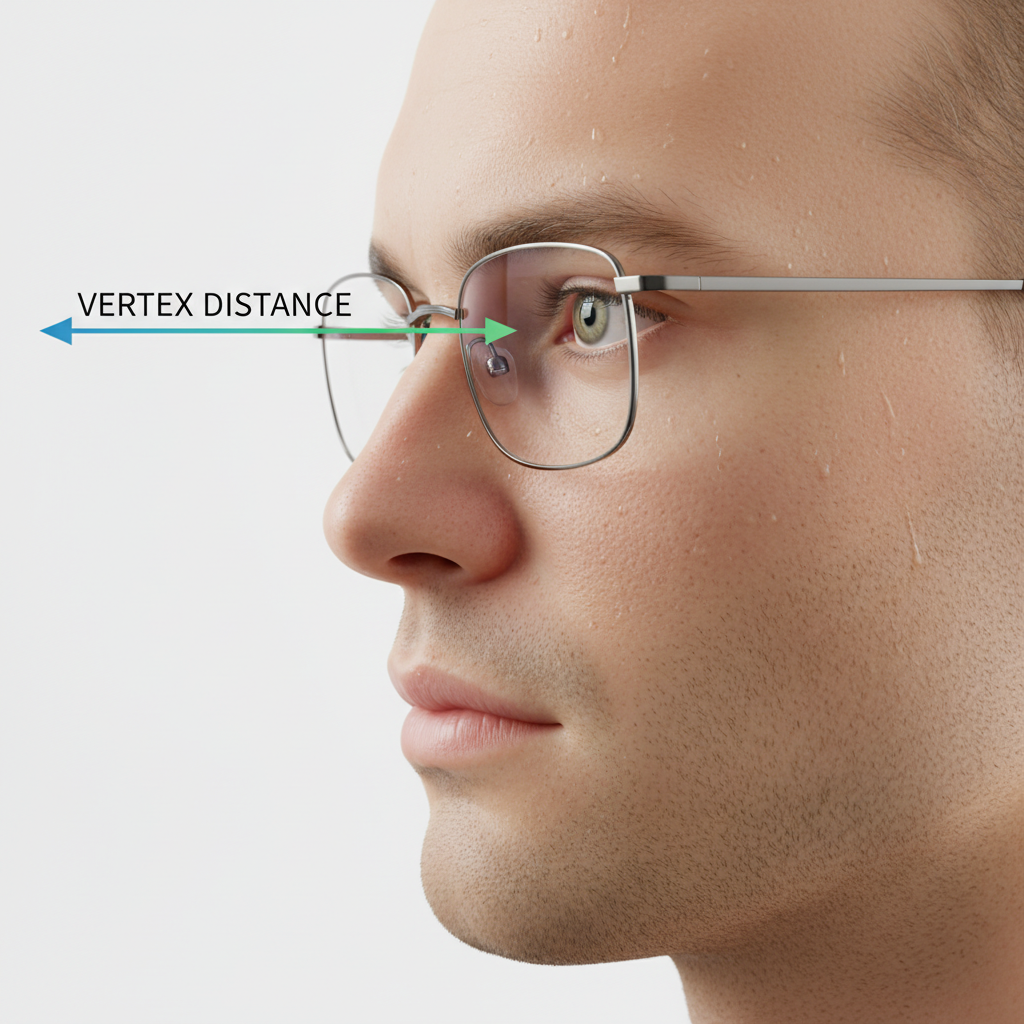
For individuals with higher-powered lenses, the distance from the back surface of the lens to the front of your eye—known as the vertex distance—is critical. A small change in how the frame sits on your face can change the effective power of the lens. If your new frames sit closer to your eyes or farther away than your old ones, it can be enough to make the prescription feel wrong and induce dizziness. This is a key reason why a proper fitting is so important for those with complex or strong prescriptions that can distort vision.
Progressive Lenses: The "Swim Effect"
Progressive lenses offer a seamless transition from distance to near vision without a visible line. However, they achieve this through a complex design with a narrow "corridor" of clear vision. If the lens is not perfectly positioned vertically in the frame, your eye may struggle to find this corridor, resulting in a "swim" or "sway" effect, especially with head movements. This sensation of the world moving unstably is a direct cause of vertigo for many new progressive wearers.
A Practical Guide to Troubleshooting Your Symptoms
If your new glasses are making you feel dizzy, don't try to "power through it" for more than a few days. Here is a structured approach to figuring out what to do next.
The 3-Day Adaptation Rule
First, it's important to distinguish between adaptation and a genuine problem. It is normal to take some time to adjust to a new prescription.
- Normal Adaptation (2-3 days): Mild eye strain, a feeling of "hyper-awareness" of your vision, or a slight "fishbowl" effect are common and usually fade within 48 to 72 hours.
- Red Flags (Persistent after 3-5 days): Dizziness, nausea, vertigo, persistent headaches, or double vision that does not improve after a few days are signs of a problem that needs to be addressed. If you feel your new online prescription feels wrong, it's time to take action.
Home Checks: A Step-by-Step Checklist
Before contacting your optician, you can perform a few simple checks to gather more information:
- Compare Prescriptions: Look at your new prescription and compare it to your old one. Was there a significant jump in power? Was a value like CYL or AXIS changed dramatically?
- Check the Fit: Do the glasses sit straight on your face? Do they feel loose or crooked? A poor fit could be the source of the issue.
- Isolate Each Eye: While reading, cover your left eye and see how your vision feels. Then, cover your right eye. If one eye feels significantly worse or more strained than the other, it could point to an error in one of the lenses.
- Note Your Triggers: Pay attention to when the dizziness occurs. Is it when you turn your head quickly? When you look up from your book? This information will be invaluable for your eye care professional.
When to See a Professional
If your symptoms persist, it is crucial to seek a professional recheck. However, it's also important to recognize the line between a vision issue and a medical one. According to experts at Johns Hopkins Medicine, normal age-related vision changes like presbyopia (the need for reading glasses) should not be confused with "Low Vision," which is vision loss from a disease that cannot be corrected with standard glasses.
If dizziness is accompanied by other symptoms or doesn't resolve with corrected glasses, consult a medical doctor to rule out other underlying health conditions.
Wrapping Up: Your Vision and Well-Being Matter
Feeling dizzy or nauseous from your reading glasses is not something you should ignore. It's a clear signal of a mismatch between your visual needs and the corrective tool you're using. The cause often lies in an incorrect prescription power, a misaligned optical center (PD), uncorrected astigmatism, or a poor frame fit.
By understanding these potential causes and following a systematic troubleshooting process, you can identify the issue. Remember the 3-day rule for adaptation, but don't hesitate to seek a professional re-evaluation if symptoms like dizziness, vertigo, or nausea persist. Your visual comfort and safety are paramount.
Frequently Asked Questions (FAQ)
1. Is it normal to feel a little dizzy with new reading glasses? A very mild, temporary sense of disorientation can be part of the normal adaptation period, which typically lasts 2-3 days. However, true dizziness, vertigo, or nausea that persists is not normal and indicates a problem with the glasses.
2. Can wearing the wrong reading glasses cause permanent eye damage? While it's highly unlikely to cause permanent damage to your eyes, wearing the wrong prescription can lead to chronic discomfort, persistent headaches, and eye strain. More significantly, the associated dizziness can increase the risk of falls and accidents, particularly in older adults.
3. How do I know if my reading glasses power is too strong? If the power is too strong, you may feel a "pulling" sensation in your eyes, experience headaches at your brow or temples, or feel a bit nauseous. Text might seem to "jump out" at you, and you may have to hold reading material farther away than is comfortable to get it in focus.
Disclaimer: This article is for informational purposes only and does not constitute professional medical advice. The information contained herein is not a substitute for and should never be relied upon for professional medical advice. Always talk to your doctor or a qualified eye care professional about any questions you may have regarding a medical condition.
References
- American Academy of Ophthalmology (AAO). (n.d.). Tips for Choosing the Right Reading Glasses. Retrieved from https://www.aao.org/eye-health/glasses-contacts/tips-choosing-right-reading-glasses
- Cleveland Clinic. (2022). How to Read Your Eye Prescription. Retrieved from https://health.clevelandclinic.org/how-to-read-your-eye-prescription
- Johns Hopkins Medicine. (n.d.). Low Vision: What You Need to Know as You Age. Retrieved from https://www.hopkinsmedicine.org/health/wellness-and-prevention/low-vision-what-you-need-to-know-as-you-age