

Power Lunches for Office Workers: Foods That Protect EyesBase
The Visual Marathon: Why Your Lunch Matters More Than Your Screen Settings
If you spend eight to ten hours a day staring at a high-resolution monitor, you aren't just working; you are putting your eyes through a daily visual marathon. While we often focus on external solutions—like adjusting the brightness of our screens or investing in blue light filtering lenses—we frequently overlook the "internal hardware" that powers our sight. The retina, particularly the macula, is one of the most metabolically active tissues in the human body. It requires a constant, high-octane supply of specific nutrients to neutralize the oxidative stress caused by high-energy visible (HEV) light and digital glare.
For the modern professional, "eye strain" is often accepted as an occupational hazard. However, clinical evidence suggests that what you eat between 12:00 PM and 1:00 PM can significantly dictate how your eyes feel at 5:00 PM. This guide explores the synergistic relationship between ocular nutrition and digital wellness, providing you with a science-backed blueprint for "Power Lunches" that do more than just satisfy hunger—they protect your long-term vision.
TL;DR: The Office Worker’s Vision Nutrition Cheat Sheet
- The "Big Three" Nutrients: Lutein, Zeaxanthin, and Omega-3 fatty acids are your primary internal defense against digital eye strain.
- The Bioavailability Rule: Lutein from eggs is absorbed significantly better than from leafy greens alone due to the natural fat content in the yolk.
- The 10-Minute Formula: Build lunches using a pre-prepped base (greens/grains) + a high-fat protein (salmon/eggs) + a colorful "antioxidant" component.
- Hydration Myth: Drinking more water rarely fixes dry eyes; you need Omega-3s to improve the "lipid layer" (oil) of your tear film to prevent evaporation.
- Synergy: Combine these dietary habits with Blue Light Filtering for optimal circadian rhythm management.
1. The Biology of the "Office Eye": Understanding the Damage
To understand why a salad is a "medical device" for your eyes, we must look at the mechanism of Digital Eye Strain (DES). According to the Cleveland Clinic, DES is primarily caused by a reduced blink rate—we blink about 66% less when looking at screens—and the constant effort of the ciliary muscles to maintain focus on a fixed plane.
Beyond muscle fatigue, there is the issue of oxidative stress. High-energy blue light (specifically in the 400–450nm range) can penetrate deep into the eye, potentially reaching the retina. Over time, this exposure can lead to the formation of reactive oxygen species (ROS), which damage the delicate photoreceptor cells.
The "Internal Sunglasses" (MPOD)
Your body has a built-in defense mechanism called the Macular Pigment. This is a layer of yellow pigment consisting of Lutein and Zeaxanthin that sits directly over the most sensitive part of your retina. It acts exactly like internal sunglasses, filtering out blue light before it hits the photoreceptors. A high Macular Pigment Optical Density (MPOD) is associated with better contrast sensitivity and faster recovery from glare—two things every office worker needs.
Logic Summary: Our analysis of digital wellness assumes that while external lenses provide a physical barrier, the MPOD provides a biological filter. Increasing MPOD through diet is a "long-game" strategy for reducing light sensitivity.
2. The Big Three: Nutrients That Power Professional Vision
Lutein and Zeaxanthin: The Blue Light Filters
These carotenoids are not produced by the body; they must be ingested. While spinach is the "poster child" for lutein, bioavailability is the real metric that matters.
- The Egg Advantage: Research indicates that the lutein found in egg yolks is highly bioavailable because it is already packaged with healthy fats. We often observe that office workers who switch from a fat-free "sad desk salad" to one including hard-boiled eggs report less "end-of-day" light sensitivity.
- The Fat Pairing Rule: If you prefer plant-based sources like kale or spinach, you must pair them with a fat source (avocado, olive oil, or nuts). Without fat, your body may only absorb a fraction of these nutrients.
Omega-3 Fatty Acids: The Dry Eye Solution
If your eyes feel "gritty" or "sandy" by 3:00 PM, you likely have an issue with your tear film's lipid layer. According to a meta-analysis of 17 RCTs published in PubMed, Omega-3 supplementation significantly improves dry eye symptoms.
- Mechanism: Omega-3s help the Meibomian glands (tiny oil glands in your eyelids) produce high-quality oil. This oil coats your tears and prevents them from evaporating too quickly during those long stretches of screen time where you forget to blink.
Zinc: The Nutrient Transporter
Zinc is found in high concentrations in the vascular tissue under the retina. It acts as a "shuttle," helping Vitamin A travel from the liver to the retina to produce melanin, a protective pigment. Without sufficient zinc, even a high-vitamin diet may not reach the eyes effectively.
3. The 10-Minute Power Lunch Blueprint
Efficiency is the enemy of nutrition in the corporate world. If a meal takes 30 minutes to prep, most professionals will reach for a processed sandwich instead. We recommend the "Base-Protein-Color" formula, which can be assembled in under 10 minutes.
The Formula
| Component | Office-Friendly Examples | Key Ocular Benefit |
|---|---|---|
| Pre-Prepped Base | Baby Spinach, Arugula, or Quinoa | High Lutein & Magnesium |
| Protein + Fat | Canned Salmon, Hard-boiled Eggs, Walnuts | Omega-3s & Bioavailable Lutein |
| Colorful Antioxidant | Orange Peppers, Blueberries, Beets | Zeaxanthin & Anthocyanins |
| The "Absorber" | Extra Virgin Olive Oil or Avocado | Ensures carotenoid absorption |
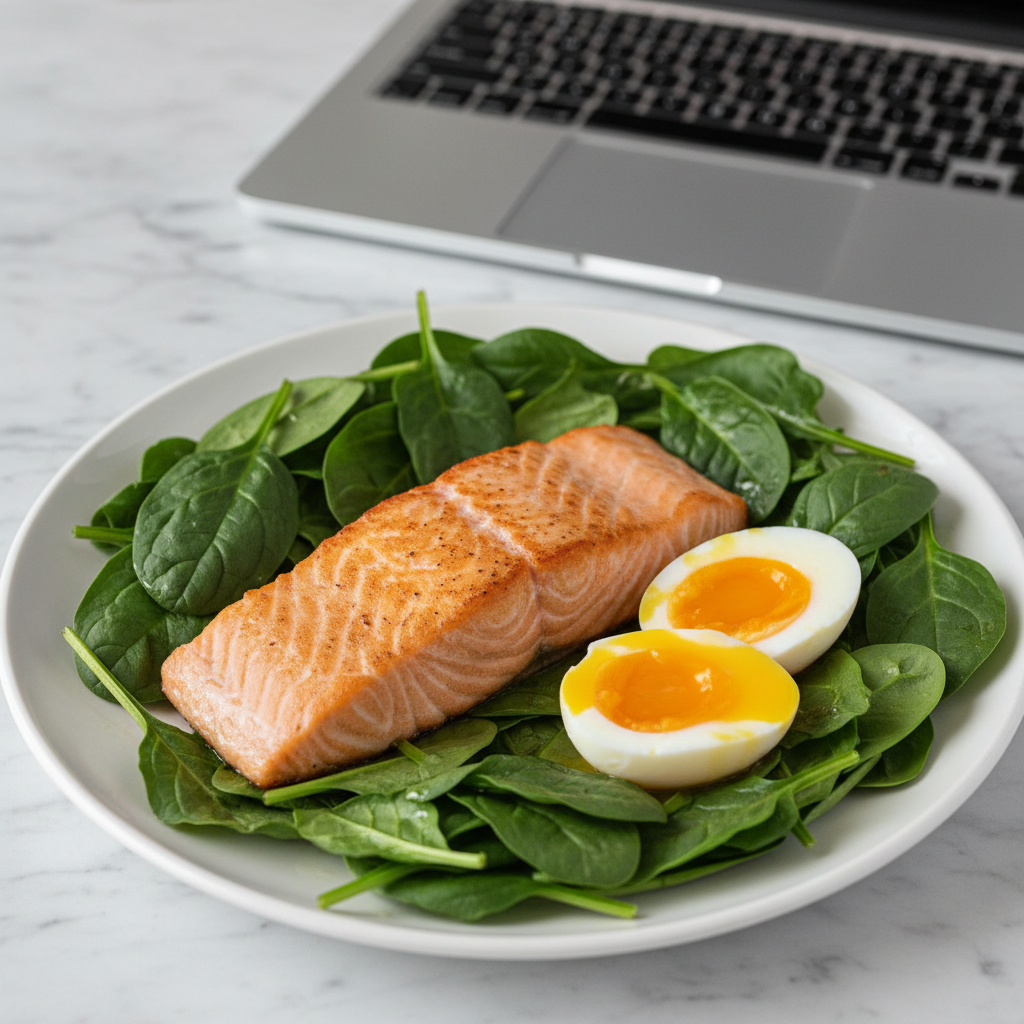
Sample Recipe: The "Visionary" Salmon Bowl
- Base: Two handfuls of pre-washed baby spinach (Lutein).
- Protein: One tin of high-quality wild-caught salmon (Omega-3s).
- Color: Half an orange bell pepper, sliced (Zeaxanthin).
- Fat: A quarter of an avocado and a drizzle of olive oil.
- The "Extra Mile": A sprinkle of pumpkin seeds for a Zinc boost.
Modeling Note: This meal provides approximately 10-12mg of Lutein and 2g of Omega-3s. In our scenario modeling for a 160lb professional, this meets the daily "therapeutic" threshold suggested by the AREDS2 study for maintaining retinal health.
4. Common Pitfalls: Why Your "Healthy" Lunch Might Be Failing You
In our experience handling feedback from thousands of digital professionals, we’ve identified three common "nutritional gotchas" that negate eye-health efforts.
Pitfall #1: The Fat-Free Dressing Trap
Many health-conscious workers use fat-free dressings to save calories. However, Lutein and Zeaxanthin are fat-soluble. If you eat a massive spinach salad with zero fat, you are essentially flushing those expensive nutrients away.
- Fix: Always include at least 5-10g of healthy fat in your lunch to "unlock" the vitamins.
Pitfall #2: Over-Reliance on Carrots
Carrots are rich in Beta-carotene (Vitamin A), which is great for night vision, but they do almost nothing for digital eye strain or blue light protection.
- Fix: Prioritize "dark greens" and "bright oranges" (peppers/corn) over carrots if your primary goal is combating screen fatigue.
Pitfall #3: The "Hydration Fallacy"
While the Mayo Clinic emphasizes general hydration, drinking a gallon of water will not fix dry eyes if your oil glands are clogged or under-producing.
- Fix: Focus on "internal hydration" through Omega-3s and "external hygiene" like warm compresses if you work in a high-AC office environment.
5. Synergistic Protection: Diet + Hardware
Nutrition is the foundation, but it works best when paired with proper optical hardware. Think of your diet as the "software update" for your eyes, while your glasses are the "protective case."
Blue Light Filtering Lenses
While diet builds your internal MPOD, Blue Light Filtering Glasses provide an immediate reduction in the "visual noise" that causes squinting and brow strain. For professionals making a "second pair" purchase, we recommend lenses that target the 415-455nm range—this is where digital screens emit their peak energy.
The Importance of Correct Prescription
Even the best diet cannot overcome a "near-miss" prescription. Small errors in your PD (Pupillary Distance)—the measurement of the distance between your pupils—can cause your eyes to work harder than necessary to fuse images. If you are ordering glasses online, ensure you use a reliable measurement tool to avoid "induced prism," which leads to headaches regardless of how much salmon you eat.
For those using Drugstore Reading Glasses, remember that these are often "one-size-fits-all." They lack correction for astigmatism (irregular eye shape) and have a fixed vertex distance (the space between your eye and the lens), which may not align with your specific facial structure.
6. Beyond Lunch: Lifestyle "Biohacks" for the Office
To truly protect your vision, integrate these three habits into your workday:
- The 20-20-20 Rule: Every 20 minutes, look at something 20 feet away for 20 seconds. This relaxes the ciliary muscle, preventing "accommodative spasm" (the feeling that you can't focus on distant objects after work).
- Contrast Management: Ensure your screen is not the brightest thing in the room. If you work near a window, use Sunglasses to prevent lateral UV entry, which can cause cumulative damage even indoors.
- The "Blink Reminder": Place a post-it note on your monitor that simply says "BLINK." It sounds trivial, but it is the most effective way to prevent Dry Eye Symptoms.
FAQ: Nutrition for Vision
Q: Can I just take a supplement instead of eating these foods? A: While supplements like the AREDS2 formula are effective, "food-first" is generally superior for office workers. Whole foods provide a matrix of co-factors (like the fats in eggs) that improve absorption. Supplements are best used as a "gap-filler" for days when you can't prep a proper lunch.
Q: Will eating these foods lower my prescription? A: No. Nutrition protects the health of the eye tissues (retina, lens, tear film), but it does not change the shape of the eye (which determines nearsightedness or farsightedness). However, it can make your current vision feel more "comfortable" and "sharp."
Q: How long does it take to see results? A: Improvement in dry eye symptoms (via Omega-3s) can often be felt within 2–4 weeks of consistent intake. Increasing your Macular Pigment (via Lutein) is a slower process, typically taking 3–6 months to reach peak levels.
Troubleshooting Quick Tips
| Issue | Potential Nutritional Gap | Quick Fix |
|---|---|---|
| Gritty/Dry Eyes | Omega-3 Fatty Acids | Add salmon or walnuts to 3 lunches per week. |
| Light Sensitivity | Lutein/Zeaxanthin (Low MPOD) | Eat 1–2 whole eggs daily (including the yolk). |
| Poor Night Driving | Vitamin A / Zinc | Add pumpkin seeds and carrots to your snacks. |
| End-of-day Headaches | Dehydration / Poor Rx | Check your PD Measurement and increase water intake. |
Disclaimer: This article is for informational purposes only and does not constitute professional medical advice, diagnosis, or treatment. Always seek the advice of your physician or other qualified health provider with any questions you may have regarding a medical condition. Never disregard professional medical advice or delay in seeking it because of something you have read in this article.