

Pinguecula: The Link Between Yellow Bumps and UV Exposure
The Yellow Bump on Your Eye: Understanding Pinguecula and Its Link to the Sun
Noticing a yellowish, slightly raised spot on the white of your eye can be unsettling. This common condition, known as a pinguecula (pronounced pin-GWEK-yoo-la), is a benign bump that serves as a physical sign of your eye's cumulative exposure to the sun. While generally harmless, it's a visible indicator of ultraviolet (UV) radiation damage and a prompt to re-evaluate your eye protection habits.
This article explains what a pinguecula is, the science behind why it forms, who is most at risk, and the definitive steps you can take to prevent its growth and protect your long-term vision. Think of it as your eye's early warning system—a sign that it's time to take sun protection seriously.
What Exactly is a Pinguecula?
A pinguecula is a common degenerative condition of the conjunctiva, the thin, clear membrane that covers the white part of your eye (the sclera). The bump is essentially a deposit of protein, fat, and calcium that builds up over time. Many people first notice it in the mirror and have no other symptoms.
Key characteristics include:
- Appearance: A yellowish or white bump, typically on the part of the eye closer to the nose.
- Texture: It can be flat and triangular or slightly raised.
- Symptoms: While often asymptomatic, a pinguecula can cause irritation, dryness, itching, redness, and a feeling that something is in your eye (foreign body sensation). When it becomes inflamed, the condition is called pingueculitis.
The primary cause is clear: chronic exposure to ultraviolet (UV) radiation from the sun. Other environmental factors like frequent exposure to wind, dust, and dry air can also contribute to its development. It's helpful to think of a pinguecula as a type of "callus" on the eye, formed in response to years of environmental irritation.
The Science of Sun Damage on the Eye's Surface
Your eyes have natural defenses, but they are not invincible against constant UV exposure. The development of a pinguecula is a direct result of UV light altering the structure of the conjunctival tissue.
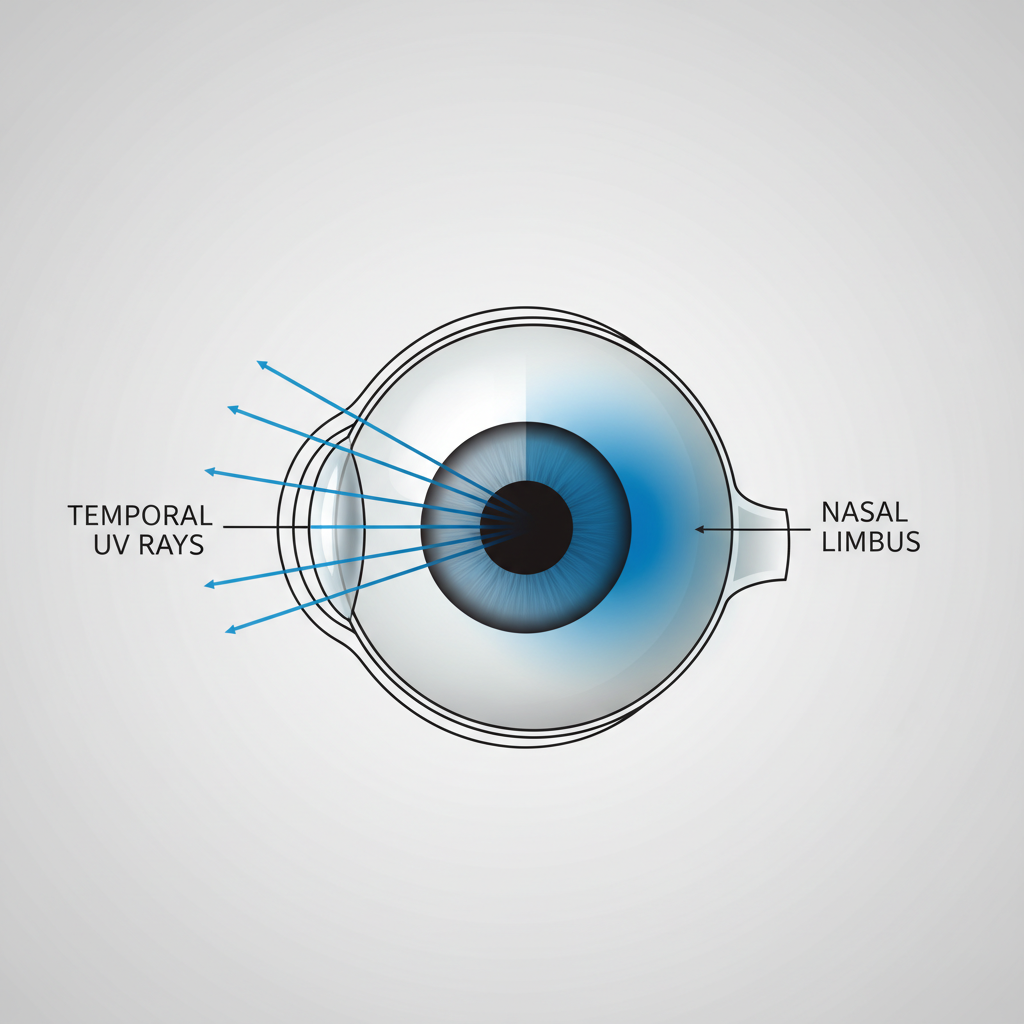
A key mechanism behind its formation, especially on the nasal side of the eye, is a phenomenon known as the Coroneo Effect, or Peripheral Light Focusing. Research published in PMC explains that UV rays entering the eye from the side are focused across the cornea onto the nasal limbus—the area where the cornea meets the sclera. This concentrated dose of UV radiation accelerates tissue damage in that specific spot, which is why pinguecula and the more advanced pterygium (surfer's eye) commonly appear there.
This damage is not the result of a single intense exposure but rather a slow accumulation over a lifetime. The Royal Australian and New Zealand College of Ophthalmologists (RANZCO) warns that a staggering 80% of children show signs of UV-induced eye damage by the age of 15. This underscores that protection is a lifelong necessity, as the effects of sun exposure in childhood manifest in adulthood.
Furthermore, not all sunglasses provide adequate protection. As noted by experts at the MD Anderson Cancer Center, wearing dark lenses that lack certified UV-blocking filters is often more dangerous than wearing no glasses at all. The dark tint causes your pupils to dilate, allowing even more harmful UV radiation to enter the unprotected eye.
Are You at High Risk for Pinguecula?
While anyone can develop a pinguecula, certain factors significantly increase your risk. Understanding these can help you adopt more targeted protective measures.
1. Environmental and Lifestyle Factors:
- High-UV Environments: Living near the equator, at high altitudes, or in areas with year-round sunshine dramatically increases your exposure.
- Reflective Surfaces: Spending extensive time on water, snow, or sand, which can reflect up to 80% of UV rays, nearly doubles your exposure.
- Occupation and Hobbies: Outdoor workers (e.g., farmers, construction workers, fishermen) and enthusiasts (e.g., surfers, skiers, hikers) are at the highest risk due to prolonged sun exposure. Research has shown that university students with over six hours of weekly outdoor activity have a prevalence rate as high as 75%.
2. Biological Predisposition:
- Light-Colored Eyes: Individuals with blue, green, or hazel eyes have less melanin—the protective pigment—in their ocular structures. A comprehensive study on uveal melanoma in PMC confirms that this lower pigmentation provides a weaker "melanin shield" against UV radiation, increasing the risk of sun-related damage.
- Age: As we age, the natural crystalline lens inside our eye, which helps filter some UV light, begins to lose its clarity and protective capabilities. This allows more radiation to reach the inner structures, compounding a lifetime of exposure.
3. Behavioral Gaps:
- Inconsistent Protection: The most significant risk factor is the failure to consistently wear proper eye protection. A large-scale study on cataract risk in Taiwan highlighted a critical "Attitude-Practice Gap": while 88% of participants knew sun protection was important, 69% rarely wore sunglasses.

Your Action Plan for Prevention and Management
While an existing pinguecula cannot be reversed without surgical intervention (which is rarely necessary), you can take definitive steps to prevent its growth, alleviate symptoms, and protect your eyes from further damage.
1. The Gold Standard: UV400 Wraparound Sunglasses This is the single most effective defense. When choosing sunglasses, look for labels that certify 100% UV protection or "UV400." This means the lenses block all UVA and UVB rays up to 400 nanometers.
However, lens certification is only half the battle. As the Coroneo Effect demonstrates, a significant amount of UV light enters from the periphery. Therefore, frame geometry is critical. Choose oversized or wraparound styles that fit snugly against your face to block light from the top and sides. This is a crucial detail often overlooked with standard fashion frames. For more on this, see our article on The Hidden Eye Damage from Uncertified Sunglasses.
2. Supplement Your Defenses
- Wear a Wide-Brimmed Hat: A hat with at least a three-inch brim can block up to 30% of the UV light that reaches your eyes from above, according to clinical resources like StatPearls. It's an essential second layer of defense.
- Use Lubricating Eye Drops: If you experience dryness or irritation from a pinguecula, over-the-counter artificial tears can provide significant relief by keeping the eye's surface moist.
3. Know When to Consult an Eye Doctor A pinguecula is benign, but it's important to monitor it. Schedule an appointment with an ophthalmologist or optometrist if you notice:
- A rapid increase in size or a change in color.
- Significant inflammation, pain, or redness that doesn't resolve.
- The growth begins to extend onto the cornea (the clear front part of the eye), as this may indicate it is developing into a pterygium, which can affect vision.
A Visible Cue for Lifelong Protection
A pinguecula is more than just a cosmetic blemish; it is a clear message from your body about the impact of the sun. While the bump itself is not a threat to your vision, the UV radiation that caused it is also the primary environmental risk factor for more severe conditions, including cataracts, eyelid cancers, and macular degeneration.
Heed this warning sign. Making high-quality, large-framed UV400 sunglasses and a wide-brimmed hat a non-negotiable part of your daily routine is one of the most effective investments you can make in preserving your vision for a lifetime.
Disclaimer: This article is for informational purposes only and does not constitute professional medical advice. Always consult with a qualified eye care professional for any health concerns or before making any decisions related to your eye health.
References
- World Health Organization (WHO). (2017). Ultraviolet radiation. https://www.who.int/news-room/fact-sheets/detail/ultraviolet-radiation
- Di Girolamo, N. (2012). Photoprotection of the Eye. PMC. https://pmc.ncbi.nlm.nih.gov/articles/PMC3872277/
- Hourihan, F., et al. (2021). The Impact of Ultraviolet Radiation on the Aetiology and Development of Uveal Melanoma. PMC. https://pmc.ncbi.nlm.nih.gov/articles/PMC8038359/
- Duke Health. (n.d.). Myth or Fact: Blue Eyes Are More Sensitive to Light. https://www.dukehealth.org/blog/myth-or-fact-people-light-eyes-are-more-sensitive-sunlight
- Royal Australian and New Zealand College of Ophthalmologists (RANZCO). (2025). Protect children’s eyes from sun damage. https://ranzco.edu/wp-content/uploads/2024/02/Media-Release-Protect-childrens-eyes-from-sun-damage-2025.pdf
- Wang, S., et al. (2021). Attitude toward and practice of eye protection against solar radiation and the risk of cataract. PMC. https://pmc.ncbi.nlm.nih.gov/articles/PMC8321156/