

Lens Coatings You Need for a Strong Prescription
TL;DR: What You Absolutely Need to Know
For anyone with a strong prescription (typically ±4.00 diopters or more), lens coatings are not optional upgrades—they are essential for good vision, durability, and appearance. If you remember nothing else, remember this: a high-quality, multi-layer anti-reflective (AR) coating is the single most important feature you can get. It dramatically reduces glare and makes thick lenses look thinner. Always pair it with a durable anti-scratch hard coat, and ensure your lenses provide 100% UV protection.
Why Strong Prescriptions Change the Rules for Lenses
If you have a high prescription, you are likely familiar with the terms "nearsighted" or "farsighted." Your prescription, explained in detail in our simple guide to reading it, quantifies this with measurements like Sphere (SPH) and Cylinder (CYL). According to the Cleveland Clinic's guide on reading prescriptions, these numbers tell the lens maker how much power is needed to correct your vision.
With a high-power lens, the curvature is steeper and the material must bend light more sharply to achieve focus. This traditionally results in the thick, heavy "coke bottle" effect. While modern high-index lenses can create thinner, more stylish frames, the physics of high-power lenses introduces another significant problem: reflections.
Thicker lenses, especially those made from higher-density materials as described by Ferris State University's overview of lens materials, have more internal surfaces for light to bounce off. This creates several visual frustrations:
Ghost Images: Faint, secondary images that float next to the object you are looking at.
Starbursts and Halos: Glare that radiates from light sources, making night driving particularly challenging.
Surface Reflections: A mirror-like effect on your lenses that prevents others from seeing your eyes clearly.
I’ve spoken with optical lab technicians who confirm that these issues are the most common complaints from users with strong prescriptions who skip essential coatings. The consensus is clear: the stronger the prescription, the more critical coatings become.
The Non-Negotiable Upgrade: Anti-Reflective (AR) Coating
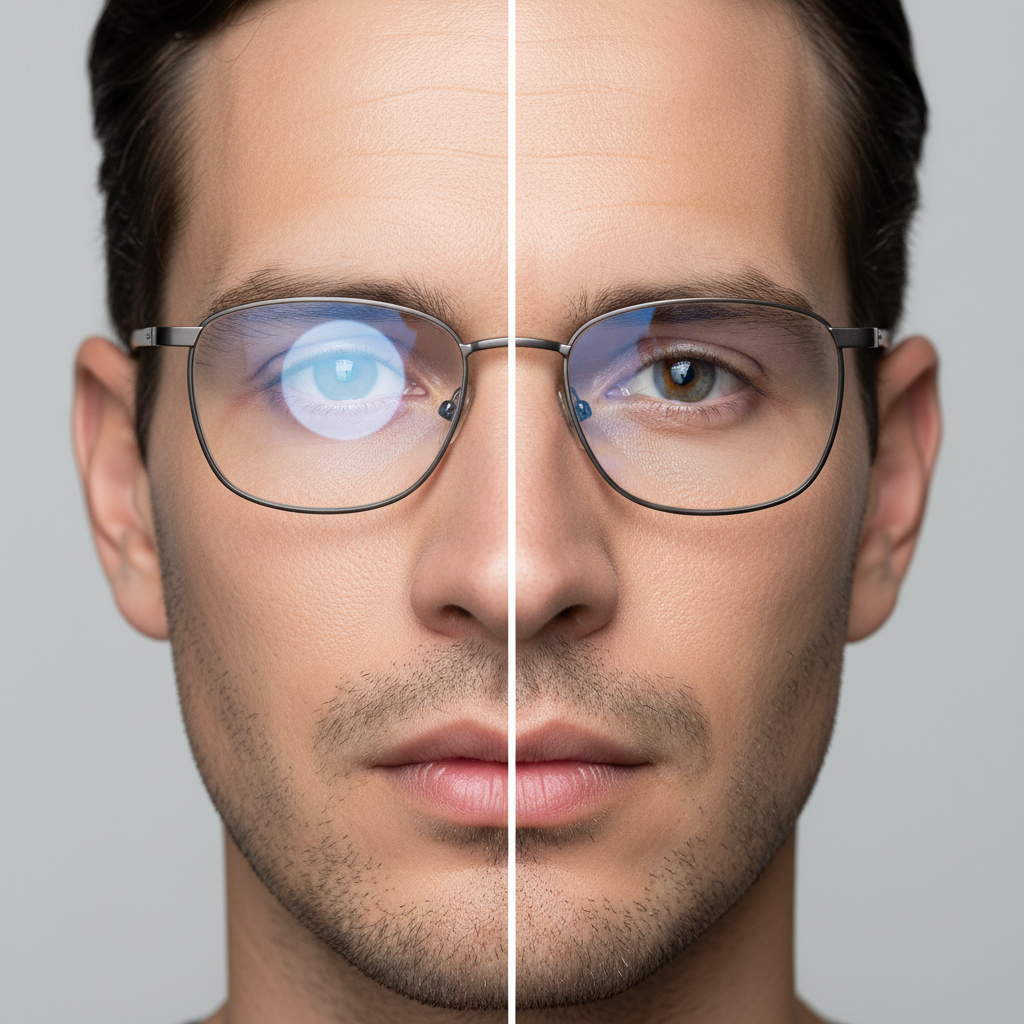
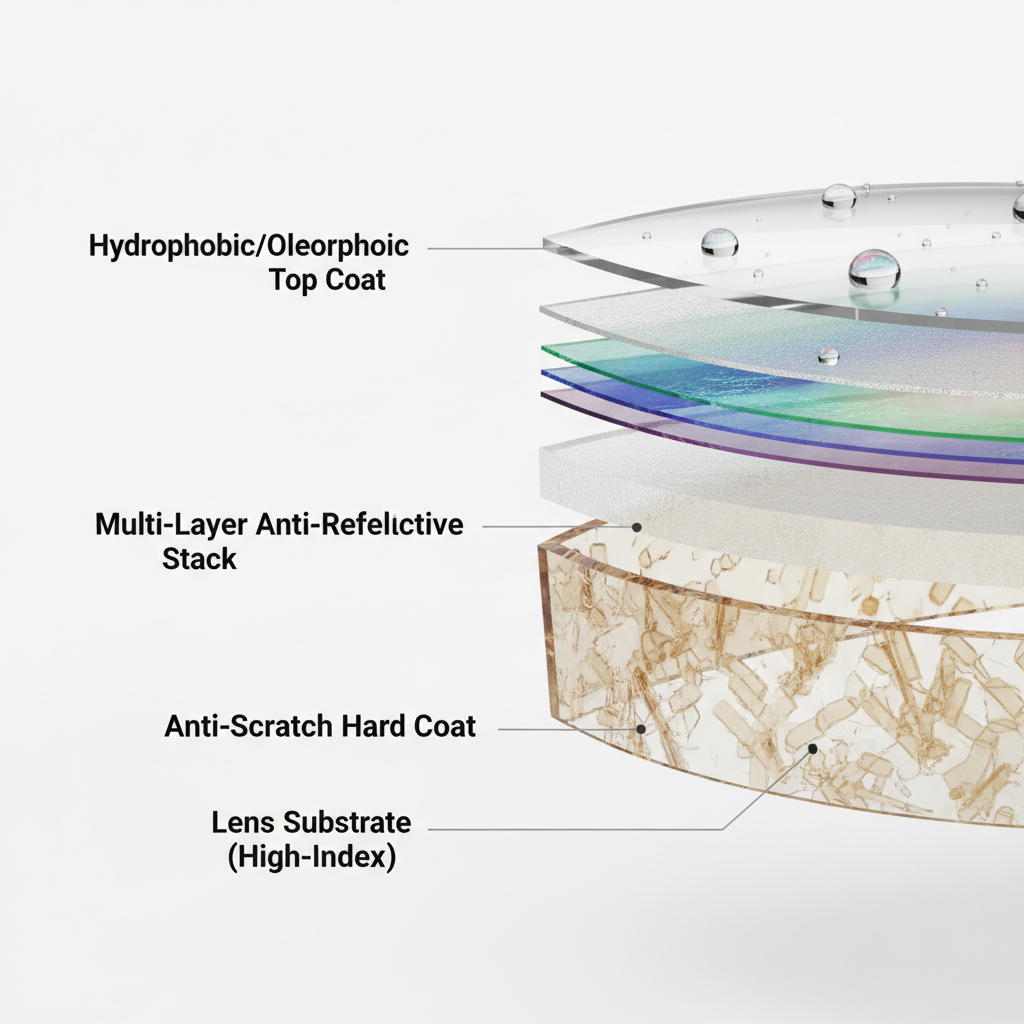
Think of an anti-reflective (AR) coating as noise-canceling headphones for your eyes. It is an ultra-thin, multi-layer treatment applied to the lens surface that is engineered to cancel out reflected light. A quality AR coating allows over 99% of available light to pass directly through the lens to your eye, leading to sharper, clearer, and more comfortable vision.
The Real-World Benefits of AR
Superior Visual Acuity: By eliminating stray reflections, AR coatings enhance contrast and detail. You’ll notice that text is sharper and your eyes feel less strained at the end of a long day, especially when working on a computer.
Improved Aesthetics: AR coatings make your lenses look nearly invisible. This is a huge cosmetic benefit for high-power lenses, as it minimizes the perceived thickness and allows people to see your eyes, not a distracting glare. It makes a world of difference in photos and video calls.
Safer Night Driving: For me, this is one of the most significant safety benefits. AR coatings drastically reduce the halos and starbursts from oncoming headlights and streetlights, providing a much clearer and less stressful view of the road.
Expert Warning: Not All AR Coatings Are Created Equal
A common misconception is that any AR coating is sufficient. This is dangerously false. I have seen firsthand how low-quality AR coatings can ruin an otherwise perfect pair of glasses. These budget coatings are often prone to peeling, crazing (a network of fine cracks), and smudging relentlessly.
An experienced optical technician will tell you that a premium AR coating is a complex stack of layers. A critical mistake is applying the AR coating without a proper foundation. As one lab expert put it, "Always apply a hard (scratch) coat before AR to prevent early delamination." A quality AR treatment also includes hydrophobic (water-repellent) and oleophobic (oil-repellent) layers on top, which make the lenses much easier to clean and keep clear.
The Foundation: Anti-Scratch and UV Protection
While AR coating tackles visual clarity, two other treatments form the foundation of a durable, long-lasting pair of glasses: a hard coat and UV protection.
The Unseen Shield: The Anti-Scratch "Hard" Coat
Modern lens materials like polycarbonate and high-index plastics are significantly lighter and more impact-resistant than old-fashioned glass. However, they are also much softer and more susceptible to scratching. An anti-scratch coating, or "hard coat," is a clear layer applied to the lens that provides a much more durable surface.
It is essential to understand that no lens is completely scratch-proof. However, a quality hard coat is your best defense against the minor scratches and scuffs that occur from everyday handling and cleaning. As mentioned, it is also the necessary foundation upon which a good AR coating must be built. Without a solid hard coat, the AR layers will not adhere properly and will fail prematurely.
UV Protection: A Health Imperative
Protecting your eyes from ultraviolet (UV) radiation is just as important as protecting your skin. Long-term exposure to UV rays can contribute to serious eye conditions. A study published in PubMed on UV radiation evaluated various lens materials and found that while some plastics offer good protection, a dedicated treatment is the only way to ensure complete safety.
Many modern lens materials, especially polycarbonate and high-index plastics, have UV protection inherently built into the monomer. However, you should always confirm that your lenses block 100% of UVA and UVB rays up to 400nm. This protection is completely clear and does not require any tint, meaning your everyday clear glasses can and should be fully UV-protective.
Furthermore, all eyeglasses sold in the United States must meet specific standards for impact resistance. The FDA requires lenses to pass a "drop-ball test" to ensure they will not shatter under normal use, a critical safety feature that provides peace of mind. When you buy from a reputable vendor, you are also ensuring this baseline of safety, which is a key part of our checklist for buying glasses online safely.
A Practical Guide to Choosing Your Coatings
Navigating the options can be overwhelming, so I’ve created a simple framework based on prescription strength. The stronger your prescription, the more you benefit from advanced features.
| Prescription Strength (Diopters) | Recommended Lens & Coatings | Key Benefit |
|---|---|---|
| Low (up to ±2.00 D) | Standard Plastic/Polycarbonate + Anti-Scratch + AR | Everyday durability and visual comfort. |
| Medium (±2.25 to ±4.00 D) | Polycarbonate/1.60 High-Index + Anti-Scratch + Premium AR + UV | Thinner profile, superior clarity, and health protection. |
| High (±4.25 to ±6.00 D) | 1.67 High-Index + Aspheric Design + Premium AR + Anti-Scratch + UV | Significantly thinner and lighter, eliminates distortion and glare. |
| Very High (> ±6.00 D) | 1.74 High-Index + Aspheric Design + Premium AR + Anti-Scratch + UV | The thinnest, most cosmetically appealing lens with maximum visual clarity. |
For those with very high prescriptions, small details in the measurements become critical. This is where ensuring an accurate pupillary distance (PD) is vital, as even a small PD error can affect vision in high-power lenses. Using a reliable method to measure your PD at home is a crucial step in the ordering process.
Wrapping Up: Your Checklist for Better Vision
For users with strong prescriptions, choosing the right lenses and coatings is a decision that impacts your daily comfort, safety, and confidence. It is not an area to cut corners.
Invest in Anti-Reflective Coating: Prioritize a premium, double-sided AR coating. It is the single most effective upgrade for reducing glare and improving appearance.
Demand a Solid Foundation: Ensure your AR coating is built on a durable anti-scratch hard coat to prevent peeling and extend the life of your glasses.
Confirm Full UV Protection: Your clear, everyday lenses should block 100% of harmful UV rays.
Match Coatings to a High-Index Lens: To get the best results, pair these essential coatings with the right high-index and aspheric lens design for your prescription. This combination delivers the best in modern optical technology: thin, lightweight, and crystal-clear.
Frequently Asked Questions (FAQ)
Q: Can I add a coating to my existing glasses?
A: Unfortunately, no. Lens coatings are applied in a vacuum chamber during the manufacturing process and are bonded directly to the lens. They cannot be added after the fact.
Q: How should I clean my coated lenses?
A: The best method is to use lukewarm running water and a drop of gentle dish soap to remove oils and debris. Then, dry them with a clean, soft microfiber cloth. Avoid using paper towels, tissues, or the hem of your shirt, as these materials can be abrasive and damage the coatings.
Q: Is a blue light filter the same as an AR coating?
A: They are not the same, but they are often combined. An AR coating reduces all reflections, while a blue light filter specifically targets and absorbs a portion of the high-energy blue light spectrum. You can, and often should, get a lens that has both.
Q: Why do I see a faint green or purple color on my lenses when I tilt them?
A: This is the residual reflection from the AR coating and is a sign that it is working correctly. Because the coating cancels out most reflected light, only a very small, specific wavelength (color) is left, which you see at certain angles.
Disclaimer: This article is for informational purposes only and does not constitute professional medical advice. Please consult with a qualified optometrist or ophthalmologist to discuss your specific vision needs and to receive a comprehensive eye examination.