



Finding a Comfortable Fit for High Rx Eyewear
TL;DR: Your Checklist for Comfortable High Rx Glasses
For those with strong prescriptions, comfort is as crucial as clarity. Thicker, heavier lenses can cause glasses to slip, create pressure points, and feel unbalanced. The solution lies in a smart combination of the right frames, advanced lenses, and precise measurements. Prioritize smaller, rounder frames made from lightweight materials. Always opt for high-index, aspheric lenses with an anti-reflective coating. Finally, ensure your pupillary distance (PD) and other fitting measurements are exact. This guide will walk you through each of these steps in detail.
Why High Prescriptions Make Fit So Challenging
A strong prescription, particularly for nearsightedness (myopia), requires lenses that are significantly thicker at the edges than in the center. This isn't just an aesthetic concern; it's a matter of physics that directly impacts wearability.
The Weight and Balance Problem
The most immediate issue is weight. Thicker lenses are heavier, and that weight has to be supported by the bridge of your nose and your ears. Poorly distributed weight leads to the number one complaint: glasses constantly sliding down your face. This isn't just annoying; it means you're not looking through the optical center of the lens, which can degrade visual quality. It also creates painful pressure points on your nose and behind your ears.
I often see people choose a frame style they love, only to find it unwearable once their high-power lenses are installed. A frame that feels fine in the store can become front-heavy and uncomfortable, a classic pitfall for the inexperienced buyer.
The "Coke Bottle" Effect and Distortion
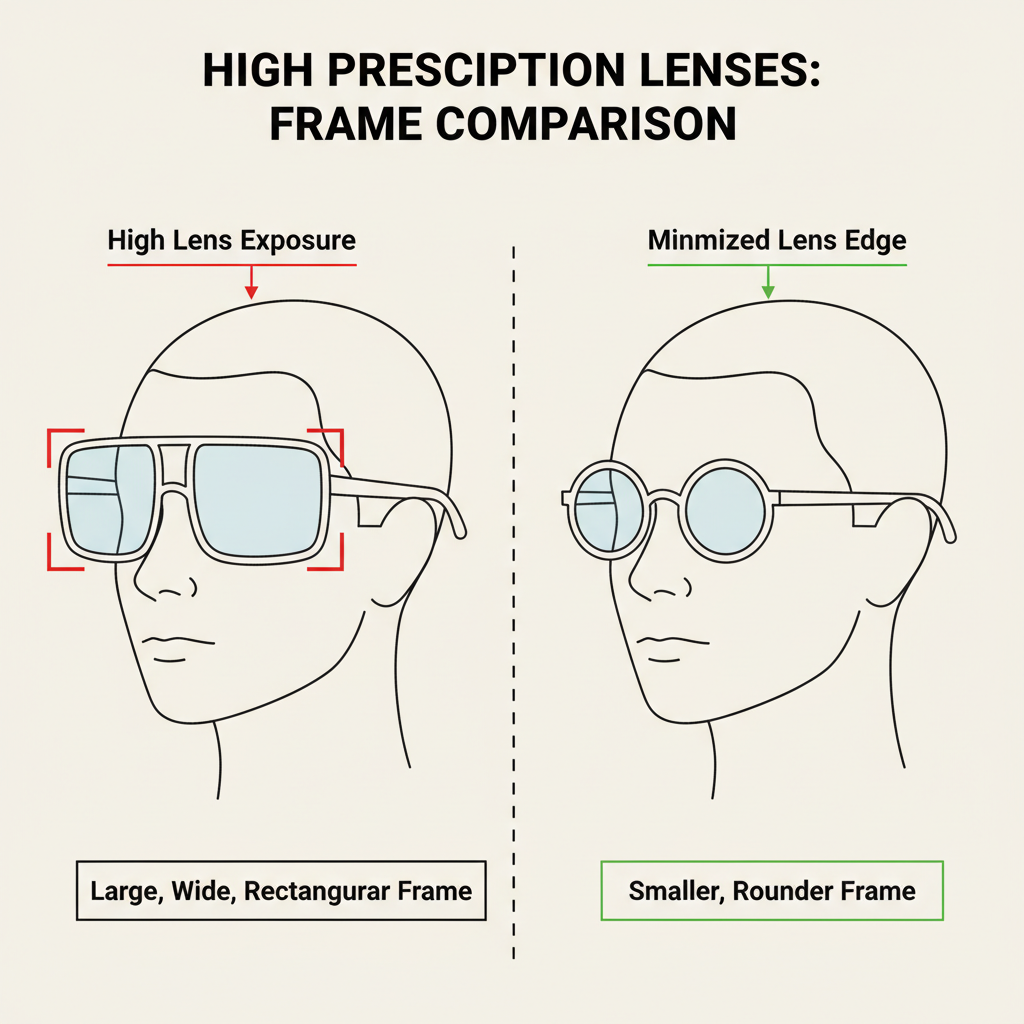
High-power lenses bend light more dramatically, which can create visible distortions. For nearsighted prescriptions, lenses minify the appearance of your eyes and face. For farsighted prescriptions, they magnify them. This effect is most pronounced at the edges of the lens. A large frame forces you to use more of this distorted peripheral area and also exposes more of the thick lens edge, contributing to the undesirable "coke bottle" look.
Choosing the Right Frames: Your First Line of Defense
Selecting the right frame is the single most important decision you can make to ensure comfort with a high prescription. It's about working with the physics of your lenses, not against them.
Pro Tip: Smaller and Rounder is Better
Here’s an insider tip from the lab: for every millimeter you increase the size of a lens, its edge thickness increases exponentially, especially for high-minus prescriptions. This is why you should prioritize frames with smaller, rounder, or more oval eye shapes. A smaller lens is not only lighter but also allows the lab to grind away more of the thickest parts of the lens blank, resulting in a much thinner and more attractive edge. This is a crucial point many overlook when prioritizing fashion trends over fit. While you may not have to give up on style, you might need to reconsider a large, geometric frame. For more on this, see our guide on wearing thin, stylish frames with a high Rx.
Frame Material Matters
When your lenses are inherently heavy, the frame material needs to be as light as possible without sacrificing strength.
Acetate: While popular and available in many colors, standard acetate frames can be heavy. If you love the look, seek out styles with a thin profile or consider them only if the lens size is very small.
Titanium: This is an excellent choice. It's incredibly lightweight, strong, and hypoallergenic. Titanium frames can counterbalance heavy lenses without adding significant weight themselves.
Stainless Steel & Other Metals: These are also great lightweight options, often more budget-friendly than titanium. They offer a minimalist aesthetic that pairs well with thicker lenses.
The Importance of the Bridge and Nose Pads
How the frame sits on your nose determines how the entire weight is managed.
Adjustable Nose Pads: For high Rx wearers, I almost always recommend frames with adjustable metal nose pads. They allow for precise adjustments to distribute weight evenly across the sides of your nose, preventing all the pressure from focusing on one spot. This also helps control the vertex distance (more on that later).
Saddle Bridge: If you prefer plastic frames, look for a "saddle bridge" or "keyhole bridge" design that fits the contour of your nose perfectly. A plastic frame with a bridge that’s too wide or sits too high will concentrate pressure and lead to slippage. Avoid thick acetate bridges that lift the lenses too far from your face.
The Lens Equation: Beyond Just "Thin"
Once you've chosen a suitable frame, selecting the right lens material and design is the next critical step. This is where modern optical technology makes a world of difference.
Myth Debunked: Thinner Isn't Always Better (On Its Own)
There's a common misconception that simply choosing the highest-index (thinnest) lens possible is the best solution. While high-index plastics are essential for reducing thickness and weight, they have other properties to consider. As the index of refraction goes up, lenses tend to reflect more light and can have lower optical clarity (a lower Abbe value), which can cause color fringing or chromatic aberration. According to guidance from Ferris State University on high-index lenses, these lenses are denser and reflect more light, making an anti-reflective coating a near necessity. The key is to balance thinness with optical performance.
A Practical Guide to Lens Materials
Understanding your options helps you make an informed choice. All prescription lenses sold in the U.S. must meet specific impact-resistance standards, as outlined by the FDA in regulation 21 CFR 801.410, but their optical properties and weight vary significantly.
| Lens Material | Refractive Index | Key Features & Trade-offs | Best For |
|---|---|---|---|
| CR-39 Plastic | 1.50 | Excellent optical clarity (high Abbe value). Thick and heavy for high prescriptions. | Low to mild prescriptions where thickness is not a concern. |
| Polycarbonate | 1.59 | Highly impact-resistant and provides inherent UV protection. Lighter than CR-39 but has lower optical clarity. | Children's eyewear, safety glasses, and active individuals. |
| High-Index 1.60 | 1.60 | A great entry point into high-index. Thinner and lighter than polycarbonate, with better optical clarity. | Mild to moderate prescriptions where a noticeable improvement in thickness is desired. |
| High-Index 1.67 | 1.67 | Significantly thinner and lighter. The sweet spot for many high Rx wearers, balancing performance and cost. | Strong prescriptions, offering a great aesthetic result without the highest cost. |
| High-Index 1.74 | 1.74 | The thinnest and lightest plastic lens material available. | Very strong prescriptions where minimizing thickness and weight is the top priority. |
The Power of Aspheric and Digital Lenses
For high prescriptions, always choose an aspheric lens design. Unlike traditional spherical lenses, aspheric lenses have a more complex, flatter curvature. This design dramatically reduces the distortion and magnification/minification effects at the edge of the lens, providing better peripheral vision and a much more natural appearance for your eyes.
Anti-Reflective (AR) Coating: A Non-Negotiable Add-On
High-index lenses reflect significantly more light than standard plastic. Without an AR coating, these reflections can be distracting for you (as glare and halos, especially at night) and for others looking at you (they see reflections on your lenses instead of your eyes). An AR coating is essential for high-index lenses to improve visual acuity, reduce eye strain, and enhance cosmetic appearance.
The Unseen Factors: Critical Measurements for Comfort and Clarity
Even with the perfect frames and lenses, a poor fit can ruin the experience. This is why precise measurements are paramount, a factor that can explain why some online glasses don't meet expectations. A study published in the journal Optometry found that a significant percentage of glasses ordered online had errors in optical parameters, which can directly affect comfort and vision. You can read more about this in our article on whether buying glasses online is safe.
Pupillary Distance (PD)
This is the distance between the centers of your pupils. It dictates where the optical center of your lenses should be placed. An incorrect PD, even by a couple of millimeters, forces your eyes to work harder to fuse images, leading to eye strain, headaches, and a feeling that the prescription is "off." For high-power lenses, PD accuracy should be within ±1 mm. You can learn how to measure your PD at home accurately to ensure a perfect fit.
Vertex Distance
This is the distance from the back surface of the lens to the front of your cornea. It's a measurement that opticians take seriously, as it can alter the effective power of the lens. If your new glasses sit just 3-4 mm closer or farther from your eyes than the glasses used during your eye exam, you may feel like your prescription is wrong. This is a common reason why a new pair of glasses can feel "off" even when the prescription is technically correct. You can explore this topic further in our guide on what to do if your new online prescription feels wrong.
Pantoscopic Tilt
This refers to the angle of the lens in relation to your face. Most frames have a slight pantoscopic tilt of about 8-12 degrees, where the bottom of the lens is angled closer to your cheek. This alignment is critical for optimizing the optical performance of modern lenses, especially progressives. An incorrect tilt can introduce aberrations and discomfort.
Wrapping Up: Your Key Takeaways
Finding comfortable, great-looking glasses with a high prescription is entirely achievable when you approach it systematically. By focusing on fit and function first, you can confidently wear a wide range of styles.
Prioritize Fit Over Trend: Choose frames with smaller, rounder eye sizes to minimize lens thickness and weight.
Choose Lightweight Materials: Opt for frames made of titanium or thin metal to avoid adding unnecessary weight.
Demand a Good Bridge Fit: Select frames with adjustable nose pads for even weight distribution.
Invest in Better Lenses: Always pair high-index lenses with an aspheric design and an anti-reflective (AR) coating.
Sweat the Small Stuff: Ensure your PD measurement is precise. Be mindful that factors like vertex distance can impact how your new prescription feels.
Frequently Asked Questions (FAQ)
Can I still wear thin metal frames with a high prescription?Yes, absolutely. Thin metal or titanium frames are often an excellent choice because they are lightweight. The key is to ensure the eye size of the frame is small, which keeps the lens from becoming too thick and heavy. Our guide on thin frames for high prescriptions offers more detail.
Why do my new glasses feel weird even with the right prescription?This is often due to a difference in fit, not an error in the prescription itself. A change in vertex distance (how close the lenses are to your eyes) or pantoscopic tilt can alter the effective power of the lenses. An inaccurate pupillary distance (PD) can also cause significant eye strain. You can learn more by reading our guide on how to read your eyeglass prescription.
Are all the extra lens coatings really necessary?For high-index lenses, an anti-reflective (AR) coating is not just an add-on; it's essential. High-index material naturally reflects more light, and an AR coating is necessary to allow more light to pass through the lens for clearer vision and to reduce distracting glare. A scratch-resistant coating is also highly recommended to protect your investment.
Disclaimer: This article is for informational purposes only and does not constitute medical advice. Please consult with a qualified eye care professional for any health concerns or before making decisions about your vision care. Your optometrist or ophthalmologist can provide a comprehensive eye exam and a prescription tailored to your specific needs.