



Using a Credit Card to Quickly Estimate Your Frame Size
TL;DR: The 30-Second Frame Size Check
Don't have a ruler? No problem. Here’s the fastest way to find your sunglass size:
- Grab a standard credit card or ID card (they are all the same width).
- Hold the card level across the bridge of your nose.
- Take a straight-on selfie with your phone from about 20-28 inches (50-70 cm) away.
- In your phone's photo editor, compare the width of your face to the width of the card.
- Use this visual reference to estimate your ideal frame width, which is the most important measurement for a great fit.
This simple trick gives you a surprisingly accurate baseline to ensure the sunglasses you buy online won't be too narrow or too wide.
Why Your Sunglass Fit Is More Important Than You Think
Getting the right fit isn't just about looking good—it directly impacts comfort, vision clarity, and even eye safety. An ill-fitting pair of sunglasses can cause more problems than it solves.
-
Comfort is King: Frames that are too narrow can dig into your temples, causing persistent headaches. Frames that are too wide will constantly slide down your nose, forcing you to push them up all day. A proper fit means you'll forget you're even wearing them.
-
Optical Performance: For prescription sunglasses, a bad fit can be a deal-breaker. If the frames don't position the lenses correctly in front of your eyes, the optical center can be off, leading to distortion and eye strain. While less critical for non-prescription lenses, a good fit still ensures you're looking through the clearest part of the lens. As we discuss in our guide on small PD errors, even minor misalignments can matter.
-
True UV Protection: The primary job of sunglasses is to protect your eyes. However, if your frames are too small or don't sit close enough to your face, they can allow sunlight to leak in from the sides, top, and bottom. A study on ocular UV exposure published in the journal Photochemical & Photobiological Sciences found that frame geometry is a critical factor in overall protection, with wraparound styles offering the most complete coverage by blocking this "peripheral leakage." A good fit maximizes this protective bubble.
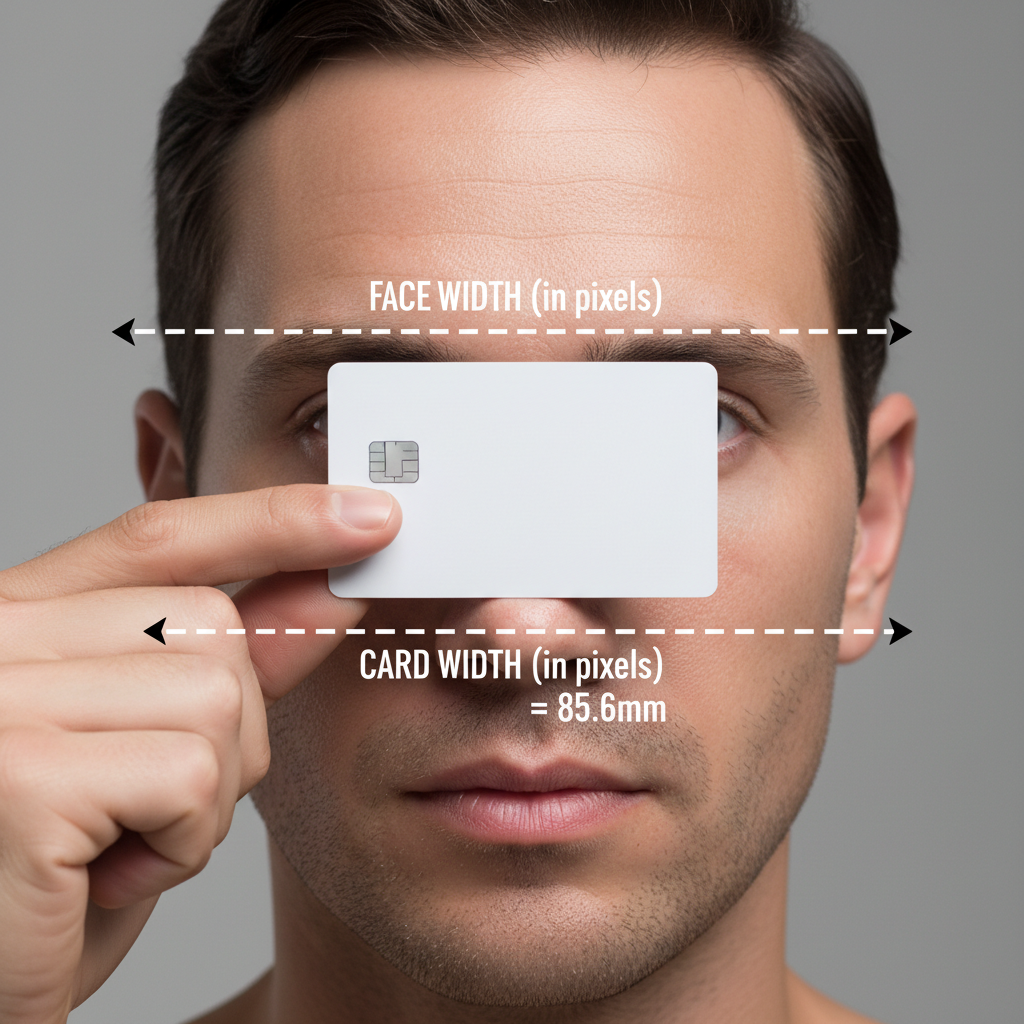
The Credit Card Method: A Precise, Step-by-Step Guide
This technique works because a standard credit card, ID card, or driver's license has a consistent width (ID-1 standard size is 85.6 millimeters). By using it as a known scale reference in a photo, you can accurately calculate your face width.
What You'll Need:
- A standard-sized credit or ID card
- Your smartphone
- A mirror (optional, but helpful for positioning)
Step 1: Position the Card Correctly
This is the most critical step. Hold the card so the long edge is flat against your forehead, centered directly above your nose. The bottom edge of the card should be resting on the bridge of your nose. It must be perfectly level and flat against your face.
Expert Warning: Avoid the #1 Measurement Mistake The most common error I see is parallax and tilt. If you angle the card or your camera, you can introduce an error of 3-6 mm, which is enough to throw off your size recommendation completely. To prevent this, ensure the card is held flush against your skin, not tilted forward or backward. Look straight ahead, not up or down.
Step 2: Take a High-Quality Photo
Stand in a well-lit area to avoid shadows. Hold your phone straight out in front of you, about 20-28 inches (50-70 cm) away. This distance is important to minimize the lens distortion that happens with close-up selfies. Look directly into the camera lens and take the picture.
Step 3: Measure the Pixel Distances
Open the photo on your phone or computer. You don't need fancy software; your phone's built-in photo editor will work. Zoom in and measure two things in pixels:
- The width of the credit card from edge to edge.
- The width of your face, from your left temple to your right temple.
You can use a screenshot tool and draw lines to see the pixel count or simply use any tool that lets you see the dimensions of a selection box.
Step 4: Calculate Your Face Width
Now for the simple math. Use this formula to convert your pixel measurements into millimeters:
(Face Width in pixels / Card Width in pixels) * 85.6 = Your Estimated Face Width in mm
For example, if your face measured 1800 pixels wide and the card measured 1100 pixels wide, the calculation would be:
(1800 / 1100) * 85.6 = 139.8 mm
This gives you a highly accurate face width measurement, typically within ±1-2 mm of a physical measurement when done correctly.
From Face Width to Frame Size: Decoding the Numbers
Once you have your face width, you can confidently choose a frame size. Eyeglass frames have three numbers, usually printed on the inside of the temple arm (e.g., 52-18-140). While lens width (52) and bridge width (18) are helpful, the most important number is the Total Frame Width, which you can either find in the product description or estimate.
My rule of thumb is to find a frame where the total width is approximately 2-6 mm wider than your measured face width. This provides a comfortable fit that isn't too tight or too loose.
Here’s a quick reference table to guide you:
| Your Estimated Face Width | Recommended Total Frame Width | Common Lens/Bridge Sizes |
|---|---|---|
| 130-134 mm (Narrow) | 132-138 mm | 50-18, 52-18 |
| 135-139 mm (Medium) | 137-143 mm | 52-19, 54-18 |
| 140-144 mm (Wide) | 142-148 mm | 55-18, 56-19 |
| 145-150 mm (Extra Wide) | 147-154 mm | 57-18, 58-20 |
Debunking a Myth: "One Size Fits Most" Many fashion sunglasses are sold as "one size." While this might work for some, it's a myth that one size can fit everyone well. The difference between a medium (138mm) and wide (145mm) frame is only about 7mm, but it makes a world of difference in comfort and appearance. Taking a moment to measure ensures you get a fit tailored to you, not an arbitrary average.
Fine-Tuning Your Fit and Solving Common Problems
A great fit goes beyond just the width. Here are some additional checks and troubleshooting tips.
Sanity Check: Use Your Existing Glasses
If you have a pair of glasses or sunglasses that already fit you well, grab them. Use a simple ruler to measure the distance from one temple screw to the other across the top of the frame. This gives you a real-world measurement of a total frame width you know works for you. Compare this to the number you calculated; they should be close.
What About Pupillary Distance (PD)?
Your PD is the distance between the centers of your pupils. It's a crucial measurement for ensuring your prescription lenses are made correctly. While this credit card method is excellent for determining frame width, it is not a substitute for a proper PD measurement. For a precise and comfortable pair of prescription glasses, you should always measure your PD separately. We've created a simple guide on how to measure your PD at home that walks you through the process.
Common Fit Problems & Solutions
Even with the right width, you might encounter other issues. This table covers the most common ones.
| Problem | Likely Cause | Solution |
|---|---|---|
| Pinching at your nose | The bridge is too narrow. | Look for a frame with a larger bridge width number (e.g., 19mm instead of 17mm). |
| Frames slide down your face | The bridge is too wide, or the temple arms are too long. | Choose a smaller bridge width. Acetate frames can sometimes be adjusted by an optician for a tighter fit. |
| Marks on your cheeks | The frame has too much "pantoscopic tilt" or the lens diameter is too large for your face shape. | Look for frames with a flatter profile or a smaller lens height. |
| Pressure behind your ears | The temple arms are too short or the total frame width is too narrow. | Ensure the temple arm length is adequate (140-145mm is standard). If the width is correct, the bend of the arm may need adjustment. If the frame is too tight overall, size up. |
Frequently Asked Questions (FAQ)
1. How accurate is the credit card measurement method? When performed carefully, it's surprisingly accurate for estimating face width and corresponding frame size, often getting you within 1-2 millimeters of a physical measurement. However, for the pupillary distance (PD) on high-power or progressive lenses, which require sub-millimeter precision, you should use a dedicated method.
2. Can I use this method for buying prescription glasses? Yes, this is an excellent way to determine the frame size you should be shopping for. However, it does not replace the need for a valid prescription and an accurate Pupillary Distance (PD) measurement. Think of it as step one (finding the right-sized chassis) before you put the engine in.
3. What if I measure between two sizes? In almost every case, it is better to size up. A frame that is slightly too large is often still comfortable, whereas a frame that is too small will almost certainly cause pressure and headaches. Choosing the next size up is the safest bet.
4. Does the type of card I use matter? No, as long as it is a standard "ID-1" format card. This includes virtually all credit cards, debit cards, driver's licenses, and modern company ID badges. They all share the same 85.6mm x 53.98mm dimensions.
Key Takeaways
Shopping for sunglasses online shouldn't be a game of chance. By using a simple credit card and your smartphone, you can take control of the process and find a pair that feels like it was made for you. Remember these key points:
- Fit is about more than style; it affects comfort, UV protection, and visual clarity.
- Your face width is the key; use the credit card method to get a reliable measurement.
- Aim for a total frame width that is 2-6mm wider than your measured face width for a balanced, comfortable fit.
With this knowledge, you're ready to explore the world of online eyewear with the confidence of an expert.
Disclaimer: This article is for informational purposes only and does not constitute medical advice. The method described is for estimating frame size and is not a substitute for a professional eye examination or a precise pupillary distance measurement from a qualified optician, especially when ordering prescription lenses. Consult an eye care professional for any vision-related health concerns.