



Do Blue Light Glasses Actually Help with Gaming Fatigue?
TL;DR: The Straight Answer
For gamers, blue light glasses are not a magic cure for eye fatigue. The strain you feel after a long session is primarily caused by reduced blinking, intense focusing, and screen glare—not blue light itself. These glasses excel at one specific task: helping you sleep better after late-night gaming by not disrupting your body's production of melatonin.
For direct relief from gaming fatigue, your best investments are an accurate prescription, high-quality anti-reflective (AR) lens coatings, and practicing good visual habits like the 20-20-20 rule.
Understanding "Gaming Fatigue": What's Really Happening to Your Eyes?
That gritty, tired feeling in your eyes after a multi-hour raid or a competitive ladder climb is a real physical response to the demands of gaming. However, a common misconception is that blue light emitted from your monitor is the primary villain. The science points to more direct, mechanical causes.
The Myth of Blue Light Toxicity
While it's true that high-energy blue light can be damaging in large, concentrated doses (like from the sun), the amount emitted from consumer electronics like your gaming monitor is not considered a danger to your eye health. According to ophthalmologist Dr. Nicole Bajic in a discussion with the Cleveland Clinic, there is no scientific evidence that blue light from digital devices causes damage to your eye. The discomfort you feel is eye strain, not retinal damage.
The Real Culprits of Digital Eye Strain
The source of your discomfort is more about how you use your eyes while gaming. Intense focus on a fixed, close-up screen creates a trio of problems that lead to what we call Digital Eye Strain (DES) or Computer Vision Syndrome.
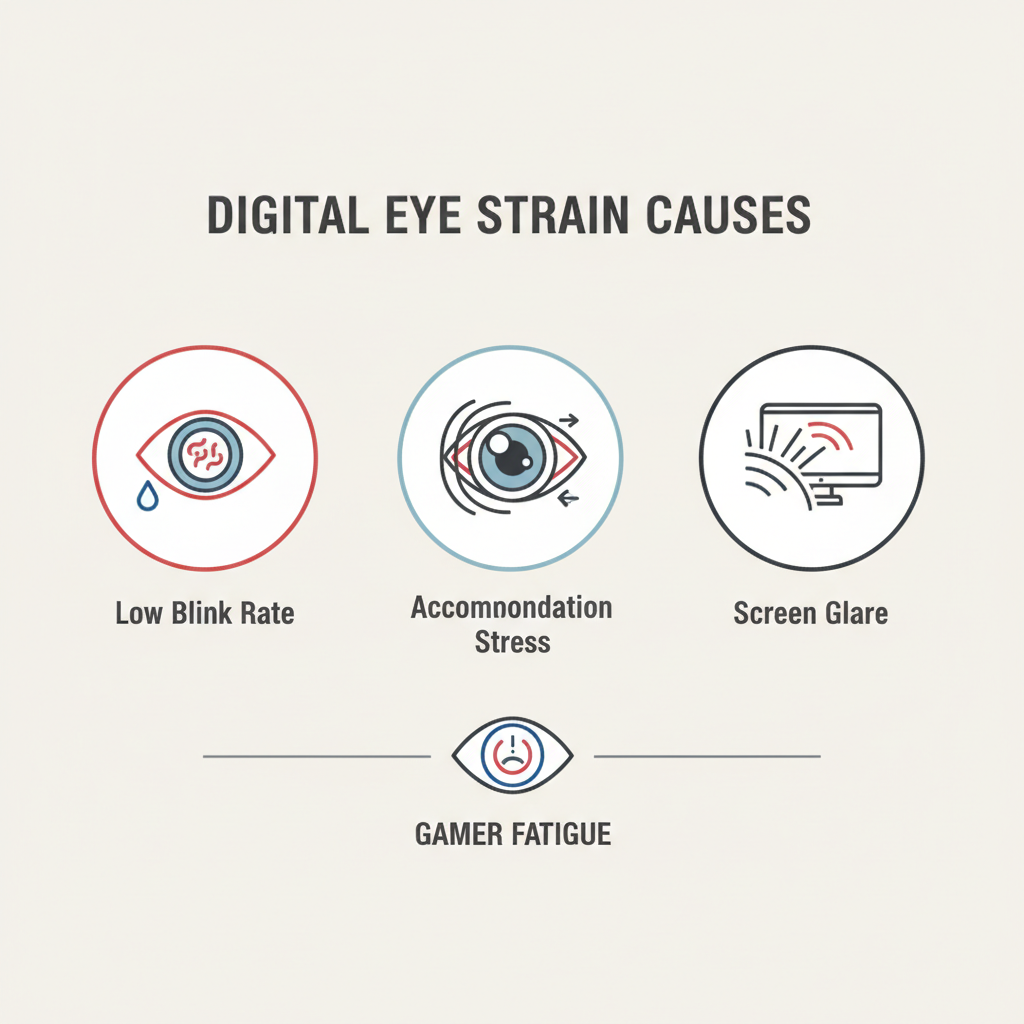
- Reduced Blink Rate: When you're locked into a game, you blink significantly less often—sometimes by more than 50%. Blinking is what spreads a fresh layer of tears over your eyes, keeping them moist and clear. Less blinking leads directly to dryness, irritation, and a burning sensation. In fact, experts from the University of Mississippi Medical Center state that dry eye is the number one cause of digital discomfort.
- Accommodative Stress: Your eyes have tiny muscles that contract to focus on near objects, like your monitor. Holding that focus for hours on end is like holding a weight at the gym without a break. These muscles become fatigued, leading to focusing problems, blurred vision, and even headaches.
- Screen Glare: Reflections on your screen from overhead lights, windows, or even your own keyboard force your eyes to work harder to distinguish the details of the game. This constant adjustment adds a significant layer of strain. This is why dispensing opticians report that a high-quality anti-reflective coating is one of the most important features for computer users.
The Science of Blue Light Glasses: Separating Fact from Fiction
The market for blue light filtering glasses is filled with bold claims, but the scientific support is narrow and specific. They are a tool with a distinct purpose, but they are often sold as a cure-all for eye strain.
Debunking the Eye Strain Myth
The most significant claim—that these glasses reduce or prevent eye strain—is not well-supported by high-quality research. A rigorous double-blind study published in PubMed by Rosenfield et al. had participants perform a reading task. While all groups experienced symptoms of eye strain, the study found no significant difference between those wearing blue-blocking lenses and those wearing placebo (clear) lenses.
This indicates that filtering blue light alone does not solve the root causes of eye strain, which are dryness and muscle fatigue.
The Real Benefit: Protecting Your Sleep Cycle
Here is where blue light glasses have a proven, tangible benefit. Your body's internal clock, or circadian rhythm, uses light as a primary signal. Blue light, in particular, signals to your brain that it's daytime and suppresses the production of melatonin, the hormone that makes you feel sleepy.
Gaming late into the evening exposes your eyes to this "daytime" signal, which can make it difficult to wind down and fall asleep. By filtering out these specific wavelengths, blue light glasses act as a "signal blocker." Research reviewed by Harvard Health Publishing suggests that wearing them in the evening can help you fall asleep faster.
For a gamer, this means you can finish your session and more easily transition your brain into sleep mode.
Myth vs. Reality: A Quick Guide
To make it simple, here’s a breakdown of what you can and cannot expect from blue light glasses.
| Claim | Scientific Consensus | The Takeaway for Gamers |
|---|---|---|
| "Reduces Digital Eye Strain" | Myth. Research shows no significant effect on strain symptoms. | Don't expect these glasses to cure tired eyes during a long session. |
| "Protects Eyes from Damage" | Myth. Standard screens don't emit harmful levels of blue light. | Your eyes are safe. The issue is comfort, not retinal damage. |
| "Improves Sleep After Late-Night Gaming" | Fact. Blocks blue light that suppresses melatonin, helping you wind down. | Wear them for 1-2 hours before you plan to sleep, not just during gaming. |
A Gamer's Guide to Smarter Eye Comfort
If blue light glasses aren't the primary solution for fatigue, what is? A truly effective strategy involves optimizing your gear and your habits to address the real causes of strain.
Optimize Your Environment and Habits
- The 20-20-20 Rule: This is the most recommended advice from eye care professionals. Every 20 minutes, look at something 20 feet away for at least 20 seconds. This simple act relaxes your eye's focusing muscles and gives you a chance to blink naturally.
- Conscious Blinking: Make an effort to blink fully and frequently, especially during loading screens or downtime.
- Use Artificial Tears: Keeping lubricating eye drops handy can provide immediate relief for dryness and irritation.
- Control Lighting: Position your monitor to avoid glare from windows or overhead lights. A soft, ambient light in the room is better than gaming in complete darkness.
Choose the Right Lenses for Gaming
When buying glasses for gaming, the blue light filter is a secondary feature. The following are far more important for in-game comfort and performance.
- Anti-Reflective (AR) Coating: This is non-negotiable. A good AR coating dramatically reduces glare and reflections off the lens surface, which directly reduces a major source of eye strain and provides a clearer view of the action.
- Accurate Prescription and PD: Even a small error in your prescription or pupillary distance (PD) can cause significant blur and strain. An incorrect PD can induce unwanted prism, forcing your eyes to work harder to merge images. For online orders, it's crucial to get this right. You can learn how to measure your PD at home or understand why even a small PD error can matter.
- Consider Lens Material and Design: If you have a strong prescription, high-index lenses are thinner and lighter, reducing the weight on your face. Aspheric lens designs can also reduce the edge distortion that can be distracting in your peripheral vision, an important factor for many gamers.
Wrapping Up: The Final Verdict for Gamers
So, do blue light glasses help with gaming fatigue? The answer is nuanced. They are not the direct solution for eye strain that marketing often claims. The fatigue you feel during a gaming session is from dryness, muscle fatigue, and glare.
Think of blue light glasses as a specialized piece of gear for a specific purpose: a sleep aid for the late-night gamer. Their real value is in helping you maintain a healthy sleep schedule, which is critical for overall performance and well-being.
For combating eye strain in the moment, your focus should be on proven solutions:
- A high-quality Anti-Reflective coating to eliminate glare.
- A perfectly accurate prescription and PD to ensure visual clarity without strain.
- Smart habits like the 20-20-20 rule and conscious blinking.
By prioritizing these fundamentals, you'll do more for your eye comfort and gaming endurance than you can with a blue light filter alone.
Frequently Asked Questions (FAQ)
Should I wear blue light glasses all day?
No. Exposure to natural blue light from the sun during the day is essential for regulating your circadian rhythm and maintaining alertness and mood. Restrict the use of blue light filtering glasses to the evening, about 1-2 hours before you intend to sleep.
Are yellow or amber-tinted gaming glasses the same thing?
Yes, these are types of blue light filtering lenses. The deeper the yellow or amber tint, the more blue light is typically blocked. While a light tint can sometimes enhance contrast, heavy tints can distort color perception, which may not be ideal for games where color accuracy is important.
Can I get blue light filtering on my prescription lenses?
Absolutely. Blue light filtering is a standard feature that can be added as a coating or integrated into the lens material for nearly any prescription, including single vision and progressive lenses.
Do I still need them if my monitor has a "low blue light" or "night" mode?
These built-in monitor settings do reduce the amount of blue light emitted at the source and can be very effective. Glasses offer a more portable and consistent solution, especially if you use multiple devices (phone, tablet, TV) before bed. Using both is not necessary, but glasses can be more convenient.
Disclaimer: This article is for informational purposes only and does not constitute professional medical advice. Consult with a qualified optometrist or ophthalmologist to address your specific eye health needs, especially if you experience persistent eye strain, headaches, or vision changes.