


How Lens Curvature Affects High Prescription Vision
The Hidden Distortion in Your Glasses and How to Fix It
If you have a strong prescription, you've likely noticed it: the world through the edges of your lenses can look warped, blurry, or swimmy. This phenomenon, known as peripheral distortion, isn't just a minor annoyance; it can limit your useful field of view and cause visual discomfort. For years, the standard spherical curve of eyeglass lenses made this problem unavoidable for those with high refractive errors.
But what if you could have crisp, clear vision from edge to edge? Modern lens manufacturing has solved this problem with aspheric and atoric designs. These advanced lenses use complex, variable curvatures to correct distortions, resulting in a wider, more natural field of view, and a much thinner and more attractive lens profile. This guide explains the science behind lens curvature and how choosing the right design can dramatically improve your visual experience with a high prescription.
TL;DR: Key Takeaways for High Prescription Wearers
Problem: Traditional spherical lenses cause distortion, blurriness, and a "fishbowl" effect at the edges for high prescriptions.
Solution: Aspheric lenses have a more complex curvature that flattens the lens, correcting distortion and expanding your clear field of view.
Aesthetics: Aspheric designs reduce the "bug-eye" (for farsightedness) or "tiny-eye" (for nearsightedness) look, creating a more natural appearance.
Materials Matter: Combining aspheric designs with high-index materials makes lenses significantly thinner and lighter.
Measurements are Critical: Precise measurements like monocular Pupillary Distance (PD), vertex distance, and pantoscopic tilt are essential for the effectiveness of high-power aspheric lenses.
Understanding High Prescriptions and Their Challenges
A prescription is generally considered "high" if the sphere (SPH) value, which corrects for nearsightedness or farsightedness, is beyond ±3.00 diopters. The challenges intensify with powers exceeding ±6.00D, a condition known as high myopia or high hyperopia. According to guidance from the Cleveland Clinic on reading prescriptions, these numbers indicate a significant deviation from normal vision, requiring powerful correction.
Users with high prescriptions face several common issues:
Lens Thickness and Weight: Higher powers require thicker lenses, which can be heavy and uncomfortable. They also create a noticeable "coke bottle" effect, especially in larger frames.
Eye Magnification/Minification: Lenses for farsightedness (+SPH) magnify your eyes, creating a "bug-eye" appearance. Lenses for nearsightedness (-SPH) minify them, making your eyes look smaller.
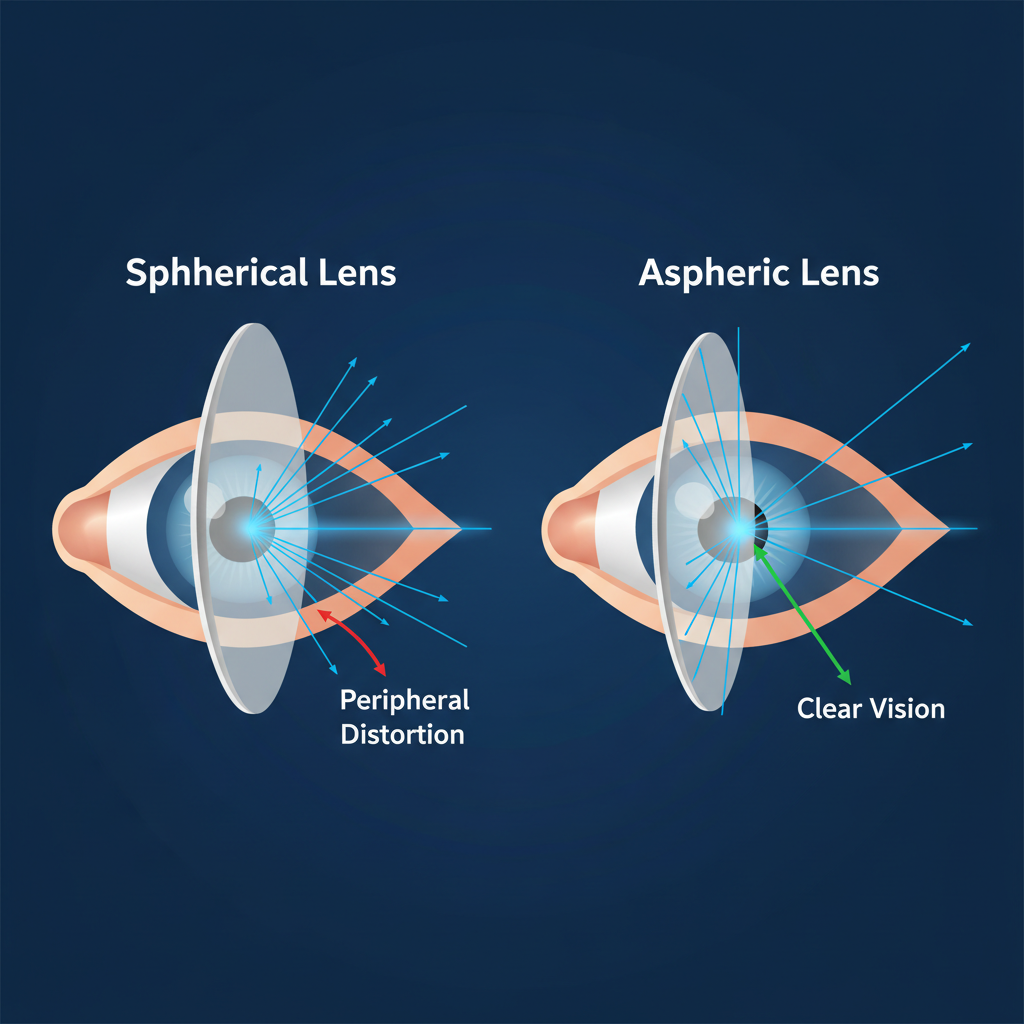
Peripheral Distortion: This is the most significant visual compromise. As your gaze moves away from the optical center of a traditional spherical lens, the power is no longer accurate, causing the world to look distorted and blurry.
The Problem with Spherical Lenses
For decades, all eyeglass lenses were spherical. This means the front and back surfaces have a simple, uniform curve, as if they were sliced from a perfect sphere. For low-power prescriptions, this design works perfectly well. The central area of the lens provides clear vision, and any distortion at the very edge is often negligible.
However, in a high-power lens, this simple geometry is the source of major optical problems. As the lens gets thicker and more curved, it introduces aberrations. The further your eye looks from the exact optical center, the more pronounced these errors become. This is why you instinctively turn your head to look at something rather than just shifting your eyes—you are trying to stay within the "sweet spot" of the lens.
Common Misconception: "My Prescription is Wrong"
A frequent complaint I hear from patients with new high-power glasses is that the prescription feels wrong, especially if they have switched to a larger frame. More often than not, the prescription is correct, but they are experiencing the inherent peripheral distortion of a spherical lens. This can lead to a frustrating adaptation period and even eye strain or headaches. For more information, you can explore our guide on what to do if your new online prescription feels wrong.
The Aspheric Advantage: Seeing Clearly, Edge to Edge
This is where aspheric lenses come in. An aspheric lens is not a simple sphere. Instead, its surface curvature gradually changes from the center to the edge. This complex, computer-designed profile is precisely calculated to correct the power errors and distortions that plague high-power spherical lenses.
How it Works:
For Nearsightedness (-SPH): The lens is flattest in the center and gets progressively steeper toward the edge.
For Farsightedness (+SPH): The lens is steepest in the center and gets progressively flatter toward the edge.
This intelligent design allows the lens to be made much flatter and thinner overall. The result is a dramatic improvement in both vision and appearance.
Key Benefits of Aspheric Lenses:
Wider Field of View: Aberrations are corrected across the entire lens, giving you a much larger "sweet spot" and clear, undistorted peripheral vision.
Thinner & Lighter: The flatter profile significantly reduces lens thickness and weight, especially when combined with high-index materials.
Improved Aesthetics: By minimizing magnification and minification, aspheric lenses make your eyes appear more natural in size. This directly addresses the aesthetic concerns many high-prescription wearers have, a point supported by optometry network guides on the visual benefits of advanced lenses.
For users with significant astigmatism (a high CYL value in their prescription), atoric lenses go one step further, applying aspheric corrections in multiple meridians to ensure clarity across the entire lens surface.

Pairing Advanced Design with the Right Materials and Frames
An aspheric design is only part of the equation. To get the best results, you must combine it with the right lens material and a suitable frame.
High-Index Materials: The Key to Thinner Lenses
High-index lenses are made from advanced plastics that have a higher refractive index, meaning they bend light more efficiently. As noted in educational materials from Ferris State University's College of Optometry, a higher index allows the lens to be made thinner and lighter while providing the same corrective power.
| Lens Material | Refractive Index | Ideal Rx Range (SPH) | Key Features |
|---|---|---|---|
| Standard Plastic | 1.50 | Up to ±2.00 | Basic, affordable, but thick for high powers. |
| Polycarbonate | 1.59 | ±2.00 to ±4.00 | Highly impact-resistant, built-in UV protection. Good for active lifestyles. |
| High-Index 1.67 | 1.67 | ±4.00 to ±8.00 | Significantly thinner and lighter. The sweet spot for many high-Rx users. |
| High-Index 1.74 | 1.74 | Above ±8.00 | The thinnest and lightest plastic lens available for extreme prescriptions. |
Expert Warning: High-Index Lenses Require AR Coating
A common mistake is ordering high-index lenses without an anti-reflective (AR) coating. High-index materials reflect more light than standard plastic, which can cause distracting glare, especially at night. An AR coating is not an optional upgrade in this case; it is essential for optimal clarity and visual comfort. It also makes your lenses appear nearly invisible, further improving aesthetics.
Frame Choice is Critical
The best lenses in the world can be compromised by a poor frame choice. For high prescriptions, the rule is simple: smaller is better. Large, oversized frames require a larger lens, which will always be thicker, heavier, and more prone to showing edge thickness, even with high-index materials. Choosing a smaller, rounder frame shape minimizes the thickest part of the lens (the edge for minus lenses, the center for plus lenses) and ensures the optical center is well-aligned with your pupil. If you have a strong prescription, our guide on wearing thin, stylish frames with a high Rx can provide more tailored advice.
The Unseen Factor: Why Precise Measurements Are Non-Negotiable
The performance of a high-power aspheric lens is highly sensitive to its position in front of your eye. This is why getting accurate measurements is arguably as important as the prescription itself.
Checklist for Ordering High-Prescription Glasses:
Monocular Pupillary Distance (PD): This is the distance from the center of your nose to the center of each pupil, measured individually (e.g., 31mm right, 32mm left). A generic binocular PD is not precise enough for high-power lenses, as it can induce prism and eye strain. If you're unsure, learn how to measure your PD at home accurately.
Optical Center (OC) Height: This measures how high or low your pupils sit within the frame. It ensures the optical center of the lens is placed directly in front of your pupil for optimal vision.
Vertex Distance: The distance from the back of the lens to the front of your cornea. A change in this distance can alter the effective power of the lens. It's a crucial measurement that is often overlooked in online orders.
Pantoscopic Tilt: The angle of the lens as it sits on your face. A standard tilt is about 8-12 degrees. An incorrect tilt can induce astigmatism and distortion.
All prescription eyewear sold in the U.S. must meet impact-resistance standards set by the FDA. This regulation, outlined in 21 CFR 801.410, ensures your lenses are safe for everyday wear. A reputable vendor will always use certified labs to ensure compliance.
Wrapping Up: A New Outlook on High-Prescription Eyewear
Living with a high prescription no longer means compromising on visual quality or aesthetics. By understanding and choosing aspheric lenses, you can eliminate the frustrating distortions of older lens technology. When combined with the right high-index material and a carefully selected frame, the result is a pair of glasses that are not only visually superior but also dramatically thinner, lighter, and more comfortable than ever before. Empowered with this knowledge, you can confidently order eyewear that provides a crystal-clear and expansive view of the world.
Frequently Asked Questions (FAQ)
Why do I need to adapt to new high-power glasses?Your brain gets used to the specific distortions and field of view of your old glasses. Even with a superior aspheric lens, the new, clearer visual information requires an adaptation period. This can last from a few days to two weeks as your brain adjusts to the "correct" way of seeing.
Are high-index lenses always worth the extra cost?For prescriptions above ±3.00D, absolutely. The reduction in thickness and weight provides a significant improvement in comfort and appearance. For lower prescriptions, the benefit is minimal, and standard plastic or polycarbonate may be sufficient.
Can I put high-prescription lenses in any frame?Technically, yes, but it's not recommended. Putting a high-power lens in a very large or oddly shaped frame will result in excessive thickness, weight, and potential fitting issues. It's best to follow your optician's guidance and choose smaller, more centered frames.
Disclaimer: This article is for informational purposes only and does not constitute medical advice. Consult with a qualified optometrist or ophthalmologist to determine the best vision correction solution for your specific needs, especially if you have a high prescription or other eye health conditions.